FIRST® (For Inspiration and Recognition of
Science and Technology) was founded by inventor Dean Kamen to inspire young
people’s interest in science and technology. As a robotics community that
prepares young people for the future, FIRST is the world’s leading
youth-serving nonprofit advancing STEM education. For 30 years, FIRST
has combined the rigor of STEM learning with the fun and excitement of
traditional sports and the inspiration that comes from community through
programs that have a proven impact on learning, interest, and skill-building
inside and outside of the classroom. FIRST provides programs that span a
variety of age groups:
-
FIRST® Robotics Competition for grades 9-12, suggested
ages 14-18
-
FIRST® Tech Challenge for grades 7-12, ages
12-18
-
FIRST® LEGO® League for grades
Pre-K-8, ages 4-16
o
FIRST® LEGO® League Challenge for
grades 4-8 (ages 9-16, ages vary by country)
o
FIRST® LEGO® League Explore for
grades 2-4 (ages 6-10)
o
FIRST® LEGO® League Discover for
grades Pre-K-1 (ages 4-6)
Please visit the FIRST website for more information
about FIRST and its programs.
|
Purpose
|
Vision
|
Mission
|
|
FIRST exists
to prepare the young people of today for the world of tomorrow.
|
To transform our
culture by creating a world where science and technology are celebrated and
where young people dream of becoming science and technology leaders.
|
The mission of FIRST
is to provide life-changing robotics programs that give young people the
skills, confidence, and resilience to build a better world.
|
In October 2019, Dr. Woodie Flowers, an innovator in design
and engineering education and a Distinguished Advisor to FIRST and
supporter of our mission, passed away. As thousands of heartfelt tributes to
Woodie have poured in from around the world, it is clear his legacy will live
on indefinitely through the gracious nature of our community and our ongoing
commitment to empowering educators and building global citizens.
Figure 1‑1
Dr. Woodie Flowers, 1943-2019

FIRST® Robotics Competition combines the
excitement of sport with the rigors of science and technology. Teams of
students are challenged to design, build, and program industrial-size robots
and compete for awards, while they also create a team identity, raise funds,
hone teamwork skills, and advance respect and appreciation for STEM within the
local community.
Volunteer professional mentors lend their time and talents
to guide each team. It’s as close to real-world engineering as a student can
get. Plus, high school students gain access to exclusive scholarship
opportunities from colleges, universities, and technical programs.
Each January at an event known as “Kickoff,” a new,
challenging game is introduced. These exciting competitions combine the
practical application of science and technology with the fun, intense energy,
and excitement of a championship-style sporting event. Teams are encouraged to
display Gracious Professionalism®, help other teams, and cooperate
while competing. This is known as Coopertition®.
In 2026, FIRST Robotics Competition is projected to
reach approximately 90,000 high-school students representing more than 3,700
teams. Teams represent more than 30 countries and come from nearly every state
in the United States.
FIRST Robotics Competition teams will participate in
56 Regional Competitions, 125 District Competitions, and 15 District
Championships. In addition, approximately 600 teams will qualify to attend the FIRST
Championship in April 2026.
This year’s game, and this manual, were presented at the 2026
FIRST Robotics Competition Kickoff on Saturday, January 10, 2026. At the
Kickoff, all teams:
-
saw the 2026 game, REBUILTTM presented by Haas, for
the first time,
-
learned about the 2026 game rules and regulations, and
-
received a set of game specific materials.
1.4.1
Core Values
The FIRST Core Values are fundamental to FIRST
and unique to its programs. They emphasize friendly sportsmanship, respect for
the contributions of others, teamwork, learning, and community involvement and
are part of our commitment to fostering, cultivating, and preserving a culture
of unity.
Our community expresses the FIRST philosophies of Gracious
Professionalism® and Coopertition® through the
FIRST Core Values.
Discovery: We explore new
skills and ideas.
Innovation: We use
creativity and persistence to solve problems.
Impact: We apply what we
learn to improve our world.
Inclusion: We respect each
other and embrace our differences.
Teamwork: We are stronger
when we work together.
Fun: We enjoy and celebrate
what we do!
Gracious Professionalism is part of the ethos of FIRST.
It’s a way of doing things that encourages high quality work, emphasizes the
value of others, and respects individuals and the community. Gracious
Professionalism is not clearly defined for a reason. It is an aspirational
ideal to always strive towards, not a goal to be achieved or a method of
measuring someone, and for this reason, you can never say someone “is” or “is
not” being Graciously Professional. We should each work to better embody Gracious
Professionalism in all our actions. How we pursue this can and should mean
different things to everyone.
Some possible meanings of Gracious Professionalism
include:
-
gracious attitudes and behaviors are win-win,
-
gracious folks respect others and let that respect show in their
actions,
-
professionals possess special knowledge and are trusted by
society to use that knowledge responsibly, and
-
gracious professionals make a valued contribution in a manner
pleasing to others and to themselves.
In the context of FIRST, this means that all teams
and participants should:
-
learn to be strong competitors, but also treat one another with
respect and kindness in the process and
-
avoid leaving anyone feeling as if they are excluded or
unappreciated.
Knowledge, pride, and empathy should be comfortably and
genuinely blended.
In the end, Gracious Professionalism is part of
pursuing a meaningful life. When professionals use knowledge in a gracious
manner and individuals act with integrity and sensitivity, everyone wins and
society benefits.
Figure 1‑2 Dr. Woodie Flowers, Gracious Professionalism advocate and
exemplar

“The FIRST spirit encourages doing high-quality, well-informed
work in a manner that leaves everyone feeling valued. Gracious Professionalism
seems to be a good descriptor for part of the ethos of FIRST. It is part of
what makes FIRST different and wonderful.”
- Dr.
Woodie Flowers, (1943 – 2019)
Distinguished Advisor to FIRST
It is a good idea to spend time going over this concept with
your team and reinforcing it regularly. We recommend providing your team with
real-life examples of Gracious Professionalism in practice, such as when
a team loans valuable materials or expertise to another team that they will
later face as an opponent in competition. Routinely highlight opportunities to
display Gracious Professionalism at events and encourage team members to
suggest ways in which they can demonstrate this quality themselves and through
outreach activities.
At FIRST, Coopertition is displaying
unqualified kindness and respect in the face of fierce competition. Coopertition
is founded on the concept and philosophy that teams can and should help and
cooperate with one another even as they compete. Coopertition involves
learning from teammates and mentors. Coopertition means competing always
but assisting and enabling others when you can.
Message from Woodie Flowers Award Recipients
The Woodie Flowers Award is the most prestigious mentoring
award in FIRST. The award recipients created an important message for all FIRST
Robotics Competition teams to consider as we tackle each season.
Performing at your best is important. Winning is important.
This is a competition.
However, winning with Gracious Professionalism and being proud
of what you have accomplished and how you have accomplished it is more
important. FIRST could create rules and penalties to cover almost any scenario
or situation, but we prefer an understandable game with simpler rules that
allow us to think and be creative in our designs.
We want to know that our partners and opponents are playing at
their best in every MATCH. We want to know they are playing with integrity and
not using strategies based on questionable behaviors.
As you create your ROBOTS and award presentations, prepare for
competition and MATCH play, create and implement game strategies, and live your
daily lives, remember what Woodie said time and time again, and let’s ‘Make
your Grandmother proud.’
|
Woodie Flowers
Liz Calef (88)
Mike Bastoni (23)
Ken Patton (51, 65)
Kyle Hughes (27)
Bill Beatty (71)
Dave Verbrugge (5110, 67)
Andy Baker (3940, 45)
Dave Kelso (131)
Paul Copioli (3310, 217)
|
Rob Mainieri (812, 64, 498, 991, &
2375)
Dan Green (111)
Mark Breadner (188)
John Novak (16, 323)
Chris Fultz (234)
John Larock (365)
Earl Scime (2614)
Fredi Lajvardi (842)
Lane Matheson (932)
Mark Lawrence (1816)
|
Eric Stokely (258, 360, 2557,
& 5295)
Glenn Lee (359)
Gail Drake (1885)
Allen Gregory (3847)
Lucien Junkin (118)
Matt Fagen (4253)
Christine Sapio (2486)
Mark Buckner (4265)
Norman Morgan (2468)
Francisco Guerra (4635)
|
Message from
the Global Volunteers
Welcome– we're excited for you to discover this season. We’re
even more excited to see what you and your team can achieve this season and at
the almost 200 events worldwide this season.
FIRST is made possible by our volunteers
Volunteers are the driving force behind the delivery of all
FIRST programs including the FIRST Robotics Competition. Each year it takes
thousands of volunteers donating their time, energy, and enthusiasm to ensure
that every FIRST Robotics Competition
team has the opportunity to achieve its goals. FIRST volunteers come from a
diverse set of backgrounds and are united by the same goal: to provide the best
possible FIRST experience for all participating teams.
We encourage everyone in the FIRST community to join in the fun
and excitement of events by participating as a volunteer.
Why
Volunteer?
·
Witness capable students learning and growing
·
Forge meaningful friendships with other awesome volunteers
·
Be part of the magic that brings events to life
·
Share the wonders of FIRST with those who are yet to discover it
·
Bring invaluable event experiences back to your team
·
Learn and grow beyond your usual circles
FIRST
Alumni and Graduating Students:
You’ve experienced firsthand the impact of FIRST in your
life, the opportunities it has provided, and the excitement of participating.
Your FIRST experience does not have to end after you graduate – being a
volunteer or mentor gives you the opportunity to continue learning, growing,
building a community, and having fun at FIRST events. Your experience as a
student in a FIRST program is invaluable to helping ensure future students have
an amazing experience. There are volunteer roles for every skill level,
background, and level of commitment
– everyone is welcome!
Learn more and sign up as a FIRST volunteer on the FIRST website.
FIRST
is about you
Volunteers eagerly donate their time and efforts to make it
possible for you to participate and have fun! We strive to demonstrate the
FIRST philosophies of Gracious Professionalism and Coopertition in every
interaction – in return, we ask the same of you. If for any reason you feel
like our volunteers could have done a better job, we want to know about it –
talk to a mentor, trusted adult, other event volunteer or staff member, or
report it to FIRST via customerservice@firstinspires.org.
Join us for the 2026 season and be a part of the incredible
journey that is FIRST Robotics Competition! Your involvement is key to our
collective success. We look forward to welcoming you!
With gratitude and excitement for what lies ahead, your 2026
Global Volunteers:
Global Field Supervisors –
Ayla DeLaat & Bryan Herbst
Global FIRST Technical Advisors (FTAs) – James Cerar & Mark McLeod
Global Head Referees – Aidan Browne & Jon Zawislak
Global Judge Advisors – Cindy Stong & Allen Bancroft
Global Lead Robot Inspectors – Chuck Dickerson & Alida Mendes-MacCracken
Global Lead Scorekeepers – Alex Herreid & Andrea “Duckie” Tribo
Global Volunteer Coordinators – Laurie Shimizu & Sarah Plemmons
1.6
This Document & Its Conventions
The 2026 Game Manual is a resource for all FIRST
Robotics Competition teams for information specific to the 2026 season and the REBUILT
game. Its audience will find the following detail:
-
a general overview of the REBUILT game,
-
detail about the REBUILT playing FIELD,
-
a description of how to play the REBUILT game,
-
rules (related to safety, conduct, game play, inspection, event,
etc.), and
-
a description of how teams advance at 2026 tournaments and
throughout the season.
The intent of this manual is that the text means exactly,
and only, what it says. Please avoid interpreting the text based on assumptions
about intent, implementation of past rules, or how a situation might be in
“real life.” There are no hidden requirements or restrictions. If you’ve read
everything, you know everything.
Specific methods are used throughout this manual to
highlight warnings, cautions, key words, and phrases. These conventions are
used to alert the reader to important information and are intended help teams
in constructing a ROBOT that complies with the rules in a safe manner.
Links to other section headings in this manual, external
articles, and rule references appear in blue
underlined text.
Key words that have a particular meaning within the context
of the FIRST Robotics Competition and REBUILT are defined in the Glossary and indicated in ALL CAPS throughout
this document.
The rule numbering method indicates the section, subsection,
and position of the rule within that subsection. The letter indicates the
section in which the rule is published.
-
Q for 6.7.1 Question Box (Q)
-
G for 7 Game Rules (G)
-
R for 8 ROBOT Construction Rules (R)
-
I for 9 Inspection & Eligibility (I)
-
T for 10 Tournaments (T)
-
C for 13 FIRST Championship Tournament (C)
-
E for 14 Event Rules (E)
The following digit(s) represents the subsection in which
the rule can be found. The final digits indicate the rule’s position within
that subsection.
Figure 1‑3 Rule numbering method

Warnings, cautions, and notes appear in blue boxes. Pay
close attention to their contents as they’re intended to provide insight into
the reasoning behind a rule, helpful information on understanding or
interpreting a rule, and/or possible “best practices” for use when implementing
systems affected by a rule.
While blue boxes are part of the manual, they do not carry
the weight of the actual rule (if there is an inadvertent conflict between a
rule and its blue box, the rule supersedes the language in the blue box).
Imperial dimensions are followed by comparable metric
dimensions in parentheses to provide metric users with the approximate size,
mass, etc. Decimal values are rounded in order to limit the number of decimal
places shown and the number of significant figures. Metric conversions in rules
round such that the metric dimension is compliant with the rule (i.e. maximums
round down, minimums round up). The metric conversions are offered for
convenient reference only and do not overrule or take the place of the imperial
dimensions presented in this manual and the official drawings (i.e. dimensions
and rules will always defer to measurements using imperial units).
Rules include colloquial language, also called headlines, in
an effort to convey an abbreviated version of the rule or rule set. There are
two versions of headline formatting.
Evergreen rules, or rules which are expected to go
relatively unchanged from season to season, are indicated with a leading
asterisk and their rule number and headline are presented in bold green text. “Relatively unchanged” means
that the overall intent and presence of the rule from season to season is
constant, but game specific terms may be updated as needed (e.g. changing
Power Cells to FUEL in a rule about what COACHES may not contact during a
MATCH). These rules also start their respective section, so their rule number
is not expected to change from season to season.
All other rule headlines use bold blue text. Any disagreement between
the specific language used in the rules and the colloquial language is an
error, and the specific rule language is the ultimate authority. If you
discover a disparity, please let us know at customerservice@firstinspires.org
and we will correct it.
Team resources that aren’t generally season specific (e.g.,
what to expect at an event, communication resources, team organization
recommendations, ROBOT transportation procedures, and award descriptions) can
be found on the FIRST Robotics Competition website.
The REBUILT manual is originally and officially written in
English and is occasionally translated into other languages for the benefit of FIRST
Robotics Competition teams whose native language may not be English. These
assets are posted on the Translated Manuals section.
A text-based English version is provided only for use with
assistive devices on the Translated Manuals section. This document is
locked for editing and has a watermark applied to indicate that it should not
be copied. If you have any questions on the document, please contact the FIRST
Robotics Competition Team Advocate at frcteamadvocate@firstinspires.org.
In the event that a rule or description is modified in an
alternate version of this manual, the English pdf version as published on the Season Materials webpage is the commanding
version.
Team Updates are used to notify the FIRST Robotics
Competition community of revisions to the official season documentation (e.g.
the manual, drawings, etc.) or important season news. Team Update posts are
scheduled as follows:
-
each Tuesday and Friday, starting on the first Tuesday after
Kickoff and ending on the Tuesday prior to Week 1 events
-
each Tuesday, starting Week 1 and ending the week after the final
District Championship events.
Team Updates are posted on the Season Materials webpage and are generally
posted before 5 pm, Eastern.
Generally, Team Updates follow the following convention:
-
Additions are highlighted in yellow. This is an example.
-
Deletions are indicated with a strikethrough. This is an
example.
The Question and Answer System (Q&A) is a
resource for clarifying the 2026 REBUILT Game Manual, Awards webpages,
official FIELD drawings, and/or District and Regional Events webpage content.
Teams can search for previously asked questions and responses or pose new
questions. Questions can include examples for clarity or reference multiple
rules to understand the relationships and differences between them.
The Q&A opens on January 14, 2026, 12:00 PM Eastern.
Details on the Q&A can be found on the Season Materials webpage. The Q&A may
result in revisions to the text in the official manuals (which are communicated
using the process described in Team Updates).
The responses in the Q&A do not supersede the text in
the manual, although every effort will be made to eliminate inconsistencies
between the two. While responses provided in the Q&A may be used to aid
discussion at each event, per section 9 Inspection & Eligibility and section 6.7 Head REFEREE and FTA Interaction, REFEREES and
INSPECTORS are the ultimate authority on rules. If you have concerns about
enforcement trends by volunteer authorities, please notify FIRST at customerservice@firstinspires.org.
The Q&A is not a resource for firm predictions on how a
situation will play out an event. Questions about the following will not be
addressed:
-
rulings on vague situations,
-
challenging decisions made at past events, or
-
design reviews of a ROBOT system for legality.
Weak questions are overly broad, vague, and/or include no
rule references. Some examples of questions that will not be answered in the
Q&A are:
-
Is this part/design legal?
-
How should the REFEREE have ruled when this specific game play
happened?
-
Duplicate questions
-
Nonsense questions
Good questions ask generically about features of parts or
designs, gameplay scenarios, or rules, and often reference one or more relevant
rules within the question. Some examples of questions that will likely be
answered in the Q&A are:
-
A device we are considering using on the ROBOT comes with purple
AWG 40 wire, does this comply with R?? and R??
-
We’re not sure how to interpret how Rule G?? applies if blue
ROBOT A does X and red ROBOT B does Y, can you please clarify?
-
If a ROBOT does this specific action, is it doing what this
defined term is describing?
Questions from “FRC 99999” represent content asked by key
volunteers (e.g., REFEREES, INSPECTORS, etc.), answered by FIRST, and
are considered relevant to teams.


Uncover the Future
|
FIRST® is the sport where every kid can
go pro. As the world’s leading non-profit that prepares young people for the
future, FIRST offers a suite of life-changing youth robotics programs
that build skills, confidence, and resilience. Participants work
collaboratively to solve the annual, themed robotics challenge.
Every artifact we uncover holds a story. Each tool, each
innovation, each work of art connects us to the people and ideas that came
before us. Using STEM skills and teamwork, today we can dig deeper into
discoveries than ever before.
Welcome to FIRST® AGE™ presented by
Qualcomm, our 2025-2026 robotics season inspired by archaeology. What will
you uncover? Join us for an experience for the ages.
|
|

|

|

|
|
LEARN MORE: firstinspires.org/firstage
|
Thank you to the 2026 FIRST® Robotics
Competition season presenting sponsor, the Gene Haas Foundation.

In REBUILTTM presented by Haas, two competing alliances
are invited to score fuel, cross obstacles, and climb the tower before time
runs out. Alliances earn additional rewards for meeting specific scoring
thresholds.
During the first 20 seconds of the match, robots are autonomous. Without
guidance from their drivers, robots score fuel into their hub. Fuel can be
pre-loaded into a robot, obtained from the human player, collected at the
depot, or picked up throughout the center of the field. Some robots may also
climb the tower to obtain additional points.
During the remaining 2 minutes and 20 seconds, drivers control their robots. Based
on the result of autonomous play, alliance hubs will alternate between active
and inactive, shifting gameplay between both sides of the field. Robots can collect
fuel at any point in the match and may control any amount of fuel at a time. Drivers
control their robots to score fuel into their hub while it is active and may
perform defensive strategies or collect more fuel while their hub is inactive.
As time runs out, all hubs become active, allowing all robots to score. Robots
can climb to the tower’s highest heights to score additional points and claim
match bonuses to increase their position in the rankings.
The alliance that earns the most points wins the match!
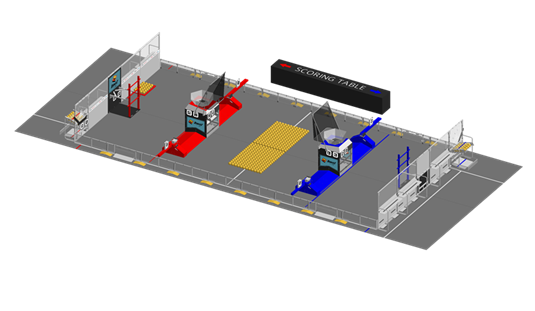
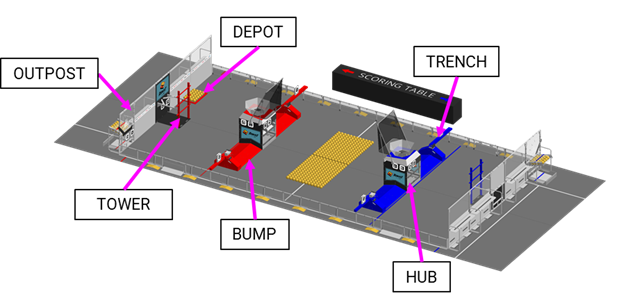
The ARENA includes all elements of the game
infrastructure that are required to play REBUILTTM presented by
Haas: the FIELD, SCORING ELEMENTS, queue area, team media area (when
available), designated TECHNICIAN area, and all equipment needed for FIELD
control, ROBOT control, and scorekeeping.
Figure 5‑1 REBUILT ARENA (queue area, TECHNICIAN area, and media area
not pictured)
All official models for the REBUILT FIELD were created in
Onshape.

The specification for the REBUILT
FIELD can be retrieved from a few locations:
-
The 3D CAD model is the official representation of the REBUILT
FIELD and how it is constructed.
-
Illustrations included in this section are for a general visual
understanding of the REBUILT ARENA, and dimensions included in the manual are
nominal and no tolerances are implied. Please refer to the official drawings
for exact dimensions, tolerances, and construction details.
-
The Field Dimension Drawings package has critical
dimensions for each FIELD element.
-
The FIELD Manual includes instructions on how to
build the FIELD along with showing the ways construction type will influence
the field tolerances. It also includes many of the key dimensions which are
listed in the Official FIELD Drawings.
-
The FIELD Acceptance Checklists for the welded FIELD and for the AndyMark FIELD include the controlled
dimensions (with relevant tolerances) which will be checked by event staff a
few times throughout the event. The FIELD is expected to change during MATCH
play. Teams can ask the FTA to re-check specific measurements if they believe
something is out of spec prior to a MATCH beginning.
The official drawings, CAD models, and drawings for low-cost
versions of important elements of the REBUILT FIELD are posted on the Playing FIELD webpage.
The ARENA is modular and assembled, used, disassembled, and
shipped many times during the competition season. It undergoes wear and tear.
The ARENA is designed to withstand rigorous play and frequent shipping. Every
effort is made to ensure that ARENAS are consistent from event to event.
However, ARENAS are assembled in different venues by
different event staff and some small variations occur. Successful teams will
design ROBOTS that are insensitive to these variations.
Each FIELD for REBUILT is an approximately 317.7in
(~8.07m) by 651.2in (~16.54m) carpeted area bounded by inward facing surfaces
of the ALLIANCE WALLS, OUTPOSTS, TOWER WALLS, and guardrails.
Figure 5‑2 FIELD boundary in pink
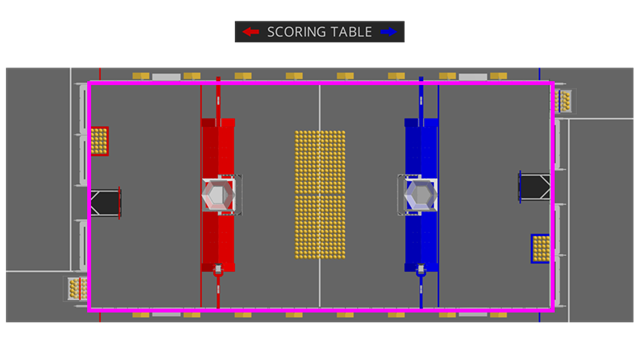
The FIELD is populated with and surrounded by the following
elements:
-
1 OUTPOST per ALLIANCE,
-
1 HUB per ALLIANCE,
-
1 TOWER per ALLIANCE,
-
2 DEPOTS,
-
4 BUMPS, and
-
4 TRENCHES.
The surface of the FIELD is low pile carpet, Shaw Floors,
Philadelphia Commercial, Neyland II 20, “66561 Medallion.” Neyland II carpet is
not available for purchase at this time, and the closest equivalent is Shaw, Philadelphia Brand, Profusion 20, Style 54933;
see results from evaluation in this blog post.
Carpet edges and seams are secured with 3MTM
Premium Matte Cloth (Gaffers) Tape GT2, GT3 or comparable Gaffer’s Tape. Tears, rips, and damage
to the carpet may be repaired with the same styles of tape and ROBOTS must be
prepared to operate on surfaces made of carpet, tape, or combinations of both
materials as repairs are made through the course of competition.
Guardrails form the long edges of the FIELD. Guardrails are
a 20.0in (50.8cm) tall system of transparent polycarbonate supported on the top
and bottom by aluminum extrusion. There are 4 gates in the guardrail that allow
access to the FIELD for placement and removal of ROBOTS. The gate passthrough,
when open, is 38.0in (96.5cm) wide. Gates are closed and shielded during the MATCH.
Figure 5‑3 Gate locations

There are 2 versions of guardrails and DRIVER STATIONS used
for competitions. 1 design is the Welded FIELD which is reflected in the 2026 Official FIRST FIELD Drawings & Models. The other is designed and sold by AndyMark. Table 5‑1 and Table 5‑2 illustrate which areas have each kind of
FIELD. All FIELDS (divisions, practice and Einstein) at the FIRST
Championship will be the Welded FIELD type.
While the designs are slightly different, the critical dimensions, performance,
and expected user experience between them are the same unless otherwise noted.
Detailed drawings for the AndyMark design are posted on the AndyMark website. All illustrations in this
manual show the traditional Welded FIELD design.
Table 5‑1: District Field Types
|
District
|
Field Type
|
|
FIRST Chesapeake
|
AndyMark
|
|
FIRST California
|
Welded
|
|
FIRST in Michigan
|
Welded
|
|
FIRST in Texas
|
AndyMark
|
|
FIRST Indiana
Robotics
|
AndyMark
|
|
FIRST Israel
|
Welded
|
|
FIRST Mid-Atlantic
|
Welded
|
|
FIRST North Carolina
|
AndyMark
|
|
FIRST South Carolina
|
Welded
|
|
FIRST Wisconsin
|
AndyMark
|
|
NE FIRST
|
AndyMark
|
|
Ontario
|
Welded
|
|
Pacific Northwest
|
Welded
|
|
Peachtree
|
Welded
|
Table 5‑2 Regional Field Types
|
Regional Location
|
Field Type
|
|
Australia
|
Welded
|
|
Brazil
|
AndyMark
|
|
Canada
|
Welded
|
|
China
|
AndyMark
|
|
Mexico
|
AndyMark
|
|
Türkiye
|
AndyMark
|
|
United States
|
Welded
|
FIELD areas, zones, and markings of consequence are
described below. Unless otherwise specified, the tape used to mark lines and
zones throughout the FIELD is 2.0in (5.1cm) 3M™ Premium Matte Cloth (Gaffers) Tape (GT2), ProGaff® Premium Professional Grade Gaffer Tape,
or comparable gaffers tape.
Figure 5‑4 Areas, markings, and zones
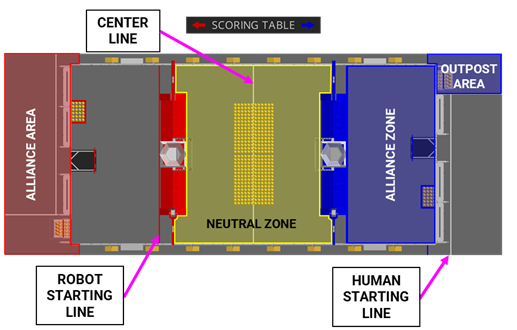
-
ALLIANCE AREA: an approximately 360in
wide by 134in deep (~9.14m by 3.4m) infinitely tall volume formed by, and
including the ALLIANCE WALL, OUTPOST, TOWER WALL, the edge of the carpet, and ALLIANCE
colored tape perpendicular to the DRIVER STATIONS.
-
ALLIANCE ZONE: A 158.6in deep by 317.7in
long (~4.03m by 8.07m), infinitely tall volume formed by an ALLIANCE WALL, TOWER
WALL, and guardrails. It surrounds an ALLIANCE TOWER and a DEPOT. It is
bounded by and includes the ROBOT STARTING LINE.
-
CENTER LINE: a white line that spans
the width of the FIELD that bisects the NEUTRAL ZONE in half.
-
NEUTRAL ZONE: A 283in deep by 317.7in
long (7.19m by 8.07m), infinitely tall volume formed by the BUMPS, TRENCHES, HUBS,
and guardrails. It surrounds and includes the CENTER LINE.
-
HUMAN STARTING LINE: a white
line spanning the ALLIANCE AREA up to the OUTPOST AREA that is parallel to
and located 24.0in (61.0cm) from the bottom square tube of the ALLIANCE WALL to
the near edge of the tape.
-
OUTPOST AREA: a 71.0in wide by 134in
deep (1.8m by 3.4m) infinitely tall volume bounded by the OUTPOST, edge of
carpet, and ALLIANCE and white colored tape.
-
ROBOT STARTING LINE: an
ALLIANCE colored line that spans the width of the FIELD at the edge of an ALLIANCE
ZONE in front of two BUMPS and an ALLIANCE HUB.
Figure 5‑5 HUB
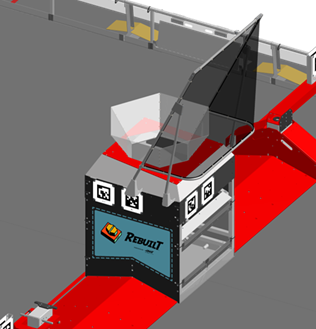
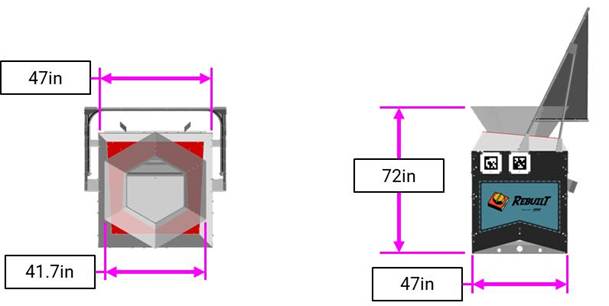
A HUB is one of two 47in by 47in (~1.19m by
1.19m) rectangular prism structures with an extended opening at the top surface.
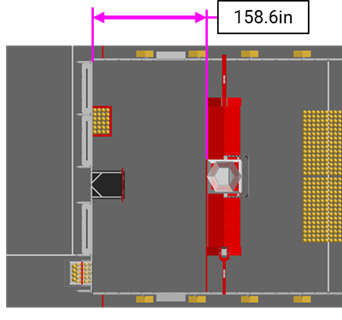
Each ALLIANCE has a dedicated HUB centered between two BUMPS located 158.6in (~4.03m)
away from their ALLIANCE WALL. Each HUB has a set of exits that randomly
distributes FUEL into the NEUTRAL ZONE. A net structure located in the back of
the HUB prevents FUEL launched from most prohibited areas from entering the
opening.
Figure 5‑6: HUB distance to the ALLIANCE WALL
The top of each HUB has a 41.7in (~1.06m) hexagonal opening into
which ROBOTS can deliver FUEL. The front edge of the opening is 72in (~1.83m) off
the carpet.
Figure 5‑7: HUB Dimensions
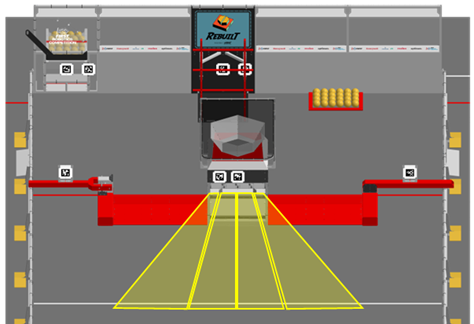
HUBS have a series of exits at the base of the HUB facing
towards the NEUTRAL ZONE. FUEL processed through the HUB are distributed into
the NEUTRAL ZONE via one of four exits as shown in Figure 5‑8. Examples of FUEL distribution from the
HUB can be found on the Playing FIELD webpage.
Figure 5‑8: HUB exits (approximation)
The top angles of the HUB are lit by DMX light bars that
indicate if the HUB is active. See Table 5‑3 for more details about the various light
states in the HUB.
Table 5‑3: HUB Lighting
|
Color
|
Pre-MATCH
|
MATCH
|
Post-Match
|
|
ALLIANCE color at 100% brightness
|
N/A
|
HUB active
|
N/A
|
|
ALLIANCE color pulsing
|
HUB deactivation warning. Starts 3 seconds before and
continues until deactivation or end of MATCH.
|
|
ALLIANCE color with white chase
|
During the TRANSITION SHIFT, Indicates the ALLIANCE HUB
that will be inactive in ALLIANCE SHIFT 1.
HUB is active.
|
|
Purple
|
N/A
|
FIELD is safe for FIELD STAFF.
|
|
Green
|
FIELD is safe for all.
|
|
White
|
Post MATCH 3 Second Scoring Assessment Period
|
|
Off
|
MATCH ready to start.
|
HUB is not active.
|
N/A
|
Figure 5‑9 BUMP
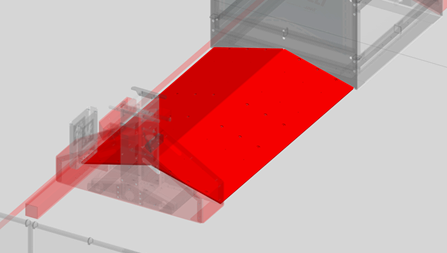
BUMPS are 73.0in (1.854m) wide, 44.4in (1.128m)
deep, and 6.513in (16.54cm) tall structures on either side of the HUB that
ROBOTS drive over. The top surface of each BUMP is made up of 0.5in (1.27cm)
thick, ALLIANCE colored, Orange Peel textured, HDPE ramps at a 15-degree angle with
one ramp sloping down towards the NEUTRAL ZONE and the other ramp sloping down
towards the ALLIANCE ZONE.
Figure 5‑10: TRENCH
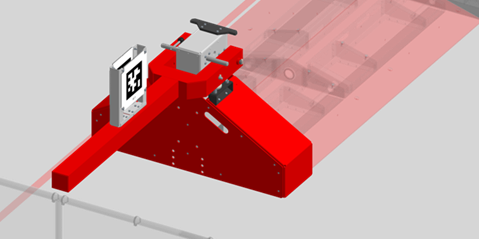
TRENCHES are a 65.65in (1.668m) wide, 47.0in
(1.194m) deep, and 40.25in (1.022m) tall structure that ROBOTS drive underneath.
The TRENCH extends from the guardrail to the BUMP on both sides of the FIELD. The
space underneath each TRENCH arm is 50.34in (1.279m) wide, 22.25in (56.52cm) tall.
TRENCHES along the guardrail closest to the scoring table contain
additional electronics to reach the HUB. The TRENCHES along the guardrail furthest
from the scoring table have a pivot arm that allows the horizontal portion of
the TRENCH to rotate into a vertical position for post-MATCH ROBOT retrieval
and to let FIELD staff reset the field between matches. The pivot arm will be
locked in the horizontal position during the MATCH.
5.7 DEPOT
Figure 5‑11: DEPOT
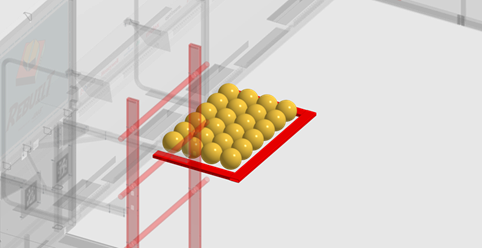
A DEPOT is a 42.0in (1.07m) wide, 27.0in (68.6cm)
deep structure located along the ALLIANCE WALL. There is 1 DEPOT per
ALLIANCE. DEPOTS are made up of 3.0in (7.62cm) wide, 1.0in (2.54cm) tall steel
barriers. The DEPOT is secured to the carpet using hook fastener which
increases the height to approximately 1.125in (2.86cm).
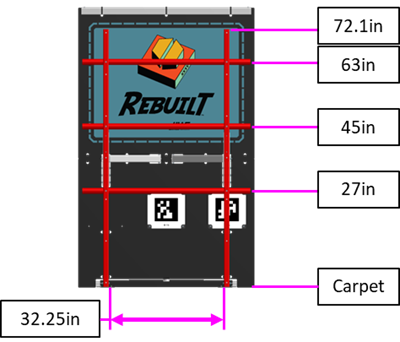
Figure 5‑12: TOWER

A TOWER is a 49.25in (1.251m) wide, 45.0in (1.143m)
deep, and 78.25in (1.988m) tall structure made up of the TOWER WALL, TOWER
BASE, UPRIGHTS, RUNGS and supporting structures. There is 1 TOWER per
ALLIANCE. A TOWER is integrated into each ALLIANCE WALL
between DRIVER STATION 2 and DRIVER STATION 3.
The TOWER BASE is a 39.0in (99.06cm) wide
by 45.18in (1.148m) deep plate that sits on the floor and extends from the
TOWER WALL. The TOWER BASE is powder-coated steel with hook fastener underneath.
The edges of the TOWER BASE are approximately 0.2in (0.5cm) to 0.3in (0.8cm)
tall.
The UPRIGHTS are two 72.1in (1.831m) tall,
1.5in (3.81cm) thick, 3.5in (8.89cm) deep sheet metal box frames that extend vertically
up from the TOWER BASE. The distance between each UPRIGHT is 32.25in (81.92cm).
The UPRIGHTS hold three horizontal RUNGS made up of 1-1/4in Sch 40 (1.66in (4.216cm) OD) pipe. Each RUNG is centered between the UPRIGHT and extend 5.875in (14.92cm) from
the outer face of the UPRIGHT on either side. The center of the LOW RUNG is
located 27.0in (68.58cm) from the floor. The center of
the MID RUNG is located 45.0in (114.3cm) from the floor.
The center of the HIGH RUNG is 63.0in (1.6m) from the floor.
The RUNGS are 18.0in (45.72cm) apart center to center.
The UPRIGHTS and RUNGS are powder-coated red or blue.
Each TOWER has additional supporting structures extending
from the UPRIGHT to the TOWER WALL between approximately 28.40in (72.14cm) and 43.38in
(1.102m) off the floor.
Figure 5‑13: TOWER Dimensions
The ALLIANCE WALL separates ROBOTS
from DRIVE TEAM members in the ALLIANCE AREA. It consists of 3 DRIVER
STATIONS, an OUTPOST, and a TOWER WALL.
Figure 5‑14: ALLIANCE WALL
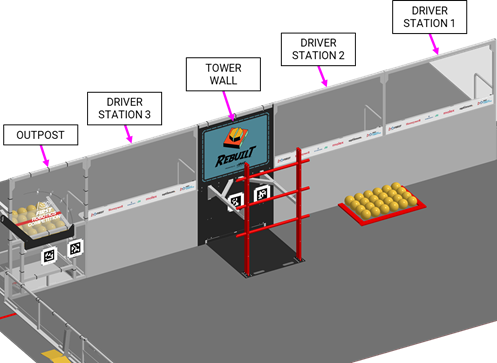
Figure 5‑15: DRIVER STATION (ALLIANCE AREA perspective and FIELD
perspective)
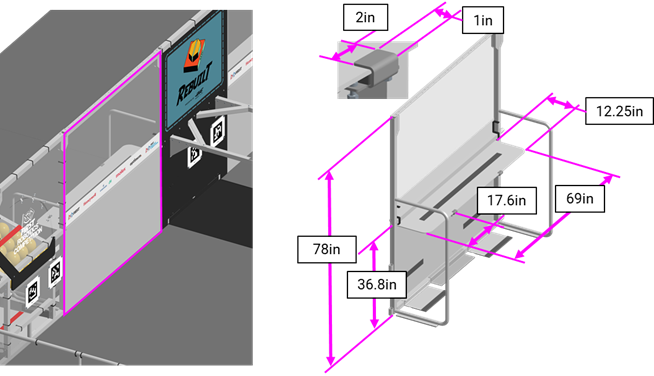
A DRIVER STATION is 1 of 3
assemblies within an ALLIANCE WALL behind which a DRIVE TEAM operates their
ROBOT. Each DRIVER STATION is made from a 36.8in (93.5cm) tall diamond
plate base topped with a 42in (1.07m) tall transparent plastic sheet and a top
rail.
An aluminum shelf is attached to each DRIVER STATION to
support an OPERATOR CONSOLE. The shelf is 69in (1.75m) wide and 12.25in (31.1cm)
deep. There is a 54.0in (1.372m) long by 2.0in (nominal) wide strip of
hook-and-loop tape (“loop” side) along the center of the support shelf that may
be used to secure the OPERATOR CONSOLE to the shelf. The shelf also includes
two clips to hold the shelf in place with a 1.0in (2.5cm) wide by 2.0in (5.1cm)
deep tab that sits on the top surface of the shelf.
There is a 6.0in (15.2cm) tall sponsor panel in each DRIVER
STATION. The top of this panel is 42.9in (1.09m) from the carpet.
There may be a ramp available at events for DRIVE TEAMS
with limited mobility. It is designed to allow an individual using a wheelchair
to access the DRIVER STATION shelf and/or see onto the FIELD; however, this
accommodation is available to anyone who has a wheelchair or other physical
disability that obstructs their view of the FIELD. Teams should speak to the
FTA before MATCHES begin to ensure that it is available for each of the team’s
MATCHES.
This ramp is available at many Regional and District
events. For questions, please connect with the local Program Delivery Partner.
Teams should also speak to the FTA for any other FIELD side
accommodations needed.
Each DRIVER STATION contains the following elements for
DRIVE TEAMS:
-
1 Ethernet cable: attaches to the Ethernet port of the OPERATOR
CONSOLE and provides connectivity to the FIELD Management System
(FMS).
-
1 120VAC NEMA 5-15R power outlet (i.e. standard US outlet):
located on each DRIVER STATION shelf and protected by its own 2-Amp circuit
breaker. It can be used to power the OPERATOR CONSOLE. DRIVE TEAMS are
responsible for monitoring their power consumption as a tripped breaker in the
outlet does not constitute an ARENA FAULT. For some events in regions that
don’t use NEMA 5-15 shaped outlets, event organizers may install appropriate
plug adapters to be used throughout the event.
-
1 Emergency Stop (E-Stop) button: located on the left side of the
DRIVER STATION shelf and is used to deactivate a ROBOT in an emergency.
-
1 Autonomous Stop (A-Stop) button: located on the right side of
the DRIVER STATION shelf and is used to DISABLE a ROBOT during AUTO.
-
1 team sign: located at the top of each DRIVER STATION. The FIELD
facing side of the sign displays the team number in the ALLIANCE color. The
ALLIANCE AREA side of the sign displays the following information in red:
o
Pre-MATCH: team number and ROBOT connection state
o
During Qualification MATCHES:
§
Current SHIFT and time remaining in that period,
·
A shows for AUTO when both ALLIANCE’s HUBS are active
·
T shows for the TRANSITION SHIFT when both ALLIANCE’s HUBS are
active
·
R shows when the Red ALLIANCE’S HUB is active
·
B shows when the Blue ALLIANCE’S HUB is active
·
E shows for END GAME when both ALLIANCE’s HUBS are active
§
Progress towards the FUEL Ranking Points. This shows total scored
out of the ENERGIZED RP and once that threshold passes it shows out of the SUPERCHARGED
RP
§
AUTO TOWER points, and
§
remaining MATCH period time.
Figure 5‑16 Back of team sign (during Qualification MATCH)

o
During the MATCH during Playoff MATCHES:
§
Which MATCH period is active and time remaining in that period,
§
MATCH scores, and
§
remaining MATCH period time.
Figure 5‑17 Back of team sign (during Playoff MATCH)

-
1 timer (in DRIVER STATION 2 only): displays the official time
remaining in the MATCH period on the FIELD-facing side (in white) and on the
team facing side the following information in red:
o
remaining MATCH period time, and
o
MATCH scores.
Figure 5‑18 Back of timer

-
1 team LED stack: indicates ALLIANCE color, ROBOT status, E-Stop
and A-Stop status, and is centered at the top of each DRIVER STATION.
The stack includes 2 identical
ALLIANCE-colored ROBOT status LEDs above a third amber A-stop/E-stop LED. LED
states are as follows:
o
ROBOT status LEDs
§
Solid: indicates that the ROBOT is connected and enabled. This
only happens during a MATCH.
§
Blinking: indicates that either the FMS is preset for the MATCH
and the ROBOT is not connected yet, or it’s during a MATCH and the
corresponding ROBOT has lost connectivity, or the E-stop was pressed.
§
Off: indicates that the ROBOT is linked and DISABLED prior to the
start of the MATCH, or the ROBOT is BYPASSED. This light is also off,
regardless of ROBOT connection status, after the MATCH has concluded.
o
A-Stop/E-stop LED
§
Solid: the ROBOT is DISABLED due to a press of the team E-stop
button, the FIELD E-stop button, or by the scorekeeper via the FMS.
§
Blinking: the ROBOT is DISABLED for the remainder of AUTO due to
a press of the team A-Stop button.
§
Off: the ROBOT is not DISABLED by the FIELD.
-
FMS hardware and wiring: mostly located below shelves in the 2
DRIVER STATIONS closer to the scoring table.
5.9.2
OUTPOST
Figure 5‑19 OUTPOST
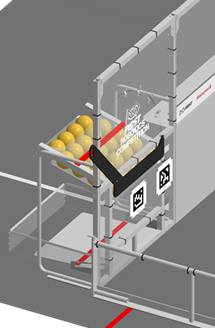
An OUTPOST is an assembly through which
HUMAN PLAYERS feed FUEL into the FIELD and ROBOTS can deliver FUEL to their
HUMAN PLAYERS. There are 2 OUTPOSTS, 1 on either end of the FIELD connecting
the guardrail to the ALLIANCE WALL. Each OUTPOST has a 31.8in (80.8cm) wide by 7.0in
(17.8cm) tall opening through which FUEL passes to the FIELD. The bottom of the
opening is 28.1in (71.4cm) off the floor.
A 15.0° sloped tunnel, called the
CHUTE, leads to the upper opening in the OUTPOST. The
CHUTE can hold approximately 25 FUEL at a time retained by the CHUTE DOOR. The
CHUTE DOOR is an HDPE arm on a pivot that can be rotated
approximately 90 degrees by the HUMAN PLAYER to open or close the CHUTE.
At the base of the OUTPOST is an opening 32.0in (81.3cm)
wide by 7.0in (17.8cm) tall where ROBOTS can push FUEL into the CORRAL. The
bottom of the opening is 1.88in (4.77cm) off the ground. The opening is divided
in the center by a vertical 1-1/4in Sch 40 (1.66in (4.216cm) OD) pipe. The
CORRAL is made up of 8.13in (20.6cm) tall polycarbonate panels
that create a 35.8in (90.8cm) wide, 37.6in (95.5cm) deep area on the floor in
which FUEL can be stored.
The CHUTE and CORRAL each feature an ALLIANCE-colored tape
line that indicates where DRIVE TEAMS may be restricted from reaching. The near
edge of the CORRAL tape is 12.7in (32.3cm) from the FIELD-facing wall of the
OUTPOST. The near edge of the CHUTE tape line is 12.9in (32.8cm) from the FIELD-facing
wall of the OUTPOST.
There are 2 stools available at events for DRIVE TEAMS to
use. Each stool is 23.0in (58.42cm) wide by 13.5in (34.29cm) deep, 6.25in (15.88cm)
tall, and rated for 300lb (136.0kg).
It is specially intended to allow individuals who are
shorter, better sightlines onto the FIELD; however, this accommodation is
available to anyone who has another physical disability that obstructs their
view of the FIELD.
Only 2 stools are available, and priority will be given to
those with the biggest need. Teams should speak to the FTA before MATCHES begin
to request that it is available for each of the team’s MATCHES. Teams may also purchase
their own (Item Number: 779ac01stpm) or bring an
equivalent (e.g. not foldable and similar dimensions) version to the event to
guarantee use for every match.
This stool is available at all events within the US &
Canada and equivalents are available at international events. For questions,
please connect with the local Program Delivery Partner.
SCORING ELEMENTS are items that teams use to score points. There
is one type of SCORING ELEMENT used in REBUILT: FUEL.
In REBUILT, a ROBOT may CONTROL any
number of SCORING ELEMENTS after the start of the MATCH.
5.10.1 FUEL
Figure 5‑20 FUEL
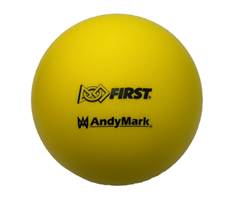
A FUEL is a 5.91in (15.0cm) diameter, high
density foam ball. FUEL is a custom made SCORING ELEMENT available for
purchase on the AndyMark website, am-5801.
FUEL has a weight of between 0.448-0.500lb (~0.203-0.227kg).
FUEL undergoes wear and tear during a competition.
Generally, a FUEL that still appears to look approximately like a FUEL is
considered a FUEL for the purposes of rule evaluation and scoring, whether
damaged or not. Small chunks of a FUEL are not considered a FUEL.
Most new FUEL will have small impressions due to being
pressed against other FUEL or the sides of the packaging during shipping. These
impressions are purely cosmetic and do not affect the function of the FUEL. Most
impressions will gradually disappear as the FUEL is used.
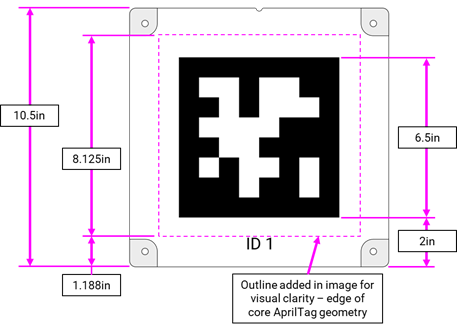
AprilTags are 8.125in (20.64cm) square targets located on
the HUB, TOWER WALL, OUTPOST, and TRENCHES. There are 32 unique markers on the
FIELD positioned as shown in Figure 5‑21.
Figure 5‑21 AprilTag Locations
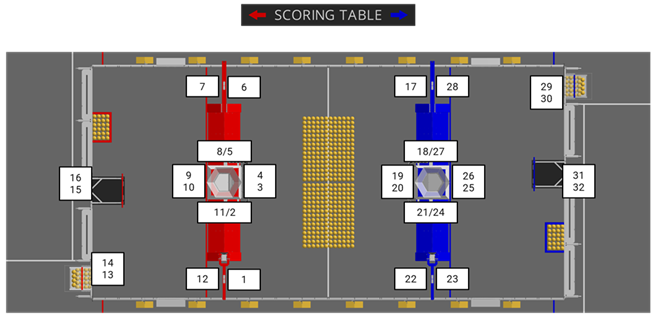
All markers are from the 36h11 tag family, IDs 1-32. All
AprilTags are mounted to and centered on a 10.5in (26.67cm) square
polycarbonate panel. Each marker has an identifying text label. If AprilTags
experience wear and marking during MATCHES they are repaired with gaffers tape.
Figure 5‑22 AprilTag sizing
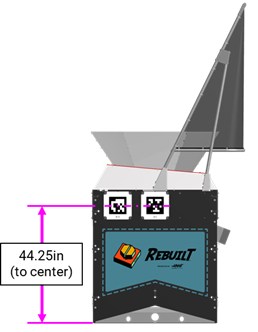
HUB AprilTags (IDs 2, 3, 4, 5, 8, 9, 10, 11, 18, 19, 20, 21,
24, 25, 26, 27) are located on all four faces of the HUB. Each face has two
AprilTags with centers located 44.25in (1.124m) off the floor as shown in Figure 5‑23. One AprilTag per face is centered and
the other AprilTag is horizontally offset.
Figure 5‑23 HUB AprilTags
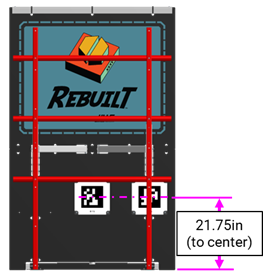
Two AprilTags (IDs 15, 16, 31, 32) are located on each TOWER
WALL with centers 21.75in (55.25cm) off the floor as shown in Figure 5‑24. One AprilTag per TOWER is centered and
the other AprilTag is horizontally offset.
Figure 5‑24 TOWER WALL AprilTags
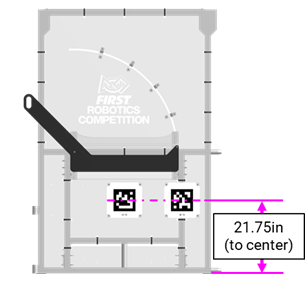
Two AprilTags (IDs 13, 14, 29, 30) are located on each
OUTPOST with centers 21.75in (55.25cm) off the floor as shown in Figure 5‑25. One AprilTag per OUTPOST is centered with
the CHUTE and CORRAL openings and the other AprilTag is horizontally offset.
Figure 5‑25 OUTPOST AprilTags
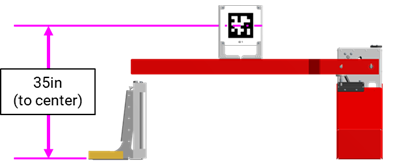
TRENCH AprilTags (IDs 1, 6, 7, 12, 17, 22, 23, 28) are attached
to mounting brackets located on the top surface of the horizontal arm of the
TRENCH. Each TRENCH has two AprilTags, one facing the ALLIANCE ZONE and one
facing the NEUTRAL ZONE. TRENCH AprilTags are approximately centered on the
opening under the TRENCH arm and their centers are located 35in (88.9cm) off
the floor as shown in Figure 5‑26.
Figure 5‑26 TRENCH AprilTags
For further marker locating information please refer to the 2026 Field Dimension Drawings. Printable copies
of the field AprilTags can be found on the Playing FIELD webpage.
The FIELD Management System (FMS) is
all the electronics responsible for sensing and controlling the FIRST
Robotics Competition FIELD. The FMS encompasses all FIELD electronics,
including computers, REFEREE touchscreens, the wireless access point,
sensors, stack lights, A-Stops and E-Stops, etc.
When a DRIVE TEAM connects the Ethernet cable from their
assigned DRIVER STATION to their OPERATOR CONSOLE, the Driver Station Software
on the OPERATOR CONSOLE computer communicates with FMS. Once connected, the
open ports available are described in Table 8‑5.
Note that ROBOT code cannot be deployed while connected to
the FMS. Additional information about the FMS may be found in the FMS Whitepaper.
The FMS alerts participants to milestones in the MATCH using
audio cues detailed in Table 5‑4. Please note that audio cues are intended
as a courtesy to participants and not intended as official MATCH markers. If
there is a discrepancy between an audio cue and the FIELD timers, the FIELD
timers are the authority.
Table 5‑4: Audio Cues
|
Event
|
Timer Value(s)
|
Audio Cue
|
|
MATCH start
|
0:20 (for AUTO)
|
“Cavalry Charge”
|
|
AUTO ends
|
0:00 (for AUTO)
|
“Buzzer”
|
|
TELEOP &
TRANSITION begins
|
2:20
|
“3 Bells”
|
|
ALLIANCE SHIFT
starts
|
2:10
1:45
1:20
0:55
|
“POWER UP –
Linear Popping”
|
|
END GAME begins
|
0:30
|
“Steam Whistle”
|
|
MATCH end
|
0:00
|
“Buzzer”
|
|
MATCH stopped
|
n/a
|
“Foghorn”
|
FIELD STAFF are responsible for making
sure the MATCHES are cycled through efficiently, fairly, safely, and with a
spirit of cooperation, Gracious Professionalism, and generosity of
spirit. FIELD STAFF roles are filled by volunteers from the community who
prepare for the event with thorough training and certification. There are 3
FIELD-side key volunteer roles with whom teams should be familiar and are
encouraged to use as resources to make their event experience valuable (in
whatever way the team defines “valuable”).
-
Head REFEREE – trains, directs, and supervises REFEREES.
They oversee all scoring processes and procedures in collaboration with the FIRST
Technical Advisor (FTA). They interact with STUDENTS, volunteers, and
contracted/FIRST staff. The Head REFEREE is positioned between the FIELD
and the scoring table and wears a yellow shirt. The Head REFEREE has final
authority for decisions regarding MATCH scores, penalties, and YELLOW and RED
CARD assignments. For additional details, please refer to the Head REFEREE role description.
-
FIRST Technical Advisor (FTA) - ensures
events run smoothly, safely, and in accordance with FIRST requirements.
The FTA collaborates with FIRST staff, event staff, and other event
volunteers in many different areas at events. The FTA is the liaison between FIRST
HQ and the event for all things related to the FIELD, ROBOTS, and game, acts as
a team advocate for all teams competing at the event and is a major point of
escalation and conflict resolution for the event. For additional details,
please refer to the FTA role description.
-
FIELD Supervisor - directs activity on the FIELD to ensure
efficient execution of the MATCHES, pacing of the event, and smooth flow of MATCH
play. FIELD Supervisors are responsible for ensuring the FIELD is intact and lead
FIELD Reset teams, who are responsible for resetting the FIELD after each MATCH
in preparation for the subsequent MATCH. For additional details, please refer
to the FIELD Supervisor role description.

Figure 6‑1 REBUILT
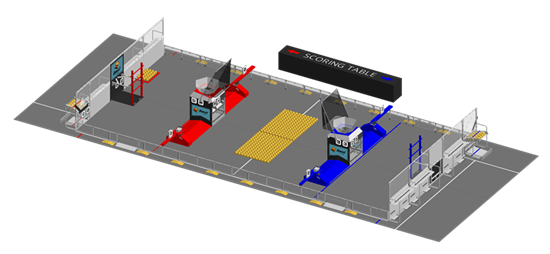
In REBUILT, 2 ALLIANCES (an ALLIANCE is a
cooperative of up to 4 FIRST Robotics Competition teams) play MATCHES,
set up and implemented per the details described below.
6.1
MATCH Overview
MATCHES run on 7–10-minute cycles, which consist of pre-MATCH
setup, the 2-minute and 40-second MATCH, and the post-MATCH
reset.
During the MATCH, ROBOTS collect FUEL and score in their HUB.
HUMAN PLAYERS can deliver FUEL to ROBOTS or score them in their HUB.
ROBOTS conclude the MATCH climbing on their TOWER.
6.2
DRIVE TEAM
A DRIVE TEAM is a set of up to 5 people
from the same FIRST Robotics Competition team responsible for team
performance for a specific MATCH. There are 4 specific roles on a DRIVE
TEAM which ALLIANCES can use to assist ROBOTS, and no more than 1 member of the
DRIVE TEAM may be a non-STUDENT.
The intent of the definition of DRIVE TEAM and DRIVE TEAM
related rules is that, barring extenuating circumstances, the DRIVE TEAM
consists of people who arrived at the event affiliated with that team and are
responsible for their team’s and ROBOT’S performance at the event (this means a
person may be affiliated with more than 1 team).
The intent is not to allow teams to “adopt” members of
other teams for strategic advantage for the loaning team, borrowing team,
and/or their ALLIANCE (e.g. an ALLIANCE CAPTAIN believes 1 of their DRIVERS has
more experience than a DRIVER on their first pick, and the teams agree the
first pick team will “adopt” that DRIVER and make them a member of their DRIVE
TEAM for Playoffs).
The definition isn’t stricter for 2 main reasons. First, to
avoid additional bureaucratic burden on teams and event volunteers (e.g.
requiring that teams submit official rosters that Queuing must check before
allowing a DRIVE TEAM into the ARENA). Second, to provide space for exceptional
circumstances that give teams the opportunity to display Gracious
Professionalism (e.g. a bus is delayed, a DRIVE COACH has no DRIVERS, and
their pit neighbors agree to help by loaning DRIVERS as temporary members of
the team until their bus arrives).
Table 6‑1 DRIVE TEAM roles
A STUDENT is a person who has not completed
high-school, secondary school, or the comparable level as of September 1 prior
to Kickoff.
The TECHNICIAN provides teams with a technical resource for
pre-MATCH setup, ROBOT connectivity, OPERATOR CONSOLE troubleshooting, and
post-MATCH removal of the ROBOT. Some pre-MATCH responsibilities for the
TECHNICIAN may include, but are not limited to:
-
location of the ROBOT radio, its power connection, and
understanding of its indicator lights
-
location of the roboRIO and understanding of its indicator lights
-
username and password for the OPERATOR CONSOLE
-
restarting the Driver Station and Dashboard software on the
OPERATOR CONSOLE
-
changing the bandwidth utilization (e.g. camera resolution, frame
rate, etc.)
-
changing a battery
-
charging pneumatics
While the TECHNICIAN may be the primary technical member of
the DRIVE TEAM, all members of the DRIVE TEAM are encouraged to have knowledge
of the basic functionality of the ROBOT, such as the location and operation of
the main circuit breaker, connecting and resetting joysticks or gamepads from
the OPERATOR CONSOLE, and removing the ROBOT from the FIELD.
Per Table 6‑1, each team is allotted up to 3 STUDENTS
who may be assigned as DRIVERS or HUMAN PLAYERS. If multiple teams on an
ALLIANCE do not have 3 STUDENTS at the event to act in these roles, 1 of the
ALLIANCE’S teams may substitute a STUDENT TECHNICIAN as a HUMAN PLAYER for that
MATCH only. In this case,
-
the Head REFEREE must be notified,
-
all HUMAN PLAYER rules now apply to this DRIVE TEAM member, and
-
this DRIVE TEAM member is no longer considered a TECHNICIAN for
that MATCH.
Before each MATCH begins, FIELD STAFF stage SCORING ELEMENTS
as described in section 6.3.4 SCORING ELEMENTS. DRIVE TEAMS stage their ROBOTS (as
described in section 6.3.3 ROBOTS) and OPERATOR CONSOLES (as described in section
6.3.2 OPERATOR CONSOLES). Then, DRIVE TEAMS take their
places as described in section 6.3.1 DRIVE TEAMS.
6.3.1
DRIVE TEAMS
DRIVE TEAMS prepare for a MATCH by staging in the
appropriate areas, according to their role on the DRIVE TEAM, and by identifying
themselves accordingly. DRIVE TEAM starting conditions are listed below, and a
DRIVE TEAM obstructing or delaying any of the conditions is at risk of
violating G301.
A.
only DRIVE TEAM members assigned to the upcoming MATCH are present,
B.
for Qualification MATCHES only DRIVE TEAM members whose ROBOTS have
passed initial, complete Inspection are present,
C.
any number of HUMAN PLAYERS are staged in their OUTPOST AREAS,
D.
HUMAN PLAYERS not included in C, DRIVERS, and DRIVE COACHES are in their
ALLIANCE AREA and behind the HUMAN STARTING LINE,
E.
TECHNICIANS are in the event-designated area near the FIELD,
F.
DRIVE TEAM members clearly display their designated buttons above their
waists (DRIVE COACH - “Drive Coach”, DRIVERS and HUMAN PLAYERS - “Drive Team”, and
TECHNICIAN - “Technician”), and
G.
if a Playoff MATCH, the ALLIANCE CAPTAIN clearly displays their
designated ALLIANCE CAPTAIN identifier (e.g. hat or armband).
6.3.2
OPERATOR CONSOLES
DRIVE TEAMS set up their OPERATOR CONSOLE as soon as the
DRIVE TEAM from the previous MATCH has cleared the area. OPERATOR CONSOLES must
be compliant with all relevant rules, specifically those in section 8.9 OPERATOR CONSOLE. The OPERATOR CONSOLE is plugged
into the team’s assigned DRIVER STATION, as indicated on the team sign. Any control
devices worn or held by their HUMAN PLAYERS and/or DRIVERS during the MATCH must
be disconnected from or set on or beside the OPERATOR CONSOLE before the MATCH
can begin. A DRIVE TEAM obstructing or delaying OPERATOR CONSOLE setup is at
risk of violating G301.
For the purposes of FIRST Robotics Competition, any
device connected to the OPERATOR CONSOLE is considered a control device because
REFEREES are not expected to differentiate between devices that can or cannot
control the ROBOT.
6.3.3 ROBOTS
DRIVE TEAMS stage their ROBOT in accordance with G303. A DRIVE TEAM obstructing or delaying ROBOT setup
requirements is at risk of violating G301.
If order of placement matters to either or both ALLIANCES,
the ALLIANCE notifies the Head REFEREE during setup for that MATCH, and the
Head REFEREE instructs ALLIANCES to alternate placement of ROBOTS. In a
Qualification MATCH, REFEREE instructions are that ROBOTS are placed in the
following order:
1.
red DRIVER STATION 1 ROBOT
2.
blue DRIVER STATION 1 ROBOT
3.
red DRIVER STATION 2 ROBOT
4.
blue DRIVER STATION 2 ROBOT
5.
red DRIVER STATION 3 ROBOT
6.
blue DRIVER STATION 3 ROBOT
In an intra-Division Playoff MATCH,
the same pattern is applied, but instead of blue ALLIANCE placing last, the
higher seeded ALLIANCE (regardless of color) places last. For inter-Division
Playoff MATCHES, the ALLIANCE that places last is determined by a (real or
virtual) coin flip facilitated by the Head REFEREE where a “heads” result
invites the red ALLIANCE to place last.
FIELD STAFF may ask teams to indicate their intended location
and are not required to wait for a team to stage their ROBOT in its exact location
before moving to the next team.
6.3.4 SCORING
ELEMENTS
Before each MATCH
begins, FIELD STAFF stage SCORING ELEMENTS.
Figure 6‑2 SCORING ELEMENT staging positions
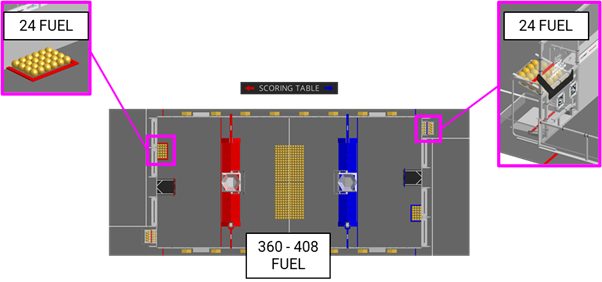
504 FUEL are staged for each MATCH as follows (reference Figure 6‑2):
A.
24 FUEL are staged in each DEPOT (FUEL may not be in a uniform layout),
B.
24 FUEL are staged in each OUTPOST CHUTE,
C.
8 FUEL may be preloaded in each ROBOT by the ROBOT’S DRIVE TEAM, such
that each FUEL is fully supported by the ROBOT (up to 48 total; a FUEL not
pre-loaded in a ROBOT is staged in the NEUTRAL ZONE), and
D.
remaining FUEL are arranged in the NEUTRAL ZONE through a process listed
in Section 6.3.4.1
(360 to 408, depending on how many are preloaded in ROBOTS).
Due to the high number of SCORING ELEMENTS in REBUILT, FIELD
STAFF may not be able to perfectly count all FUEL put into the NEUTRAL ZONE.
The number of FUEL staged in the NEUTRAL ZONE for any given match may fluctuate
around +/- 24 FUEL.
For District Championship and/or FIRST Championship
events, the quantity of FUEL staged in a MATCH may increase up to 600. If this
happens, the additional FUEL will be included as part of an updated FUEL arrangement
in the NEUTRAL ZONE.
The NEUTRAL ZONE is staged by the FIELD crew by corralling
all FUEL within a bounding box that is approximately 206.0in (5.23m) wide and 72.0in
(1.83m) deep. The bounding box has a solid divider in the middle that is 2.0in
(5.08cm) wide that will result in a small gap in FUEL. The dividers will be
removed prior to the start of the MATCH.
Figure 6‑3 NEUTRAL ZONE FUEL setup
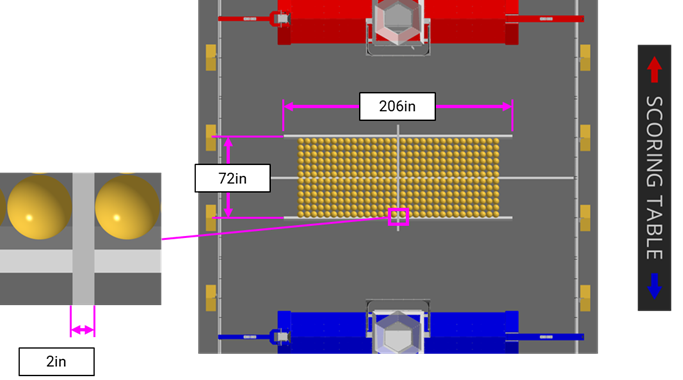
The expected result of the dispersal is a roughly equal
split of FUEL on both sides of the CENTER LINE. The dispersal between the scoring
table side and non-scoring table side of the field is expected to vary match to
match.
The placement of FUEL in the NEUTRAL ZONE is not intended
to be in a perfect grid. Teams should expect variances in the placement of FUEL
in the NEUTRAL ZONE at the start of the MATCH.
The first period of each MATCH is 20 seconds long and called
the Autonomous Period (AUTO). During AUTO, ROBOTS operate without any DRIVE
TEAM control or input. ROBOTS score SCORING ELEMENTS, may leave their ROBOT
STARTING LINE and retrieve additional SCORING ELEMENTS, and may climb their TOWER.
There is a 3-second delay between AUTO and TELEOP for scoring purposes as
described in section 6.5 Scoring.
The second period of each MATCH is the remaining 2 minutes
and 20 seconds (2:20) and called the Teleoperated Period
(TELEOP). During TELEOP, DRIVERS remotely operate ROBOTS to retrieve and score SCORING
ELEMENTS and climb their TOWER. TELEOP is split into further segments: the TRANSITION SHIFT, the ALLIANCE SHIFTS,
and END GAME. There are four ALLIANCE SHIFTS named SHIFT
1, SHIFT 2, SHIFT 3, and SHIFT 4. The duration of each timeframe is shown
in Table 6‑2.
Table 6‑2: MATCH SHIFTS
|
MATCH Period
|
MATCH Timeframe
|
Duration
|
Timer Values
|
|
AUTO
|
AUTO
|
20 Seconds
|
0:20 – 0:00
|
|
TELEOP
|
TRANSITION SHIFT
|
10 Seconds
|
2:20 – 2:10
|
|
SHIFT 1
|
25 Seconds
|
2:10 – 1:45
|
|
SHIFT 2
|
25 Seconds
|
1:45 – 1:20
|
|
SHIFT 3
|
25 Seconds
|
1:20 – 0:55
|
|
SHIFT 4
|
25 Seconds
|
0:55 – 0:30
|
|
END GAME
|
30 Seconds
|
0:30 – 0:00
|
6.4.1
HUB Status
During the MATCH, the status of a HUB can be either active
or inactive. FUEL scored in an active HUB is worth MATCH points but FUEL scored
in an inactive HUB will not earn any points as shown in Table 6‑3. Both ALLIANCE HUBS are active during
AUTO, the TRANSITION SHIFT, and END GAME. During the ALLIANCE SHIFTS, only one ALLIANCE
HUB will be active while the other ALLIANCE’S HUB becomes inactive.
The status of both HUBS during the ALLIANCE SHIFTS is based
on the results of AUTO. The ALLIANCE that scores the most FUEL during AUTO will
have their HUB set to inactive for SHIFT 1 while their opponent’s HUB will be
active, as shown in Table 6‑3. HUB statuses will then alternate at the
start of each following ALLIANCE SHIFT, until the start of END GAME where both HUBS return to active. If both ALLIANCES score
the same number of FUEL during AUTO, the FMS will randomly select an ALLIANCE and
use its HUB status order for the ALLIANCE SHIFTS during the MATCH.
FMS Game Data relays the ALLIANCE who
scored more FUEL during AUTO, or the ALLIANCE selected by FMS, to all OPERATOR
CONSOLES simultaneously at the start of TELEOP. Lights on the HUB will also
indicate the ALLIANCE HUB that will be inactive in ALLIANCE SHIFT 1 as noted in
Table 5‑3.
Specific details on the format of the data can be found on the 2026 FRC Control System website.
Table 6‑3: Hub Status during MATCH
Timeframes
|
AUTO Result:
|
RED ALLIANCE scores more FUEL
during AUTO or is selected by the FMS
|
BLUE ALLIANCE scores more
FUEL during AUTO or is selected by the FMS
|
|
MATCH Timeframe
(timer values)
|
RED ALLIANCE HUB status
|
BLUE ALLIANCE HUB status
|
RED ALLIANCE HUB status
|
BLUE ALLIANCE HUB status
|
|
AUTO
(0:20 – 0:00)
|
Active
|
Active
|
Active
|
Active
|
|
TRANSITION SHIFT
(2:20 – 2:10)
|
Active
|
Active
|
Active
|
Active
|
|
SHIFT 1
(2:10 – 1:45)
|
Inactive
|
Active
|
Active
|
Inactive
|
|
SHIFT 2
(1:45 – 1:20)
|
Active
|
Inactive
|
Inactive
|
Active
|
|
SHIFT 3
(1:20 – 0:55)
|
Inactive
|
Active
|
Active
|
Inactive
|
|
SHIFT 4
(0:55 – 0:30)
|
Active
|
Inactive
|
Inactive
|
Active
|
|
END GAME
(0:30 – 0:00)
|
Active
|
Active
|
Active
|
Active
|
6.5
Scoring
ALLIANCES are rewarded for accomplishing various actions
throughout a MATCH, including scoring FUEL, climbing their TOWER, and winning
or tying MATCHES.
Rewards are granted either via MATCH points or Ranking
Points (often abbreviated to RP, which increase the measure used to rank
teams in the Qualification Tournament).
All scores are assessed and updated throughout the MATCH,
except as follows:
A.
assessment of FUEL scored in the HUB continues for up to 3 seconds after
the ARENA timer displays 0:00 following AUTO.
B.
assessment of FUEL scored in the HUB continues for up to 3 seconds after
the ARENA timer displays 0:00 following TELEOP.
C.
assessment of AUTO TOWER points is made after the ARENA timer displays
0:00 following AUTO.
D.
assessment of TELEOP TOWER points is made 3 seconds after the ARENA
timer displays 0:00 following TELEOP, or when all ROBOTS have come to rest
following the conclusion of the MATCH, whichever happens first.
Assessment of FUEL scored in the HUB continues for 3 seconds
after the HUB deactivates to account for FUEL processing time.
TOWER points are evaluated and scored by human volunteers.
Teams are encouraged to make sure that it is obvious and unambiguous that the
criteria are met.
6.5.1
SCORING ELEMENT Scoring Criteria
A FUEL is scored in the HUB once it passes through the top
opening of the HUB and through the sensor array.
6.5.2
ROBOT Scoring Criteria
To qualify for TOWER points for a given
LEVEL, a ROBOT must meet the following conditions:
-
For LEVEL 1 – a ROBOT must no longer be touching the carpet or
the TOWER BASE, or
-
For LEVEL 2 – a ROBOT must be positioned such that its BUMPER
covers are completely above the LOW RUNG, or
-
For LEVEL 3 – a ROBOT must be positioned such that its BUMPER
covers are completely above the MID RUNG.
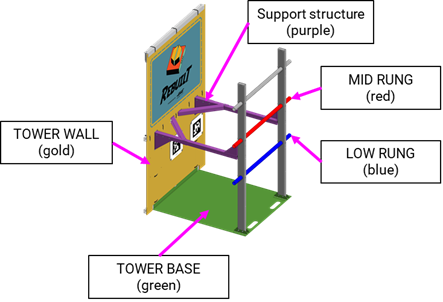
Additionally, a ROBOT must be contacting at least one
RUNG and/or UPRIGHT on their TOWER and may additionally only contact the
following elements:
A.
the TOWER WALL,
B.
support structure,
C.
FUEL, and/or.
D.
another ROBOT.
A ROBOT may only earn TOWER points for LEVEL 1 during AUTO. A
ROBOT may only earn TOWER points for a single LEVEL during TELEOP. A ROBOT that
earns TOWER points in AUTO is eligible to earn additional TOWER points during
TELEOP.
Figure
6‑4: TOWER contact limitation for ROBOT
Scoring Criteria
6.5.3
Point Values
Point values for tasks in REBUILT are detailed in Table 6‑4.
Table 6‑4 REBUILT point values
Table 6‑5: REBUILT BONUS RP thresholds
|
BONUS RP
Type
|
Regional/ District Events
|
District Championships
|
FIRST Championship
|
|
ENERGIZED
RP
|
100
|
240
|
360
|
|
SUPERCHARGED
RP
|
360
|
360
|
500
|
|
TRAVERSAL
RP
|
50
|
50
|
50
|
BONUS RP thresholds for District Championships and FIRST
Championship will be announced in Team Updates.
Unless otherwise noted, all violations are assigned for each
instance of a rule violation. A description of the penalties is listed in Table 6‑6. All rules throughout the Game Rules
section are called as perceived by a REFEREE.
Table 6‑6 Rule violations
6.6.1
YELLOW and RED CARDS
In addition to rule violations explicitly listed throughout this
document, YELLOW CARDS and RED CARDS are used in FIRST Robotics
Competition to address team and ROBOT behavior that does not align with the
mission, values, and culture of FIRST.
The Head REFEREE may assign a YELLOW CARD as a warning, or a
RED CARD for egregious behavior inappropriate at a FIRST Robotics
Competition event.
If an action resulting in the assignment of a YELLOW or RED
CARD is determined to be the result of an ARENA FAULT, per section 10.2,
the CARD will be rescinded.
A YELLOW or RED CARD is indicated on the audience display
MATCH results screen. During Qualification MATCHES, A YELLOW or RED CARD is
indicated next to the team who received the CARD and the Game Announcer
describes the violation. During Playoff MATCHES, the card is applied to the
whole ALLIANCE and as such “RED CARD" or "YELLOW CARD" appears
above the ALLIANCE number.
YELLOW CARDS are additive, meaning that a second YELLOW CARD
is automatically converted to a RED CARD. A team is issued a RED CARD for any
subsequent incident in which they receive an additional YELLOW CARD, including
earning a second YELLOW CARD during a single MATCH. A second YELLOW CARD is
indicated with a RED CARD on the audience display next to the team who received
the CARDS. A team that has received either a YELLOW CARD or a RED CARD carries
a YELLOW CARD into subsequent MATCHES, except as noted below.
Once a team receives a YELLOW or RED CARD, a yellow
rectangle will show next to the team number on the audience display during
subsequent MATCHES, including any replays.
Figure 6‑5 Example audience screen graphic showing YELLOW CARD
indicators

All YELLOW CARDS and G301 VERBAL WARNINGS are cleared at the
conclusion of Practice, Qualification, and division Playoff MATCHES. Other VERBAL
WARNINGS issued by the head REFEREE are cleared after Practice MATCHES and
persist from Qualification MATCHES through subsequent tournament phases.
6.6.2
YELLOW and RED CARD application
YELLOW and RED CARDS are applied based on the following:
Table 6‑7: YELLOW and RED CARD application
|
Time YELLOW or RED CARDS earned:
|
MATCH to which CARD is
applied:
|
|
Prior to Qualification
MATCHES
|
REFEREES may or may not be
present during Practice MATCHES. With input from event staff, the Head
REFEREE may opt to perpetuate a VERBAL WARNING or YELLOW CARD earned prior to
Qualification MATCHES to the first Qualification MATCH for particularly
egregious behavior.
|
|
during the Qualification
MATCHES
|
team’s current (or
just-completed) MATCH. In the case where the team participated as a SURROGATE
in the current (or just completed) MATCH, the card is applied to the team’s
previous MATCH (i.e. the team’s second Qualification MATCH)
|
|
between the end of
Qualification MATCHES and the start of Playoff MATCHES
|
ALLIANCE’S first Playoff MATCH
|
|
during the Playoff MATCHES
|
ALLIANCE’S current (or
just-completed) MATCH
|
A MATCH is no longer the current MATCH once the results of
the MATCH have been posted or the Head REFEREE or their designee has indicated
that teams can collect their ROBOTS, whichever is later.
Please see examples of the application of YELLOW and RED
CARDS as shown in section 6.6.4 Violation Details.
During Playoff MATCHES, YELLOW and RED CARDS are assigned to
the violating team’s entire ALLIANCE instead of to only the violating team. If
an ALLIANCE receives 2 YELLOW CARDS, the entire ALLIANCE is issued a RED CARD
which results in DISQUALIFICATION for the associated MATCH. If both ALLIANCES
receive a RED CARD, the ALLIANCE assessed the first RED CARD, chronologically,
is DISQUALIFIED and loses the MATCH.
There are several styles of violation wording used in this
manual. Below are some example violations and a clarification of the way the
violation would be assessed. The examples shown do not represent all possible
violations, but rather a representative set of combinations.
Table 6‑8 Violation examples
|
Example Violation
|
Expanded Interpretation
|
|
MINOR FOUL
|
Upon violation, a MINOR FOUL is
assessed against the violating ALLIANCE.
|
|
MAJOR FOUL and YELLOW CARD
|
Upon violation, a MAJOR FOUL is
assessed against the violating ALLIANCE. After the MATCH, the Head REFEREE
presents the violating team with a YELLOW CARD.
|
|
MINOR FOUL per additional
SCORING ELEMENT. If egregious, YELLOW CARD
|
Upon violation, a number of MINOR
FOULS are assessed against the violating ALLIANCE equal to the number of
additional SCORING ELEMENTS beyond the permitted quantity. Additionally, if
the REFEREES determine that the action was egregious, the Head REFEREE
presents the violating team with a YELLOW CARD after the MATCH.
|
|
MINOR FOUL. MAJOR FOUL IF
REPEATED
|
Upon initial violation in a
MATCH, a MINOR FOUL is assessed against the violating ALLIANCE. If the
ALLIANCE ROBOT repeats the infraction in the MATCH, a MAJOR FOUL is assessed
against the violating ALLIANCE. Assuming no additional infractions of that
rule by that ROBOT in that MATCH, the ROBOT has “earned” a MINOR FOUL and a MAJOR
FOUL for their ALLIANCE.
|
|
MAJOR FOUL, and for every 3
seconds in which the situation is not corrected, a MAJOR FOUL is assessed
|
Upon violation, a MAJOR FOUL is
assessed against the violating ALLIANCE and the REFEREE begins to count.
Their count continues until the criteria to discontinue the count are met,
and for each 3 seconds within that time, an additional MAJOR FOUL is assessed
against the violating ALLIANCE. A ROBOT in violation of this type of rule for
15 seconds receives a total of 6 MAJOR FOULS (assuming no other rules were
being simultaneously violated).
|
|
RED CARD for the ALLIANCE
|
After the MATCH, the Head
REFEREE presents the violating ALLIANCE with a RED CARD in the following
fashion:
·
In a PLAYOFF MATCH, a single RED CARD
is assessed to the ALLIANCE.
·
In all other scenarios, each team on
the ALLIANCE is issued a RED CARD.
|
6.7 Head
REFEREE and FTA Interaction
The Head REFEREE has the ultimate authority in the ARENA
during the event, but may receive input from additional sources, e.g. Game
Designers, FIRST personnel, FTA, and other event staff. The Head REFEREE
rulings are final. No event staff, including the Head REFEREE, will review
video, photos, artistic renderings, etc. of any MATCH, from any source, under
any circumstances.
Each ALLIANCE has a designated Question Box near the scoring
table. If a DRIVE TEAM has a question about a MATCH, the FIELD, etc., they may
send up to 2 DRIVE TEAM members to their corresponding Question Box. Depending
on timing, the Head REFEREE or FTA may postpone any requested discussion until
the end of the subsequent MATCH.
Technical questions regarding FIELD or ROBOT operation are
addressed by the FTA, and additional team members are invited to participate in
these conversations if necessary. If a DRIVE TEAM needs clarification on a
ruling or score, per Q101, up to 2 DRIVE TEAM members should address the
Head REFEREE after the ARENA Reset Signal (e.g. FIELD lights turn green).
While FMS tracks quantities of MINOR and MAJOR FOULS, FIRST
instructs REFEREES to not self-track details about MINOR FOULS and MAJOR FOULS;
as a result, REFEREES are not expected to recall details about what MINOR FOULS
and MAJOR FOULS were made, when they occurred, and against whom.
Any reasonable question is fair game in the Question Box,
and Head REFEREES will make good faith efforts to provide helpful feedback
(e.g. how/why certain MINOR FOULS are being called, why a particular ROBOT may
be susceptible to certain MINOR FOULS based on its design or game play, how
specific rules are being called or interpreted), but please know that they may
not be able to supply specific details.
Q101 *Head REFEREE Interactions. A team may only
address the Head REFEREE with maximum of 2 people, 1 of which must be a STUDENT.
Violation: The Head REFEREE will not address non-compliant
team members or peripheral conversations.
Some events may restrict ARENA access to members of the
DRIVE TEAM. Team members are permitted to swap buttons within their team as
needed to access the Question Box.
As much as possible, the STUDENT should be an active
participant in the conversation.
Teams should not record interactions without consent (see E117).
Q102
Conversations must be civil. Any
team interaction with the Head REFEREE must be appropriate.
Violation: The Head REFEREE may terminate the conversation
to allow time for parties to cool down. A person with subsequent violations
will not be allowed to interact with the Head REFEREE.
Examples of inappropriate behavior are outlined in G201.
SCORING ELEMENTS that leave the FIELD (other than through
the opening at the base of the OUTPOST) are placed back into the FIELD
approximately at the point of exit by FIELD STAFF (REFEREES, FTAs, or other
staff working around the FIELD) at the earliest safe opportunity.
Note that ROBOTS and HUMAN PLAYERS may not deliberately
cause SCORING ELEMENTS to leave the FIELD (see G405).
An ARENA FAULT (an error in ARENA operation described in section
10.2 MATCH Replays) is not called for MATCHES that
accidentally begin with damaged SCORING ELEMENTS. Damaged SCORING ELEMENTS are
not replaced until the next ARENA reset period. DRIVE TEAMS should alert the
FIELD STAFF to any missing or damaged SCORING ELEMENTS prior to the start of
the MATCH but as noted in 6.3.4, the exact number of FUEL in the NEUTRAL ZONE
may vary.
Once the MATCH is over and the Head REFEREE determines that
the FIELD is safe for FIELD STAFF and DRIVE TEAMS, they or their designee
change the FIELD lights to green and DRIVE TEAMS may retrieve their ROBOT. Some
MATCHES may include a short period afterward to allow FIELD staff to begin to clean
the field to make it easier and safer for teams to collect their robot. This
period is indicated with purple lights on the team signs and the word “clean”
displayed. TEAMS are not allowed on the field during this time.
During ARENA reset, the ARENA is cleared of ROBOTS and
OPERATOR CONSOLES from the MATCH that just ended, ROBOTS and OPERATOR CONSOLES
for the subsequent MATCH are loaded into the ARENA by DRIVE TEAMS, and FIELD
STAFF reset ARENA elements.
FIRST Robotics Competition uses 3 words in the
context of how durations and actions are assessed with regards to evaluation of
rules and assignment of violations. These words provide general guidance to
describe benchmarks to be used across the program. It is not the intent for
REFEREES to provide a count during the time periods.
-
MOMENTARY describes durations that are fewer
than approximately 3 seconds.
-
CONTINUOUS describes durations that are more
than approximately 10 seconds.
-
REPEATED describes actions that happen more than
once within a MATCH.
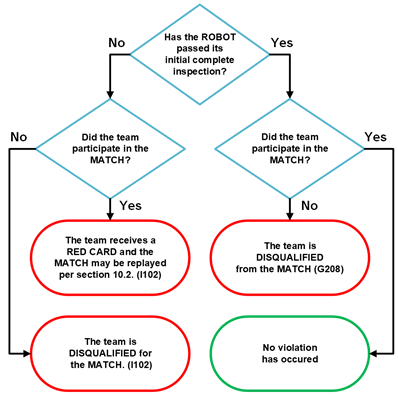
G101 *Humans, remain outside the FIELD. A team
member may not reach into the FIELD with any part of their body during a MATCH .
Violation: VERBAL WARNING. YELLOW CARD if subsequent
violations during the event.
Violations of this rule apply to the entire team, not
specifically to any 1 individual. For example, a member of Team 9999 reaches
onto the FIELD during MATCH 3, and a different member reaches onto the FIELD during
MATCH 25. The team receives a VERBAL WARNING for the first violation and a
YELLOW CARD for the second.
G102 *Never step over the guardrail. A team member
may only enter or exit the FIELD through open gates and only enter if FIELD
lighting (FIELD facing side of the team signs and timers) is green, unless
explicitly instructed by a REFEREE or an FTA.
Violation: VERBAL WARNING. YELLOW CARD if subsequent
violations during the event.
Teams are encouraged to ensure that all members of their
DRIVE TEAM are aware of this rule. It’s easy to violate, particularly when
teams are doing their best to move on and off the FIELD quickly. The violations
of this rule are intended to avoid nuisance penalties, but still enforce safety
requirements around the FIELD. There is the potential for injury when stepping
over the guardrail.
Violations of this rule apply to the entire team, not
specifically to any 1 individual. For example, a member of Team 9999 steps over
the guardrail prior to MATCH 3, and a different member steps over the guardrail
prior to MATCH 25. The team receives a VERBAL WARNING for the first violation
and a YELLOW CARD for the second.
G103 *Be careful what you interact with. A team
member is prohibited from the following actions with regards to interaction
with ARENA elements.
A. climbing
on or inside,
B. hanging
from,
C. manipulating
such that it doesn’t return to its original shape without human intervention,
and
D. damaging.
Violation: VERBAL WARNING. YELLOW CARD if
subsequent violations during the event.
The REBUILT FIELD has obstacles, and caution should be
applied when navigating the FIELD. Teams should avoid carrying their ROBOT over
the BUMP.
Walking over the BUMP is not considered climbing on.
G104
*Teams may not enable their ROBOTS on
the FIELD. Teams may not tether to the ROBOT while on the FIELD except
in special circumstances (e.g. after Opening Ceremonies, before an immediate MATCH
replay, etc.) and with the express permission from the FTA or a REFEREE.
Violation: VERBAL WARNING. YELLOW CARD if subsequent
violations during the event.
Teams are encouraged to consider this rule when developing
their ROBOTS.
FMS will not enable ROBOTS after the conclusion of the MATCH.
For the purposes of this rule, tethering includes any wired
or wireless connection used to electrically energize and/or control elements on
the ROBOT. The safety of teams and volunteers in close proximity to ROBOTS and ARENA
elements on the FIELD is of the utmost importance, therefore ROBOTS or ROBOT
COMPONENTS may not be enabled in any way on the FIELD before or after the MATCH.
ROBOTS need to be safely transported off the FIELD and back
to the pits after the MATCH, and there may be bystanders, doorways, or height
restrictions along the route.
G201 *Be a good person. All teams must be civil
toward everyone and respectful of team and event equipment while at a FIRST
Robotics Competition event.
Violation: VERBAL WARNING. YELLOW CARD if subsequent
violations during the event.
Examples of inappropriate behavior include, but are not
limited to, the use of offensive language or other uncivil conduct.
Examples of particularly contemptible behavior that is
likely to result in ARENA ejection include, but are not limited to, the
following:
A. assault, e.g. throwing something that hits another person
(even if unintended),
B. threat, e.g. saying something like “if you don’t reverse
that call, I’ll make you regret it,”
C. harassment, e.g. badgering someone with no new information
after a decision’s been made or a question’s been answered,
D. bullying, e.g. using body or verbal language to cause
another person to feel inadequate,
E. insulting, e.g. telling someone they don’t deserve to be on
a DRIVE TEAM,
F. swearing at another person (versus swearing under one’s
breath or at oneself), and
G. yelling at another person(s) in anger or frustration.
G202
*Don’t bang on the glass. A team
member may never strike or hit the DRIVER STATION plastic windows.
Violation: VERBAL WARNING. YELLOW CARD if subsequent
violations during the event.
G203
*Asking other teams to throw a MATCH
– not cool. A team may not encourage an ALLIANCE of which it is not a
member to play beneath its ability.
Note: This rule is not intended to prevent an
ALLIANCE from planning and/or executing its own strategy in a specific MATCH in
which all the teams are members of the ALLIANCE.
Violation: VERBAL WARNING. RED CARD if subsequent violations
during the event.
Example 1: A MATCH is being played by Teams A, B, and C, in
which Team C is encouraged by Team D to not get on the TOWER at the end of the
MATCH, resulting in Teams A, B, and C not earning a Ranking Point. Team D’s
motivation for this behavior is to prevent Team A from rising in the Tournament
rankings and negatively affecting Team D’s ranking. Team D has violated this
rule.
Example 2: A MATCH is being played by Teams A, B, and C, in
which Team A is assigned to participate as a SURROGATE. Team D encourages Team
A to not participate in the MATCH so that Team D gains ranking position over
Teams B and C. Team D has violated this rule.
Example 3: Asking a team to “no show” for a MATCH.
FIRST considers the
action of a team influencing another team to throw a MATCH, to deliberately
miss Ranking Points, etc. incompatible with FIRST values and not a
strategy any team should employ.
G204
*Letting someone coerce you into
throwing a MATCH – also not cool. A team, as the result of encouragement
by a team not on their ALLIANCE, may not play beneath its ability.
Note: This rule is not intended to prevent an
ALLIANCE from planning and/or executing its own strategy in a specific MATCH in
which all the ALLIANCE members are participants.
Violation: VERBAL WARNING. RED CARD if subsequent violations
during the event.
Example 1: A MATCH is being played by Teams A, B, and C.
Team D requests Team C ignore the TOWER at the end of the MATCH, resulting in
Teams A, B, and C not being able to earn the TRAVERSAL RP. Team C accepts this
request from Team D. Team D’s motivation for this behavior is to prevent Team A
from rising in the Tournament rankings negatively affecting Team D’s ranking.
Team C has violated this rule.
Example 2: A MATCH is being played by Teams A, B, and C, in
which Team A is assigned to participate as a SURROGATE. Team A accepts Team D’s
request not to participate in the MATCH so that Team D gains ranking position
over Teams B and C. Team A has violated this rule.
FIRST considers the
action of a team influencing another team to throw a MATCH, to deliberately
miss Ranking Points, etc. incompatible with FIRST values and not a
strategy any team should employ.
G205
*Throwing your own MATCH is bad.
A team may not intentionally lose a MATCH or sacrifice Ranking Points in an
effort to lower their own ranking or manipulate the rankings of other teams.
Violation: VERBAL WARNING. RED CARD if subsequent violations
during the event.
The intent of this rule is not to punish teams who are
employing alternate strategies, but rather to ensure that it is clear
that throwing MATCHES to negatively affect your own rankings, or to manipulate
the rankings of other teams (i.e. throw a MATCH to lower a partner's ranking,
and/or increase the ranking of another team not in the MATCH) is incompatible
with FIRST values and not a strategy any team should employ.
G206
*Don't violate rules for RPs.
A team or ALLIANCE may not collude with another team to each purposefully
violate a rule in an attempt to influence Ranking Points.
Violation: YELLOW CARD and the ALLIANCE is ineligible for the
BONUS RPs.
For example, if Team A on the blue ALLIANCE agrees with
Team F on the red ALLIANCE to contact each other while each ROBOT is climbing
the TOWER resulting in both ALLIANCES being awarded the TRAVERSAL RP.
G207
*Don’t abuse ARENA access. A team
member (except DRIVERS, HUMAN PLAYERS, and DRIVE COACHES) granted access to
restricted areas in and around the ARENA (e.g. via TECHNICIAN button, event
issued Media badges, etc.) may not assist or use signaling devices during the
MATCH. Exceptions will be granted
for inconsequential infractions and in cases concerning safety.
Violation: VERBAL WARNING. YELLOW CARD if subsequent
violations during the event.
The TECHNICIAN’S role is to help the team prepare the ROBOT
so it can perform at its full potential during a MATCH. The TECHNICIAN, except
as described at the end of section 6.2 DRIVE TEAM, is not an
additional DRIVE COACH, DRIVER, or HUMAN PLAYER.
Team members in open-access spectator seating areas are not
considered to be in a restricted area and are not prevented from assisting or
using signaling devices. See E102 for related details.
G208 *Show up to your Qualification MATCHES. If a
ROBOT has passed initial, complete inspection, at least 1 member of its DRIVE
TEAM must report to the ARENA and participate in each of their assigned
Qualification MATCHES.
Violation: DISQUALIFIED from the current MATCH.
Figure 7‑1 MATCH participation
flowchart

The team should inform the Lead Queuer if the team’s ROBOT
is not able to participate.
G209
*Keep your ROBOT together. A ROBOT
may not intentionally detach or leave a part on the FIELD.
Violation: RED CARD.
G210
*Don’t expect to gain by doing others
harm. A strategy not consistent with standard gameplay and clearly aimed
at forcing the opponent ALLIANCE to violate a rule is not in the spirit of FIRST
Robotics Competition and not allowed. Rule violations forced in this manner
will not result in an assignment of a penalty to the targeted ALLIANCE.
Violation: MAJOR FOUL. YELLOW CARD if REPEATED.
This rule does not apply for strategies consistent with
standard gameplay, for example:
A. a red ALLIANCE ROBOT attempting to climb their TOWER in the
final 30 seconds of the MATCH contacts a blue ALLIANCE ROBOT.
B. a blue ALLIANCE ROBOT is attempting to play defense on a red
ALLIANCE ROBOT attempting to score into the HUB from within their ALLIANCE ZONE
and pushes them outside their ALLIANCE ZONE.
This rule requires an intentional act with limited or no
opportunity for the team being acted on to avoid the penalty such as:
C. forcing an opponent ROBOT to catch FUEL by pushing them far
from (i.e. more than 48.0in (1.22m)) the HUB exit to under the HUB exit to make
them violate G408.
D. a blue ALLIANCE ROBOT, pushing a red ALLIANCE ROBOT far
from (i.e. more than 48.0in (1.22m)) the TOWER into another blue ALLIANCE ROBOT
which is in contact with the blue TOWER and the REFEREE perceives that the blue
ROBOT is deliberately making the red ROBOT violate G420.
G211 *Egregious or exceptional violations. Egregious
behavior beyond what is listed in the rules or subsequent violations of any
rule or procedure during the event is prohibited.
In addition to rule violations explicitly
listed in this manual and witnessed by a REFEREE, the Head REFEREE may assign a
YELLOW or RED CARD for egregious ROBOT actions or team member behavior at any
time during the event.
Intentionally violating a rule that only
results in a YELLOW CARD in an ALLIANCE’S potential last match (such as a
team’s last qualification MATCH, a lower bracket MATCH, or Finals 2 or 3) will
be under increased scrutiny and will likely result in a RED CARD.
Please see section 6.6.1 YELLOW and RED CARDS for additional detail.
Violation: YELLOW or RED CARD.
The intent of this rule is to provide the Head REFEREES the
flexibility necessary to keep the event running smoothly, as well as keep the
safety of all the participants as the highest priority. Behaviors that put the FIRST
community or integrity of the game at risk are not allowed and are violations
of this rule. Those behaviors include, but are not limited to the list below:
A. inappropriate behavior as outlined in the blue box of G201,
B. jumping over the guardrail,
C. pushing past the FIELD reset person blocking an open gate
to get on the FIELD,
D. reaching into the FIELD and grabbing a ROBOT during a MATCH,
E. a single PIN in excess of 15 seconds,
F. exploiting the 3-second window after a MATCH described in section 6.5 Scoring to avoid rule violations (e.g. triggering an over-extension that enables TOWER points
or using a ROBOT’S residual energy to impact an opponent ROBOT on their TOWER),
G. triggering scoring sensors or otherwise interfering with FMS
or FIELD operation,
H. intentionally crossing the CENTER LINE in AUTO and
contacting and/or blocking an opponent ROBOT,
I.
intentionally ejecting a large quantity of
FUEL out of the FIELD,
J. intentionally exceeding the expansion limits for strategic
benefit (i.e. climb the TOWER, block part of the FIELD, etc.),
K. a HUMAN PLAYER hoarding a large quantity of FUEL outside
the designated locations in G427,
L. Intentionally scoring a large quantity of FUEL into the HUB
from the NEUTRAL ZONE.
The Head REFEREE may assign a YELLOW or RED CARD for a
single instance of a rule violation such as the examples given in items above, or
for multiple instances of any single rule violation. Teams should be aware that
any rule in this manual could escalate to a YELLOW or RED CARD. The Head
REFEREE has final authority on all rules and violations at an event.
G212
*All teams can play. A team
may not encourage another team to exclude their ROBOT or be BYPASSED from a
qualification MATCH for any reason.
Violation: YELLOW CARD. RED CARD if the ROBOT does not
participate in the MATCH.
G301 *Be prompt. A DRIVE TEAM member may not cause
significant delays to the start of their MATCH. Causing a significant delay
requires both of the following to be true:
A.
The expected MATCH start time has passed, and
Event volunteers communicate schedule delays with teams to
the best of their ability. The Pit Display (which is typically located near the
Pit Administration desk) shows any event timing delay. Announcements on the
FIELD and in the pits also provide information on delays, and any team
uncertain of when to queue for a MATCH should communicate with queuing
volunteers.
During Qualification MATCHES, the expected start time of
the MATCH is the time indicated on the MATCH schedule or the cycle time for
current round minus 3 minutes from the end of the previous MATCH (which is
reflected on the schedule on the Pit Display), whichever is later.
During Playoff MATCHES, the expected start time of the
MATCH is the time indicated on the MATCH schedule or 15 minutes from either
ALLIANCE’S previous MATCH, whichever is later.
B.
The DRIVE TEAM has access to the FIELD and is neither MATCH ready nor
making a good faith effort, to quickly become MATCH ready.
Teams that have violated G208 or have 1 DRIVE TEAM
member present and have informed event staff that their ROBOT will not be
participating in the MATCH are considered MATCH ready and not in violation of
this rule.
Violation: If a Qualification MATCH, VERBAL WARNING. MAJOR
FOUL for the upcoming MATCH if a subsequent violation occurs within the
tournament phase. If the DRIVE TEAM is not MATCH ready within 2 minutes of the VERBAL
WARNING/MAJOR FOUL and the Head REFEREE perceives no good faith effort by the
DRIVE TEAM to quickly become MATCH ready, DISABLED.
If a Playoff MATCH, VERBAL WARNING issued to the ALLIANCE. MAJOR
FOUL for the ALLIANCE’S upcoming MATCH if a subsequent violation occurs within
the tournament phase. If the ALLIANCE is not MATCH ready within 2 minutes of
the VERBAL WARNING/MAJOR FOUL having been issued to all 3 teams and the Head
REFEREE perceives no good faith effort by the DRIVE TEAM(s) to quickly become
MATCH ready, the offending team’s ROBOT is DISABLED.
The intent of this rule is to provide an equitable amount
of time for both ALLIANCES to prepare for each MATCH and give DRIVE TEAMS grace
given extenuating circumstances that cause them to be late.
Once a VERBAL WARNING /MAJOR FOUL is issued, the Head
REFEREE starts a 2-minute timer and makes a good faith effort to share the
timer’s status with the delaying DRIVE TEAM.
Being “MATCH ready” requires that the ROBOT is on the
FIELD, in its STARTING CONFIGURATION, and turned on. Additionally, the DRIVE
TEAM members must be in their starting positions.
In general, good faith efforts to quickly become MATCH
ready are entirely for the purposes of transitioning the ROBOT into a MATCH
ready state (i.e. not attempts to significantly alter a ROBOT’s capabilities.)
Examples of good faith efforts to quickly become MATCH ready include but are
not limited to:
A. walking safely towards the FIELD with a ROBOT that a team
is not actively modifying,
B. applying quick fixes such as tape or cable ties to make the
ROBOT compliant with STARTING CONFIGURATION requirements,
C. waiting for an OPERATOR CONSOLE computer to boot, and
D. working with FIELD STAFF to get the ROBOT connected to the
FIELD.
Examples that are not considered good faith efforts to
quickly become MATCH ready include but are not limited to:
E. a ROBOT not moving to the FIELD,
F. a ROBOT moving to the FIELD but being actively modified
while doing so,
G. a DRIVE TEAM member remaining on the FIELD once a MATCH is
ready to begin (indicated by the green LEDs having turned off),
H. installing BUMPERS, charging pneumatic systems, or any
other ROBOT maintenance not considered a quick fix as described in item B above
once on the FIELD,
I.
time-consuming use of alignment devices that
are external to the ROBOT (e.g. a DRIVE TEAM could bring and use a measuring
tape, as long as there is no delay to the MATCH by doing so), and
J. repairs more substantial than those described in B.
There are no rules that prohibit use of hand tools
(including battery operated tools) while setting up ROBOTS from the FIELD,
provided they do not cause significant delay or cause safety concerns.
G302 *Limit what you use during a MATCH. Items
used during a match must fit on your team’s DRIVER STATION shelf, be worn or
held by members from your DRIVE TEAM, or be an item used as an accommodation
(e.g. stools, crutches, etc.). Regardless of if the equipment fits the criteria
above, it may not:
A.
be employed in a way that introduces a safety hazard,
B.
extend more than 78.0in (1.981m) above the floor,
C.
communicate with anything or anyone outside of the ARENA with the
exception of medically required equipment,
D.
block visibility for FIELD STAFF or audience members, or
E.
jam or interfere with the remote sensing capabilities of another team or
the FIELD.
Exceptions to part B are granted for
momentary extensions above 78.0in (1.91m) and for individuals above 78.0in
(1.91m) wearing PPE or reasonable decorative apparel such as hats, headbands,
etc.
Violation: MATCH will not start
until the situation is remedied. If discovered or used inappropriately during a
MATCH, YELLOW CARD.
Examples of equipment that may be considered a safety
hazard in the confined space of the ALLIANCE AREA include, but are not limited
to, a folding step stool, ladder, or a large signaling device.
Using an item that has wireless communications disabled
complies with C above.
Examples of jamming or interfering with remote sensing
capabilities include, but are not limited to, mimicking the FIELD AprilTags and
shining bright lighting or laser pointers onto the FIELD.
G303
*Start your ROBOTS. A ROBOT
must meet all following MATCH-start requirements:
A. it
does not pose a hazard to humans, FIELD elements, or other ROBOTS,
B.
has passed initial, complete inspection, i.e. it’s compliant with all
ROBOT rules (for exceptions regarding Practice MATCHES, see section 9 Inspection & Eligibility (I),
C. if
modified after initial Inspection, it’s compliant with I104,
D.
its BUMPERS overlap their ROBOT STARTING LINE,
E.
it’s not contacting the BUMP,
F.
it’s the only team-provided item left on the FIELD,
G.
it’s not attached to, entangled with, or suspended from any FIELD
element,
H.
it’s confined to its STARTING CONFIGURATION (reference R102 and R104), and
I.
it fully and solely supports not more than 8 FUEL (as described in section
6.3.4 SCORING ELEMENTS).
Violation: If fix is a quick remedy, the MATCH won’t start
until all requirements are met. If it is not a quick remedy, DISABLED and, at
the discretion of the Head REFEREE, must be re-inspected. If a ROBOT not
compliant with part B or C participates, its team receives a RED CARD.
If a ROBOT is BYPASSED prior to the start of the MATCH, the
DRIVE TEAM may not remove the ROBOT from the FIELD without permission from the
Head REFEREE or the FTA.
For assessment of many of the items listed above, the Head
REFEREE is likely to consult with the LRI.
ROBOTS may be asked to move if at least 1 of the FIELD
gates for each ALLIANCE are not able to open/close when the ROBOT is in its
starting location. Teams are encouraged to have multiple AUTO starting
locations.
Locations for FIELD gates can be found in the Field Dimension Drawings.
Rules in this section pertain to game play once a MATCH
begins.
7.4.1
AUTO
The AUTO period is the first 20 seconds of the
MATCH, and the FMS blocks any DRIVER control, so ROBOTS operate with only their
pre-programmed instructions. Rules in this section apply only during the
AUTO period.
G401
*Behind the lines. In AUTO, each
DRIVE TEAM member must remain in their staged areas. A DRIVE TEAM member staged
behind a HUMAN STARTING LINE may not contact anything in front of that HUMAN STARTING
LINE, unless for personal or equipment safety, to press the E-Stop or A-Stop,
or granted permission by a Head REFEREE or FTA.
Violation: MINOR FOUL regardless of the number of items
contacted.
Pointing, gesturing, or otherwise extending across the HUMAN
STARTING LINE such that contact is not made with carpet or other ARENA elements
is not a violation of this rule.
An example of an exception for equipment safety is if an
OPERATOR CONSOLE starts to fall from, or has already fallen off of, the DRIVER
STATION shelf. In that circumstance, DRIVE TEAM members may step forward to
catch it or pick it up off the ground and return it to the shelf.
G402
*Let the ROBOT do its thing.
In AUTO, a DRIVE TEAM member may not directly or indirectly interact with a
ROBOT or an OPERATOR CONSOLE unless for personal safety, OPERATOR CONSOLE
safety, or pressing an E-Stop or A-Stop. A HUMAN PLAYER entering FUEL onto the FIELD
is an exception to this rule.
Violation: MINOR FOUL and YELLOW CARD.
G403 Limited AUTO opponent
interaction. In AUTO, a ROBOT may
not completely cross the CENTER LINE (i.e. to the opposite side of the CENTER
LINE from its ROBOT STARTING LINE).
Violation: MAJOR FOUL. Additional MAJOR FOUL per instance of
contact with an opponent ROBOT.
A ROBOT is considered completely across when their
BUMPERS are completely across the CENTER LINE.
7.4.2
SCORING ELEMENTS
G404 *ROBOTS: use SCORING ELEMENTS as directed. A ROBOT
may not deliberately use a SCORING ELEMENT in an attempt to ease or amplify a challenge
associated with a FIELD element.
Violation: MAJOR FOUL.
Examples include, but are not limited to:
A. launching SCORING ELEMENTS at opponent ROBOTS,
B. using SCORING ELEMENTS to elevate ROBOTS in an attempt to climb
the TOWER,
C. positioning SCORING ELEMENTS to impede opponent access to
their TOWER,
G405 *Keep SCORING ELEMENTS in bounds. A ROBOT may
not intentionally eject SCORING ELEMENTS from the FIELD (either directly or by
bouncing off a FIELD element or other ROBOT) with an exception of through the
opening at the base of the OUTPOST.
Violation: MINOR FOUL. If REPEATED, MAJOR FOUL.
G406
*Don’t abuse SCORING ELEMENTS. Neither a ROBOT nor a HUMAN PLAYER may
damage a SCORING ELEMENT.
Violation: VERBAL WARNING. MAJOR FOUL if REPEATED in any
subsequent MATCHES during the event. If via a ROBOT and the Head REFEREE
determines that further damage is likely to occur, DISABLED. Corrective action
(such as eliminating sharp edges, removing the damaging MECHANISM, and/or
re-inspection) may be required before the ROBOT may compete in subsequent
MATCHES.
SCORING ELEMENTS are expected to undergo a reasonable
amount of wear and tear as they are handled by ROBOTS, such as scratching or
marking. Routinely gouging, tearing off pieces, or marking SCORING ELEMENTS are
violations of this rule.
G407
Only score while in your ALLIANCE
ZONE. A ROBOT may not launch a SCORING
ELEMENT into their HUB unless their BUMPERS are partially or fully within their
ALLIANCE ZONE.
Violation: MAJOR FOUL
G408 Don’t catch FUEL. A ROBOT may not do
either of the following with FUEL released by the HUB unless and until that
FUEL contacts anything else besides that ROBOT or FUEL CONTROLLED by that ROBOT:
A.
gain greater than MOMENTARY CONTROL of FUEL, or
B.
push or redirect FUEL to a desired location or in a preferred direction.
A ROBOT is in CONTROL of a SCORING
ELEMENT if the SCORING ELEMENT is fully supported by or stuck
in, on, or under the ROBOT.
Violation: MINOR FOUL. If strategic, MAJOR FOUL and VERBAL
WARNING. If subsequent strategic violations during the event, MAJOR FOUL and
YELLOW CARD.
Examples of interaction with a SCORING ELEMENT that are not
“CONTROL” include, but are not limited to:
A. “bulldozing” (inadvertent contact with a SCORING ELEMENT
while in the path of the ROBOT moving about the FIELD),
B. “deflecting” (being hit by a SCORING ELEMENT that bounces
off a ROBOT and moves in a random direction.)
Examples of interaction which would be considered strategic
include, but are not limited to:
C. intentionally sitting under the HUB to collect a large
quantity of FUEL,
D. intentionally sitting under the HUB in order to redirect
FUEL into your ALLIANCE ZONE.
Violations of
this rule are per instance and not per FUEL CONTROLLED. Generally, an instance
is considered for each time a ROBOT is catching or redirecting a quantity of
FUEL from the HUB. Any time flow of FUEL into the robot has stopped would be
considered a separate instance. Generally, any action which attempts to exploit
the definition of an instance of any rule in order to gain benefit will likely
be a violation of G211
and would quickly escalate to a RED CARD.
7.4.3
ROBOT
G409
*ROBOTS must be safe. A ROBOT may
not pose an undue hazard to a human, an ARENA element, or another ROBOT in the
following ways:
A.
the ROBOT or anything it CONTROLS, e.g. FUEL, contacts anything outside
the FIELD or CORRAL except for MOMENTARY contact inside the CHUTE,
B.
its BUMPERS fail such that a segment completely detaches,
C.
a corner of its ROBOT PERIMETER is exposed,
D.
its team number or ALLIANCE color are indeterminate,
E.
its BUMPERS leave the BUMPER ZONE (see R405)
REPEATEDLY or for more than a MOMENTARY amount of time, or
F.
its operation or design is dangerous or unsafe.
Violation: DISABLED. Corrective action (such as repair of
BUMPERS, removing the unsafe MECHANISM, and/or re-inspection) may be required
before the ROBOT will be allowed to compete in subsequent MATCHES.
Examples of dangerous operation or designs that likely pose
undue hazards include, but are not limited to:
A. uncontrolled motion that cannot be stopped by the DRIVE
TEAM,
B. ROBOT parts “flailing” outside of the FIELD,
C. ROBOTS dragging their battery, and
D. ROBOTS that consistently extend outside the FIELD.
Please be conscious of REFEREES and FIELD STAFF working
around the ARENA who may be in close proximity to your ROBOT.
G410 *Keep your BUMPERS low.
ROBOT extensions may not interact with the carpet, BUMPS, or TOWER BASE such
that the BUMPERS are lifted out of the BUMPER ZONE (see R405).
Violation: MINOR FOUL. Corrective action (such as removing
the offending MECHANISM, and/or re-inspection) may be required before the ROBOT
will be allowed to compete in subsequent MATCHES.
G411
Don’t damage the FIELD.
A ROBOT may not damage FIELD elements.
Violation: VERBAL WARNING. If the Head REFEREE infers that
additional damage is likely, DISABLED. YELLOW CARD for any subsequent damage
during the event.
Corrective action (such as eliminating sharp edges, removing
the damaging MECHANISM, and/or re-inspection) may be required before the ROBOT
will be allowed to compete in subsequent MATCHES.
G412
Watch your FIELD interaction. A ROBOT is prohibited from the following
interactions with FIELD elements (with the exception of the RUNGS and
UPRIGHTS):
A.
grabbing,
B.
grasping,
C.
attaching to (including the use of a vacuum or hook fastener to anchor
to the FIELD carpet),
D.
becoming entangled with, and
E.
suspending from.
Violation: MAJOR FOUL, plus YELLOW CARD if REPEATED, or
longer than MOMENTARY. If the Head REFEREE infers that damage is likely,
DISABLED. Corrective action (such as removing the offending MECHANISM, and/or
re-inspection) may be required before the ROBOT will be allowed to compete in
subsequent MATCHES.
G413
Expansion
limits. A ROBOT may not extend
beyond any of the horizontal or vertical expansion limits described in R105, R106, and R107.
Exceptions to this rule:
A.
If the over-expansion that violates R105 or R107 is due to visible damage and not used for
strategic benefit, no penalty is imposed.
B.
If an expansion that contributes to a violation of R106 is due to visible damage the team may extend a
different component in a different direction, and no penalty is imposed.
C.
If the over-expansion is MOMENTARY and is not used for strategic benefit,
no penalty is imposed.
D.
If an expansion that contributes to a violation of R106 is due to flex of ROBOT components and is
within 1.5in of the ROBOT PERIMETER, the team may extend in a different
direction, and no penalty is imposed.
Violation: MAJOR FOUL. Corrective action (such as removing
the offending MECHANISM, and/or re-inspection) may be required before the ROBOT
will be allowed to compete in subsequent MATCHES.
The intent of the G413-A and G413-B exceptions to this rule are to prevent
piling on a punitive response to a ROBOT that’s already experienced hardship
and not leveraging that hardship for gain.
Exceptions are only given for visible damage, as perceived
by a REFEREE. Teams should not assume that REFEREES will give an exception for
unobservable damage even if ROBOT function is affected.
Teams exploiting the exception to part B by designing in
something to “break” will not be given an exception and will likely also be
given a violation of G211.
Examples related to exceptions A and B include the
following:
A. a physical device on a team’s ROBOT, whose purpose is to
restrain their TOWER mechanism from extending beyond the 30in (76.2cm) height limit
imposed by R107, breaks after a
collision with another ROBOT. Provided the ROBOT does not use the now-too-long
extension to climb the TOWER, no violation is assigned.
B. a vertical structural member of a ROBOT breaks at the
bottom and rotates out such that it exceeds the 12in (30.48cm) limit imposed by
R105. The
ROBOT then parks such that its extension blocks opponent ROBOTS from reaching the
OUTPOST. A MAJOR FOUL is issued.
C. a part of a ROBOT is damaged causing a panel to extend out
less than 12in (30.48cm) on one side of the ROBOT. The ROBOT then extends out
in another direction to intake FUEL. As visible damage has caused an expansion
that contributes to the violation of R106, no penalty is
imposed.
D. a mechanism that controls a ROBOT’S intake is damaged in a
way that’s not visible to a REFEREE and the team can no longer bring their
intake back in. The team then extends out in another direction to climb the
TOWER. The intake is not visibly damaged, so a violation of a MAJOR FOUL is
issued.
The intent of the G413-C extension is to prevent violations for
inadvertent mechanism flexing and movement for short periods of time during the
MATCH not to provide a pathway to intentionally design less-than-MOMENTARY
over-extensions.
Examples related to exception C include the
following:
E. A ROBOT has a mechanism deployed out over one side of the
ROBOT PERIMETER which, due to ROBOT movement or a collision, flexes MOMENTARILY
beyond the projection of that side of the ROBOT PERIMETER. As the action is
less than MOMENTARY and not used for strategic benefit, no penalty is imposed.
F. A ROBOT has a mechanism designed to rotate from side A to
side B of their ROBOT and MOMENTARILY extends out both side A and B during
rotation. This action is used for strategic benefit so a violation of a MAJOR
FOUL is issued.
For example F, the ROBOT will likely need to take
corrective action before being allowed to compete in subsequent MATCHES.
Note that G211 may apply if a team
is intentionally exceeding the expansion limits for strategic benefit.
At the conclusion of the MATCH, the Head REFEREE may elect
to visually inspect a ROBOT and remove the violation if the damage is verified.
G414
Don’t Climb on each other. ROBOTS
may not fully support the weight of other ROBOTS on their ALLIANCE to climb the
TOWER.
Violation: Supported ROBOTS become ineligible for TOWER
points for the remainder of the MATCH.
7.4.4
Opponent Interaction
Note, G415, G416, G417 are mutually exclusive. A single ROBOT to ROBOT
interaction which violates more than 1 of these rules results in the most
punitive penalty, and only the most punitive penalty, being assessed.
G415
*Stay out of other ROBOTS. A
ROBOT with BUMPERS completely outside of their ALLIANCE ZONE may not damage or
functionally impair an opponent ROBOT by initiating contact, either directly or
transitively via a SCORING ELEMENT CONTROLLED by the ROBOT:
A.
inside the vertical projection of an opponent’s ROBOT PERIMETER, or
B.
with the opponent’s BUMPER backing or mounting.
Exceptions to this rule:
C.
Contact between the ROBOT’S BUMPERS or COMPONENTS inside the ROBOT
PERIMETER and COMPONENTS inside an opening of an opponent’s BUMPERS or in the
space above the BUMPER opening
D.
Damage or functional impairment because of contact with a tipped-over
opponent ROBOT
E.
A ROBOT that is not in violation of G403 making contact with an opponent ROBOT
during AUTO
F.
Damage that appears to the REFEREE as cosmetic only
Violation: MAJOR FOUL and YELLOW CARD, or if opponent ROBOT
is unable to drive, then MAJOR FOUL and RED CARD.
FIRST Robotics
Competition can be a full-contact competition and may include rigorous game
play. While this rule aims to limit severe damage to ROBOTS, teams should
design their ROBOTS to be robust.
Examples for this rule include, but are not limited to:
A. A ROBOT leaves an arm extended and hits an opponent ROBOT
inside their ROBOT PERIMETER in the NEUTRAL ZONE. No damage is seen so no
violation is assigned.
B. A RED ROBOT in their ALLIANCE ZONE hits a BLUE ROBOT inside
their ROBOT PERIMETER. As this occurred inside the RED ALLIANCE ZONE, no
violation is assigned.
C. A ROBOT leaves an arm extended, spins around to change
course, and unintentionally hits and damages a COMPONENT inside the ROBOT
PERIMETER of a nearby opponent ROBOT in the NEUTRAL ZONE. This would result in
a MAJOR FOUL + YELLOW CARD.
D. A ROBOT, in the process of trying to quickly reverse
direction, tips up on a single pair of wheels, lands atop an opponent ROBOT in
the NEUTRAL ZONE, and damages a COMPONENT inside that opponent’s ROBOT
PERIMETER. This would result in a MAJOR FOUL + YELLOW CARD.
E. Accidentally opening an opponent’s relief valve in the
NEUTRAL ZONE such that the opponent’s air pressure drops and they can no longer
use their intake. This is seen as functionally impairing the ROBOT so would
result in a MAJOR FOUL + YELLOW CARD.
F. Accidentally powering off an opponent ROBOT in the NEUTRAL
ZONE. This is seen as functionally impairing the ROBOT and results in a MAJOR
FOUL + RED CARD as the ROBOT is no longer able to drive.
At the conclusion of the MATCH, the Head REFEREE may elect
to visually inspect a ROBOT to confirm violations of this rule made during a
MATCH and remove the violation if the damage cannot be verified.
For the purposes of this rule, “initiating contact” is a
judgement call as to which ROBOT(s) in any interaction were responsible for the
contact occurring based on direction of travel and relative speeds of both
ROBOTS. Generally, for a ROBOT to have initiated contact, at minimum they have
to be both moving towards the opponent ROBOT and have reasonable possibility to
have avoided the contact.
In a collision, it’s possible for both ROBOTS to initiate
contact.
"Unable to drive" means that because of the
incident, for approximately ~20+ seconds, the DRIVER can no longer drive to a
desired location in a reasonable time (generally). For example, if a ROBOT can
only move in circles, or can only move extremely slowly, the ROBOT is
considered unable to drive.
The exception in G415-C effectively means that ROBOTS with
BUMPER gaps are at their own risk regarding damaging contact in these areas.
G416 *This isn’t combat robotics. A ROBOT may not intentionally
and/or recklessly damage or functionally impair an opponent ROBOT.
Violation: MAJOR FOUL and YELLOW CARD, or if opponent ROBOT
is unable to drive, then MAJOR FOUL and RED CARD.
The intent of this rule is to cover situations where a
ROBOT intentionally and/or recklessly, as perceived by the REFEREE, damages
another ROBOT anywhere on the FIELD.
Situations where a REFEREE is likely to infer are
intentional and would be a violation if they caused damage include, but are not
limited to:
A. A ROBOT REPEATEDLY smashing into an opponent ROBOT intake.
B. A ROBOT REPEATEDLY hitting another ROBOT with their
extension.
Examples that
would be reckless and would be a violation if they cause damage, include, but
are not limited to:
C. A ROBOT driving at high speed, across the FIELD, rams into
an opponent ROBOT with their extension.
D. A ROBOT rams into an opponent with their extension
REPEATEDLY.
E. A ROBOT violently driving into an opponent that is already
firmly against a FIELD element.
Examples that are
not reckless include, but are not limited to:
F. A ROBOT making REPEATED BUMPER to BUMPER contact with an
opponent.
G. A ROBOT driving at high speed makes BUMPER to BUMPER
contact with an opponent.
H. A red ROBOT is driving around and picking up FUEL in the
NEUTRAL ZONE with an extension out. Blue ROBOT is playing defense and moves
into their path at the last second resulting in a collision. The red ROBOT is
not considered reckless and there is no call because the red ROBOT did not have
an opportunity to avoid the contact.
I.
A red ROBOT is travelling slowly and picking
up FUEL in the NEUTRAL ZONE with an extension out. A blue ROBOT races towards
the red ROBOT such that the red ROBOT’s extension contacts the blue ROBOT
causing damage. The red ROBOT is not considered reckless and there is no call
because the blue ROBOT initiated the contact because the blue ROBOT was
travelling much faster.
At the conclusion of the MATCH, the Head REFEREE may elect
to visually inspect a ROBOT to confirm violations of this rule made during a
MATCH and remove the violation if the damage cannot be verified.
"Unable to drive" means that because of the
incident, for approximately ~20+ seconds, the DRIVER can no longer drive to a
desired location in a reasonable time (generally). For example, if a ROBOT can
only move in circles, or can only move extremely slowly, the ROBOT is
considered unable to drive.
Due to the prevalence of FUEL around the FIELD during
gameplay, it is highly unlikely that a REFEREE could determine if an
interaction causing an opponent ROBOT to be “beached” on FUEL is intentional
versus regular defensive play.
G417 *Don’t tip or entangle. A ROBOT may not
deliberately, attach to, tip over, or entangle with an opponent ROBOT.
Violation: MAJOR FOUL and YELLOW CARD, or if CONTINUOUS or
opponent ROBOT is unable to drive, then MAJOR FOUL and RED CARD.
Examples of violations of this rule include, but are not
limited to:
A. using a wedge-like MECHANISM to tip over opponent ROBOTS,
B. making BUMPER-to-BUMPER contact with an opponent ROBOT that
is attempting to right itself after previously falling over and causing them to
fall over again, and
C. causing an opponent ROBOT to tip over by contacting the
ROBOT after it starts to tip if, in the judgement of the REFEREE, that contact
could have been avoided.
Tipping as an unintended consequence of normal ROBOT to
ROBOT interaction, including single BUMPER to BUMPER hits that result in a
ROBOT tipping, is not a violation of this rule.
"Unable to drive" means that because of the
incident, the DRIVER can no longer drive to a desired location in a reasonable
time (generally). For example, if a ROBOT can only move in circles, or can only
move extremely slowly, the ROBOT is considered unable to drive.
G418
*There’s a 3-count on PINS. A
ROBOT may not PIN an opponent’s ROBOT for more than 3 seconds. A ROBOT is
PINNING if it is preventing the movement of an opponent ROBOT by
contact, either direct or transitive (such as against a FIELD element). A
PIN count ends once any of the following criteria below are met:
A.
the ROBOTS have separated by at least 72.0in (1.83m) from each other for
more than 3 seconds,
B.
either ROBOT has moved 72.0in (1.83m) from where the PIN initiated for
more than 3 seconds, or
C.
the PINNING ROBOT gets PINNED.
For criteria A, the PIN count
pauses once ROBOTS are separated by 72.0in (1.83m) until either the PIN ends or
the PINNING ROBOT moves back within 72.0in (1.83m), at which point the PIN
count is resumed.
For criteria B, the PIN count pauses once
either ROBOT has moved 72.0in (1.83m) from where the PIN initiated until the
PIN ends or until both ROBOTS move back within 72.0in (1.83m), at which point
the PIN count is resumed.
Violation: MINOR FOUL, and for every 3 seconds in which the
situation is not corrected, a MAJOR FOUL is assessed.
A team’s desired direction of travel is not a consideration
when determining if a ROBOT is PINNED.
G419 *Don’t collude with your partners to shut down major
parts of game play. 2 or more ROBOTS that appear to a REFEREE to be
working together may not isolate or close off any major element of MATCH play.
Violation: MAJOR FOUL, and
for every 3 seconds in which the situation is not corrected, a MAJOR FOUL is
assessed.
Examples of violations of this rule include, but are not
limited to:
A.
shutting down access to all SCORING ELEMENTS,
B.
quarantining all opponents to a small area of
the FIELD,
C.
preventing access to the opponent’s TOWER,
D.
preventing traversal between field zones by
blocking both TRENCHES, and
E.
preventing traversal between field zones by
blocking both BUMPS.
Examples of standard gameplay that are not violations,
include, but are not limited to:
F. A single ROBOT blocking access to a particular area of the
FIELD, and
G. 2 ROBOTS independently collecting SCORING ELEMENTS in front
of a BUMP or TRENCH at the same time.
G420 TOWER protection. A ROBOT may not contact, directly or transitively through
a SCORING ELEMENT, an opponent ROBOT in contact with an opponent TOWER during
the last 30 seconds of the MATCH regardless of who initiates contact.
Violation: MAJOR FOUL and if the opponent ROBOT is off the
ground the opponent ROBOT is awarded LEVEL 3 TOWER points.
Transitive contact requires that each robot is contacting
the same SCORING ELEMENT(S) simultaneously.
7.4.5
Human
G421
*No wandering. A DRIVE TEAM
member must remain in their designated area as follows:
A.
DRIVERS and DRIVE COACHES may not contact anything outside their ALLIANCE
AREA,
B.
a DRIVER must use the OPERATOR CONSOLE in the DRIVER STATION to which
they are assigned, as indicated on the team sign,
C.
a HUMAN PLAYER may not contact anything outside their ALLIANCE AREA, and
D.
a TECHNICIAN may not contact anything outside their designated area.
Exceptions are granted as follows:
E.
for a HUMAN PLAYER partially outside the ALLIANCE AREA,
F.
in cases concerning safety, and
G.
for actions that are inadvertent, MOMENTARY, and inconsequential.
Violation: MINOR FOUL.
An intent of item B is to prevent unsafe situations where
long tethers to OPERATOR CONSOLE devices increase tripping hazards as the
operator moves about the ALLIANCE AREA. In the interest of avoiding nuisance
penalties associated with a DRIVE TEAM member stepping outside of a prescribed
area, we prefer to offer a general guideline as to what it means to use the
OPERATOR CONSOLE in the ALLIANCE AREA. Provided the DRIVE TEAM member is within
close proximity of their DRIVER STATION, there will be no repercussions. However,
a DRIVE TEAM member located more than approximately half a DRIVER STATION width
away from their own DRIVER STATION while using their OPERATOR CONSOLE is likely
violating this rule.
G422
*DRIVE COACHES and other teams: hands
off the controls. A ROBOT shall be operated only by the DRIVERS and/or
HUMAN PLAYERS of that team. A DRIVE COACH activating their E-Stop or A-Stop is
the exception to this rule.
Violation: MAJOR FOUL. RED CARD if greater-than-MOMENTARY.
Exceptions may be made before a MATCH for major conflicts,
e.g. religious holidays, major testing, transportations issues, etc.
G423
*DRIVE TEAMS, watch your reach.
A DRIVE TEAM member may not extend:
A.
into the CHUTE beyond the ALLIANCE-colored tape
line while the CHUTE DOOR is open, or
B.
into the CORRAL beyond the ALLIANCE-colored tape line.
Violation: MINOR FOUL.
Teams should be careful when placing or collecting SCORING
ELEMENTS and be aware of G101.
G424
*Humans: use SCORING ELEMENTS as
directed. A DRIVE TEAM member may not deliberately use a SCORING ELEMENT
in an attempt to ease or amplify a challenge associated with a FIELD
element.
Violation: MAJOR FOUL.
An example of a violation of this rule is if a HUMAN PLAYER
uses a FUEL to disrupt an opponent ROBOT attempting to climb on the TOWER.
G425
*SCORING ELEMENT delivery. FUEL
may only be introduced to the FIELD by a HUMAN PLAYER or DRIVER in the
following ways:
A.
through the CHUTE,
B.
through the bottom opening in the OUTPOST, or
C.
thrown over the top of the ALLIANCE WALL from the OUTPOST AREA.
Violation: MAJOR FOUL.
G426
*DRIVE COACHES, SCORING ELEMENTS are
off limits. DRIVE
COACHES may not touch SCORING ELEMENTS, unless for safety
purposes.
Violation: MINOR FOUL.
G427
The OUTPOST has a storage limit.
Off-FIELD FUEL may only be stored in the CHUTE and the CORRAL. Excess FUEL, defined
as the CHUTE & CORRAL being full, must immediately be entered onto the
FIELD.
HUMAN
PLAYERS holding up to 2 FUEL or making a good-faith effort to immediately move
or enter additional FUEL is an exception to this rule.
Violation: MINOR FOUL, and if CONTINUOUS, a MAJOR FOUL is
assessed.
G501 *Leave promptly. A DRIVE TEAM member may not
cause significant or multiple delays to the start of a subsequent MATCH,
scheduled break content, or other FIELD activities.
Violation: VERBAL WARNING. YELLOW CARD if subsequent
violations at any point during the event.
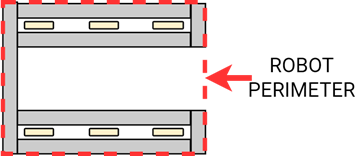
8
ROBOT Construction Rules (R)
The rules listed below explicitly address legal parts and
materials and how those parts and materials may be used on a REBUILT ROBOT. A ROBOT
is an electromechanical assembly built by the FIRST Robotics
Competition team to play the current season’s game and includes all the basic
systems required to be an active participant in the game –power,
communications, control, BUMPERS, and movement about the FIELD. A BUMPER is
a protective assembly designed to attach to the exterior of the ROBOT and
constructed as specified in section 8.4 BUMPER Rules.
There are many reasons for the structure of the rules,
including safety, reliability, parity, creation of a reasonable design
challenge, adherence to professional standards, impact on the competition, and
compatibility with the Kit of Parts (KOP). The KOP is the
collection of items listed on the current season’s Kickoff Kit Checklists,
distributed to the team via FIRST Choice in the current season, or paid
for completely (except shipping) with a Product Donation Voucher (PDV) from the
current season.
Another intent of these rules is to have all energy sources
and active actuation systems on the ROBOT (e.g. batteries, compressors, motors,
servos, cylinders, and their controllers) drawn from a well-defined set of
options. This is to ensure that all teams have access to the same actuation
resources and that the INSPECTORS are able to accurately and
efficiently assess the legality of a given part.
ROBOTS are made up of COMPONENTS and MECHANISMS. A COMPONENT
is any part in its most basic configuration, which cannot be
disassembled without damaging or destroying the part or altering its
fundamental function. A MECHANISM is an assembly of
COMPONENTS that provide specific functionality on the ROBOT. A MECHANISM can be
disassembled (and then reassembled) into individual COMPONENTS without damage
to the parts.
Many rules in this section reference
Commercial-Off-The-Shelf (COTS) items. A COTS item must be a
standard (i.e. not custom order) part commonly available from a VENDOR for all
teams for purchase. To be a COTS item, the COMPONENT or MECHANISM must be
in an unaltered, unmodified state (with the exception of installation or
modification of any software). Items that are no longer commercially available
but are functionally equivalent to the original condition as delivered from the
VENDOR are considered COTS and may be used.
Example 1: A team orders 2 ROBOT grippers from RoboHands
Corp. and receives both items. They put 1 in their storeroom and plan to use it
later. Into the other, they drill “lightening holes” to reduce weight. The
first gripper is still classified as a COTS item, but the second gripper is now
a FABRICATED ITEM, as it has been modified.
Example 2: A team obtains openly available blueprints of a
drive module commonly available from Wheels-R-Us Inc. and has local machine
shop “We-Make-It, Inc.” manufacture a copy of the part for them. The produced
part is not a COTS item, because it is not commonly carried as part of the
standard stock of We-Make-It, Inc.
Example 3: A team obtains openly available design drawings
from a professional publication during the pre-season and uses them to
fabricate a gearbox for their ROBOT during the build period following Kickoff.
The design drawings are considered a COTS item and may be used as “raw
material” to fabricate the gearbox. The finished gearbox itself would be a
FABRICATED ITEM, and not a COTS item.
Example 4: A COTS part that has non-functional label
markings added would still be considered a COTS part, but a COTS part that has
device-specific mounting holes added is a FABRICATED ITEM.
Example 5: A team has a COTS single-board processor version
1.0, which can no longer be purchased. Only the COTS single-board processor
version 2.0 may be purchased. If the COTS single-board processor version 1.0 is
functionally equivalent to its original condition, it may be used.
Example 6: A team has a COTS gearbox which has been
discontinued. If the COTS gearbox is functionally equivalent to its original
condition, it may be used.
A VENDOR is a legitimate business source for
COTS items that satisfies all the following criteria:
A.
has a Federal Tax Identification number. In cases where the VENDOR is
outside of the United States, they must possess an equivalent form of
registration or license with the government of their home nation that
establishes and validates their status as a legitimate business licensed to
operate within that country.
B.
is not a “wholly owned subsidiary” of a FIRST Robotics Competition
team or collection of teams. While there may be some individuals affiliated
with both a team and the VENDOR, the business and activities of the team and
VENDOR must be completely separable.
C.
should maintain sufficient stock or production capability so they are
able to ship any general (i.e., non-FIRST unique) product within 5
business days of receiving a valid purchase request. It is recognized that
certain unusual circumstances (such as such as a global supply chain disruption
and/or 1,000 FIRST teams all ordering the same part at once from the
same VENDOR) may cause atypical delays in shipping due to backorders for even
the largest VENDORS. Such delays due to higher-than-normal order rates are
excused. This criterion may not apply to custom-built items from a source that
is both a VENDOR and a fabricator.
For example, a VENDOR may sell flexible belting that the
team wishes to procure to use as treads on their drive system. The VENDOR cuts
the belting to a custom length from standard shelf stock that is typically
available, welds it into a loop to make a tread, and ships it to a team. The
fabrication of the tread takes the VENDOR 2 weeks. This would be considered a
FABRICATED ITEM, and the 2-week ship time is acceptable. Alternately, the team
may decide to fabricate the treads themselves. To satisfy this criterion, the
VENDOR would just have to ship a length of belting from shelf stock (i.e. a
COTS item) to the team within 5 business days and leave the welding of the cuts
to the team.
D.
makes their products available to all FIRST Robotics Competition
teams. A VENDOR must not limit supply or make a product available to just a
limited number of FIRST Robotics Competition teams.
The intent of this definition is to be as inclusive as
possible to permit access to all legitimate sources, while preventing ad hoc
organizations from providing special-purpose products to a limited subset of
teams in an attempt to circumvent the cost accounting rules.
FIRST desires to
permit teams to have the broadest choice of legitimate sources possible, and to
obtain COTS items from the sources that provide them with the best prices and
level of service available. Teams also need to protect against long delays in
availability of parts that will impact their ability to complete their ROBOT.
The build season is brief, so the VENDOR must be able to get their product,
particularly FIRST unique items, to a team in a timely manner.
Ideally, chosen VENDORS should have national distributors
(e.g. Home Depot, Lowes, MSC, McMaster-Carr, etc.). Remember, FIRST Robotics
Competition events are not always near home – when parts fail, local access to
replacement materials is often critical.
A FABRICATED ITEM is any COMPONENT
or MECHANISM that has been altered, built, cast, constructed, concocted,
created, cut, heat treated, machined, manufactured, modified, painted,
produced, surface coated, or conjured partially or completely into the final
form in which it will be used on the ROBOT.
Note that it is possible for an item (typically raw
materials) to be neither COTS nor a FABRICATED ITEM. For example, a 120.0in (3.048m)
length of aluminum which has been cut into 60.0in (1.52m) pieces by the team
for storage or transport is neither COTS (it’s not in the state received from
the VENDOR), nor a FABRICATED ITEM (the cuts were not made to advance the part
towards its final form on the ROBOT).
Teams may be asked to provide documentation proving the
legality of non-REBUILT KOP items during inspection where a rule specifies
limits for a legal part (e.g. pneumatic items, current limits, COTS
electronics, etc.).
Some of these rules make use of English unit requirements
for parts. If your team has a question about a metric-equivalent part’s
legality, please e-mail your question to the FIRST Robotics Competition
Kit of Parts team at frcparts@firstinspires.org for an official
ruling. To seek approval for alternate devices for inclusion in future FIRST
Robotics Competition seasons, please contact the Kit of Parts team at frcparts@firstinspires.org
with item specifications.
Teams should acknowledge the support provided by the
corporate sponsors and mentors with an appropriate display of their school and
sponsors names and/or logos (or the name of the supporting youth organization,
if appropriate).
FIRST Robotics Competition can be a full-contact
competition and may include rigorous game play. While the rules aim to limit
severe damage to ROBOTS, teams should design their ROBOTS to be robust.
R101
*ROBOT PERIMETER must be fixed. The
ROBOT (excluding BUMPERS) must have a ROBOT PERIMETER, contained
within the BUMPER ZONE and established while in the ROBOT’S STARTING
CONFIGURATION, that is comprised of fixed, non-articulated structural elements
of the ROBOT. Minor protrusions no greater than 0.25in (0.64cm) such as
bolt heads, fastener ends, weld beads, and rivets are not considered part of
the ROBOT PERIMETER.
To determine the ROBOT PERIMETER, wrap a piece of string
around the outer most parts of the ROBOT (excluding BUMPERS) at the BUMPER ZONE
described in R405 and pull it taut.
The string outlines the ROBOT PERIMETER.
Example: A ROBOT’S chassis is shaped like the letter ‘U’,
with a large gap between chassis elements on the front of the ROBOT. When
wrapping a taut string around this chassis, the string extends across the gap
and the resulting ROBOT PERIMETER is a rectangle with 4 sides.
Figure 8‑1 ROBOT PERIMETER example
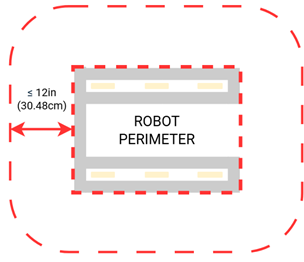
R102 *STARTING CONFIGURATION – no overhang. In
the STARTING CONFIGURATION (the physical
configuration in which a ROBOT starts a MATCH), no part of the ROBOT shall
extend outside the vertical projection of the ROBOT PERIMETER, with the
exception of its BUMPERS and minor protrusions such as bolt heads, fastener
ends, rivets, cable ties, etc.
If a ROBOT is designed as intended and each side is pushed
up against a vertical wall (in STARTING CONFIGURATION and with BUMPERS
removed), only the ROBOT PERIMETER (or minor protrusions) will be in contact
with the wall.
The allowance for minor protrusions in this rule is
intended to allow protrusions that are both minor in extension from the ROBOT PERIMETER
and cross-sectional area.
If a ROBOT uses interchangeable MECHANISMS per I103, Teams should be
prepared to show compliance with this rule and R105 in all
configurations.
R103 *ROBOT weight limit. The ROBOT weight must not
exceed 115.0lb (52.16kg). When determining weight, the basic ROBOT structure
and all elements of all additional MECHANISMS that might be used in a single
configuration of the ROBOT shall be weighed together (see I103).
For the purposes of determining compliance with the weight limitations, the
following items are excluded:
A.
ROBOT BUMPERS,
B. ROBOT
battery and its associated half of the Anderson cable quick connect/disconnect
pair (including wire, the associated cable lugs, connecting bolts, and
insulation), and
C.
tags used for location detection systems if provided by the event.
R104 STARTING CONFIGURATION – max size.
A ROBOT’S STARTING CONFIGURATION may not have a ROBOT PERIMETER
greater than 110.0in (2.794m) and may not be more than 30in (76.2cm) tall.
Be sure to consider the size of the ROBOT on its cart to
make sure it will fit through doors. Also consider the size of the ROBOT to
ensure that it will fit into a shipping crate, vehicle, etc.
Note that rules contained in section 8.4 BUMPER Rules may impose
additional restrictions on ROBOT design.
R105
ROBOT horizontal extension
limit. ROBOTS may not extend more than 12in (30.48cm)
beyond the vertical projection of their ROBOT PERIMETER.
Figure 8‑2 ROBOT PERIMETER extension
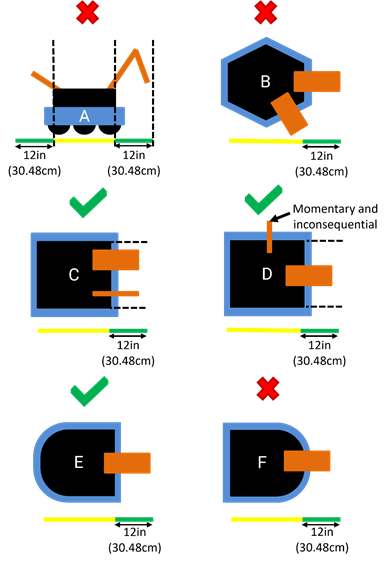
Teams should expect to have to demonstrate a ROBOT’S
ability to constrain itself per above during inspection. Constraints may be
implemented with either hardware or software.
R106 Horizontal extension – one direction at a time.
ROBOTS may not extend beyond their ROBOT PERIMETER in more than one direction
(i.e. over more than 1 side of the ROBOT) at a time. The extension may not
reach outside the projection of that side of the ROBOT PERIMETER.
For the purposes of this rule, a round or circular section of ROBOT PERIMETER is
considered to have an infinite number of sides. Exceptions include:
A.
BUMPERS
B.
Minor protrusions excluded from the ROBOT PERIMETER per R101
Teams are responsible for maintaining compliance with
expansion limits and subject to violations listed in G413 for any violations during the MATCH.
G413
includes an exception for MOMENTARY actions that are not used for strategic
benefit such as a wire or cable tie swinging out of the ROBOT PERIMETER,
including while an extension is deployed out a different side.
Examples of compliance and non-compliance of this rule are
shown in Figure 8‑3.
Yellow bars represent the limits of the ROBOT PERIMETER and
are drawn in the same orientation of the ROBOT’S PERIMETER.
Green bars represent a measured extension from the ROBOT PERIMETER
that does not exceed the limit defined in R105.
-
ROBOT A violates this rule for
extending in more than one direction
-
ROBOT B violates this rule for
extending in more than one direction
-
ROBOT C does not violate this rule
-
ROBOT D does not violate this rule as
the additional extension is MOMENTARY and is not used for strategic benefit
-
ROBOT E does not violate this rule
-
ROBOT F violates this rule for
extending in more than one direction by extending over a round segment of ROBOT
PERIMETER.
Figure 8‑3 Examples of compliance
and non-compliance of this rule
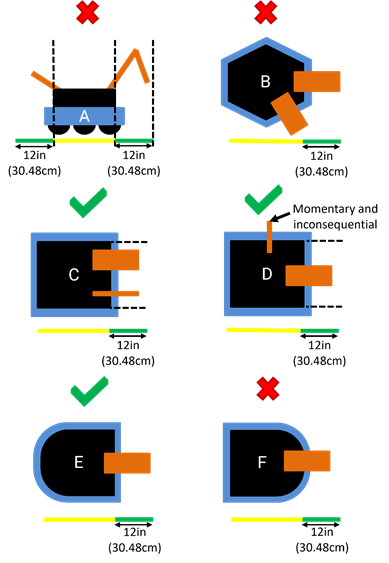
R107 ROBOT vertical extension limit. ROBOTS may
not extend such that their total height exceeds 30.0in (76.2cm).
This measurement is intended to be made as if the ROBOT is
resting on a flat floor (without changing the ROBOT configuration), not
relative to the current height of the ROBOT from the FIELD carpet at any given
time (i.e. the measurement is made perpendicular to the ROBOT PERIMETER
polygon).
R108
ROBOT extension floor
interaction ROBOT extensions may not interact with the
carpet, BUMPS, or TOWER BASE such that the BUMPERS are lifted out of the BUMPER
ZONE (see R405).
R201
*No digging into carpet. Traction
devices must not have surface features that could damage the ARENA (e.g. metal,
sandpaper, inflexible studs, cleats, hook-loop fasteners or similar
attachments). Traction devices include all parts of the ROBOT that are designed
to transmit any propulsive and/or braking forces between the ROBOT and FIELD
carpet.
R202
*No exposed sharp edges.
Protrusions from the ROBOT and exposed surfaces on the ROBOT shall not pose
hazards to the ARENA elements (including SCORING ELEMENTS) or people.
Note that the use of acrylic or other materials which may
break into jagged pieces is not explicitly prohibited, but any such breakage
must be corrected immediately to comply with this rule.
R203 *General safety. ROBOT parts shall not be made
from hazardous materials, be unsafe, cause an unsafe condition, or interfere
with the operation of other ROBOTS.
Examples of items that will violate this rule include (but
are not limited to):
A. shields, curtains, or any other devices or materials
designed or used to obstruct or limit the vision of any DRIVE TEAM members
and/or interfere with their ability to safely control their ROBOT,
B. speakers, sirens, air horns, or other audio devices that
generate sound at a level sufficient to be a distraction,
C. any devices or decorations specifically intended to jam or
interfere with the remote sensing capabilities of another ROBOT, including
vision systems, acoustic range finders, sonars, infrared proximity detectors,
etc. (e.g. including imagery on your ROBOT that utilizes or closely mimics
36h11 AprilTags),
D. lasers other than those listed as IEC/EN 60825-1 ”Class 1”
or IEC/EN 62471 “Exempt,”
E. flammable gasses,
F. any device intended to produce flames or pyrotechnics,
G. hydraulic fluids or hydraulic items,
H. switches or contacts containing liquid mercury,
I.
circuitry used to create voltages in excess of
24 Volts,
J. any ballast not secured sufficiently, including loose
ballast e.g. sand, ball bearings, etc., such that it may become loose during a MATCH,
K. hazardous materials (e.g. lead, whether encapsulated or not)
used on the ROBOT,
L. high intensity light sources used on the ROBOT (e.g. super
bright LED sources marketed as ‘military grade’ or ‘self-defense’) may only be
illuminated for a brief time while targeting and may need to be shrouded to
prevent any exposure to participants. Complaints about the use of such light
sources will be followed by re-inspection and possible disablement of the
device, and
M. Bright lights which flash more than approximately 5 times
per second, per E108.
R204
*Leave SCORING ELEMENTS at the FIELD.
ROBOTS must allow removal of SCORING ELEMENTS from the ROBOT and the ROBOT from
FIELD elements while DISABLED and powered off.
ROBOTS will not be re-enabled after the MATCH, so teams
must be sure that SCORING ELEMENTS and ROBOTS can be quickly, simply, and
safely removed.
Teams are encouraged to consider G501 when developing their
ROBOTS.
R205
*Don’t contaminate the FIELD. Liquids,
gels, greases and fine particles must not contaminate the FIELD or other
ROBOTS.
R206
*Don’t damage SCORING ELEMENTS.
ROBOT elements likely to come in contact with a SCORING ELEMENT shall not pose
a significant hazard to the SCORING ELEMENT.
SCORING ELEMENTS are expected to undergo a reasonable
amount of wear and tear as they are handled by ROBOTS, such as scratching or
marking. Gouging, tearing off pieces, or routinely marking SCORING ELEMENTS are
violations of this rule.
R301
*Individual item cost limit.
No individual, non-KOP item or software shall have a Fair Market Value (FMV)
that exceeds $600 USD. The total cost of COMPONENTS purchased in bulk may
exceed $600 USD as long as the cost of an individual COMPONENT does not exceed
$600 USD.
Teams should be ready to show INSPECTORS documentation of
FMV for any COMPONENTS that appear to be in the range of the $600 USD limit.
The Analog Devices IMU MXP Breakout Board, P/N ADIS16448,
does not have a published FMV. This device is considered to comply with this
rule regardless of its true FMV.
The FMV of a COTS item is its price defined by a VENDOR for
the part or an identical functional replacement. This price must be generally
available to all FIRST Robotics Competition teams throughout the build
and competition season (i.e. short-term sale prices or coupons do not reflect
FMV), however teams are only expected to make a good faith effort at
determining the item price and are not expected to monitor prices of ROBOT
items throughout the season. The FMV is the cost of the item itself and does
not include any duties, taxes, tariffs, shipping, or other costs that may vary
by locality.
The FMV of COTS software is the price, set by the VENDOR,
to license the software (or piece of the software) that runs on the ROBOT for
the period from Kickoff to the end of the FIRST Championship. The FMV of
software licensed free-of-cost, including through the Virtual KOP, for use on
the ROBOT is $0.
The FMV of FABRICATED parts is the value of the material
and/or labor, except for labor provided by team members (including sponsor
employees who are members of the team), members of other teams, and/or event
provided machine shops. Material costs are accounted for as the cost of any
purchasable quantity that can be used to make the individual part (i.e. the
purchasable raw material is larger than the FABRICATED part).
Example 1: A team orders a custom bracket made by a company
to the team's specification. The company’s material cost and normally charged
labor rate apply.
Example 2: A team receives a donated sensor. The company
would normally sell this item for $450 USD, which is therefore its FMV.
Example 3: A team purchases titanium tube stock for $400
USD and has it machined by a local machine shop. The machine shop is not
considered a team sponsor but donates 2 hours of expended labor anyway. The
team must include the estimated normal cost of the labor as if it were paid to
the machine shop and add it to the $400 USD.
Example 4: A team purchases titanium tube stock for $400
USD and has it machined by a local machine shop that is a recognized sponsor of
the team. If the machinists are considered members of the team, their labor
costs do not apply. The total applicable cost for the part would be $400 USD.
It is in the best interests of the teams and FIRST
to form relationships with as many organizations as possible. Recognizing
supporting companies as sponsors of, and members in, the team is encouraged,
even if the involvement of the sponsor is solely through the donation of
fabrication labor.
Example 5: A team purchases titanium tube stock for $400
USD and has it machined by another team. The total applicable cost for the part
would be $400 USD.
Example 6: A team purchases a widget at a garage sale or
online auction for $300, but it’s available for sale from a VENDOR for $700.
The FMV is $700.
If a COTS item is part of a modular system that can be
assembled in several possible configurations, then each individual module must
fit within the price constraints defined in this rule.
If the modules are designed to assemble into a single
configuration, and the assembly is functional in only that configuration, then
the total cost of the complete assembly including all modules must fit within
the price constraints defined in this rule.
In summary, if a VENDOR sells a system or a kit, a team
must use the entire system/kit FMV and not the value of its COMPONENT pieces.
Example 7: VENDOR A sells a gearbox that can be used with a
number of different gear sets, and can mate with 2 different motors they sell.
A team purchases the gearbox, a gear set, and a motor, then assembles them
together. Each part is treated separately for the purpose of determining FMV
since the purchased pieces can each be used in various configurations.
Example 8: VENDOR B sells a robotic arm assembly that a
team wants to use. However, it costs $630 USD, so they cannot use it. The
VENDOR sells the “hand”, “wrist”, and “arm” as separate assemblies, for $210
USD each. A team wishes to purchase the 3 items separately, then reassemble
them. This would not be legal, as they are really buying and using the entire
assembly, which has a Fair Market Value of $630 USD.
Example 9: VENDOR C sells a set of wheels or wheel modules
that are often used in groups of 4. The wheels or modules can be used in other
quantities or configurations. A team purchases 4 and uses them in the most
common configuration. Each part is treated separately for the purpose of
determining FMV, since the purchased pieces can be used in various
configurations.
R302
*MAJOR MECHANISM, from this year
only. MAJOR MECHANISMS, as defined in I101, created before Kickoff are not permitted.
Neither this rule nor the language in this blue box define
specific thresholds for how much of a MAJOR MECHANISM must be constructed after
Kickoff. This rule expects and requires the team’s honest assessment of whether
they built the MAJOR MECHANISMS of their ROBOT after Kickoff.
Attempts to exploit loopholes in the definition of MAJOR
MECHANISM in order to bypass this requirement are in the spirit of neither this
rule nor FIRST Robotics Competition. Examples of exploitation include:
A. Pre-assembling significant portions of a MAJOR MECHANISM
prior to Kickoff and attaching those assemblies together post-Kickoff,
B. Removing a small COMPONENT of a MAJOR MECHANISM prior to
Kickoff such that it is no longer a MAJOR MECHANISM and replacing it after
Kickoff.
R303
*Create new designs and software,
unless they’re public. ROBOT software and designs created before Kickoff
are only permitted if the source files (complete information sufficient to
produce the design) are available publicly prior to Kickoff.
Example 1: A team realizes that the transmission designed
and built in the fall perfectly fits their need for a transmission to drive the
ROBOT arm. They build an exact copy of the transmission from the original
design plans and bolt it to the ROBOT. This would be prohibited, as the
transmission – although made during the competition season – was built from
detailed designs developed prior to Kickoff.
Example 2: A team developed an omni-directional drive
system for the 2019 competition. In July 2019 they refined and improved the
control software, written in C++, to add more precision and capabilities. They
decided to use a similar system for the REBUILT competition. They copied large
sections of unmodified code over into the control software of the new ROBOT,
also written in C++. This would be a violation of the schedule constraint and
is not allowed.
Example 3: The same team decides to use LabVIEW as their
software environment for REBUILT. Following Kickoff, they use the previously
developed C++ code as a reference for the algorithms and calculations required
to implement their omni-directional control solution. Because they developed
new LabVIEW code as they ported over their algorithms, this is permitted.
Example 4: A different team develops a similar solution
during the fall and plans to use the developed software on their competition ROBOT.
After completing the software, they post it in a generally accessible public
forum and make the code available to all teams. Because they have made their
software publicly available before Kickoff, they can use it on their ROBOT.
Example 5: A team develops a transmission prior to Kickoff.
After completing the project, they publish the CAD files on a generally
accessible public forum and make them available to all teams. Because they have
made the design publicly available before Kickoff, they can use the design to
create an identical transmission, fabricated after Kickoff, for use on their REBUILT
ROBOT.
8.4 BUMPER
Rules
A BUMPER is a required assembly which
attaches to the ROBOT frame. BUMPERS protect ROBOTS from damaging/being damaged
by other ROBOTS and FIELD elements.
A BUMPER guide providing additional information on materials
and design based on historical best practices may be found under the Mechanical
Resources section of the Technical Resources page. Teams may also reference the KitBot Instructions for a detailed step-by-step
on how to build bumpers for the KitBot.
All dimensions specified in this section are nominal and
will be measured during inspection with a tolerance of 0.25in (0.63cm) unless
otherwise specified. This means that maximums specified have a tolerance of +0.25in
(0.63cm) and minimums specified have a tolerance of –0.25in (0.63cm). Teams are
encouraged to design to the nominal dimension and reserve the tolerance for
unexpected deviation such as manufacturing error or tolerance stack-up.
R401
*BUMPERS almost all around. ROBOTS
are required to use BUMPERS to protect the entire ROBOT PERIMETER. Gaps of less than 1.25in (3.17cm) between adjacent
segments are permitted as long as all corners are filled per R406.
A single gap larger than 1.25in (3.17cm) is permitted, as long as at least 5.0in
(12.7cm) of ROBOT PERIMETER on each side of each corner is protected by BUMPER.
An arc is considered to have infinite corners and therefore
may not have a gap larger than 1.25in (3.17cm).
Figure 8‑4 BUMPER coverage requirements
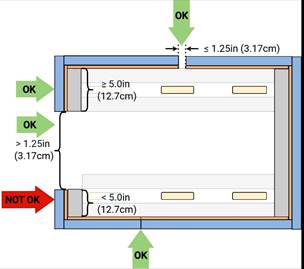

R402 *BUMPER construction. BUMPERS must consist of
the following elements. With the exception of padding and cover extending into
corners and cover wrapping around the end of segments, any vertical cross
section of the BUMPER must include parts A, B, and C:
A. Padding
– A minimum of 2.25in (5.72cm) depth of foam padding, at least 4.5in (11.43cm)
tall consisting of solid blocks, sheets, or stacked rods of one or more of the
following materials:
i.
Solid pool noodles or backer rod
ii.
Solid polyethylene closed cell foam (including crosslinked) with density
between 1.5 and 3.0lb/ft3 (24.03 to 48.05kg/m3)
iii.
Solid EVA closed cell foam with density between 2.0 and 6.0lb/ft3
(32.04 to 96.11kg/m3)
iv.
Foam floor tiles
Multiple types,
shapes, and/or layers of foam may be used within a single BUMPER.
Teams should be prepared to provide information about the
padding material used in their BUMPERS. Teams do not need to have a separate
material sample or expose padding for direct inspection to show compliance with
this rule.
B. Backing
– A backer at least 4.5in (11.43cm) tall which supports the padding (i.e.
padding is not cantilevered other than in corners) and facilitates installation
and removal of the BUMPER from the ROBOT (as noted in R410). Additional elements may be added to
strengthen the backing, fill space between the BUMPER and ROBOT frame, serve as
part of the attachment system, or for any other purpose.
Figure 8‑5 BUMPER backing supporting padding (cross section)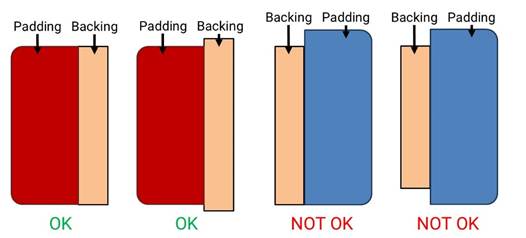
C. Cover
– Cloth (as noted in R411) which covers all outward, upward and downward
facing surfaces of padding such that no padding is exposed to interaction with
the FIELD or other ROBOTs.
D. Fastening
System – BUMPERS must attach to the ROBOT PERIMETER with a rigid fastening
system to form a tight, robust connection to the main structure/frame (e.g. not
attached with hook-and-loop tape, tape, or cable ties). The fastening system
must be designed to withstand vigorous game play. All removable fasteners (e.g.
bolts, locking pins, quick release pins, etc.) may be considered part of either
the BUMPERS or ROBOT for determination of weight per R103 and R408.
The BUMPER Rules provide teams significant freedom in
choosing designs and materials. For information on a reference design, see the
Bumper Guide under the Mechanical Resources section of the Technical Resouces Page.
Figure 8‑6 BUMPER Cross Section Example
-
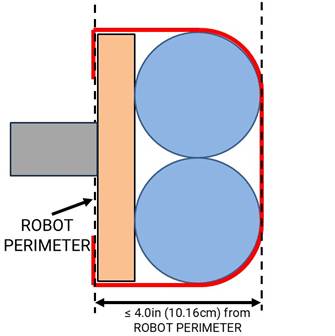
R403
*BUMPER extension limit.
BUMPERS must not extend more than 4.0in (10.16cm) from the ROBOT PERIMETER.
Figure 8‑7 BUMPER Extension Limit
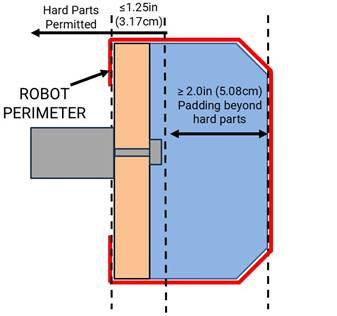
R404
*BUMPERS must be soft. Hard
parts of BUMPERS must not extend more than 1.25in (3.17cm) out from the ROBOT
PERIMETER. Only padding (per R402-A), cover
(per R402-C,
including any coatings or markings), and soft fasteners used to secure padding
or cover are permitted beyond this limit. Padding must extend at least 2.0in (5.08cm)
beyond any hard parts of the BUMPER. There is no limit on how far BUMPER hard
parts may extend inside the ROBOT PERIMETER.
Figure 8‑8 BUMPER Hard Parts Limit
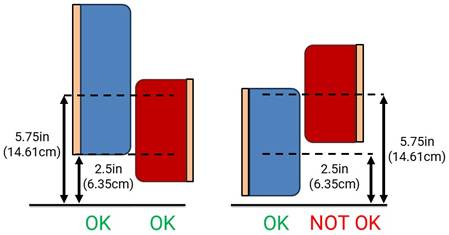
Hard parts include any items which are likely to cause
damage to the cloth or padding of other BUMPERS such as nuts and bolts, cable
ties, hard plastics, etc.
R405 *BUMPERS interact with BUMPERS. While
navigating the FIELD normally, all BUMPERS must have padding (per R402-A) supported
by backing (per R402-B) entirely
filling the BUMPER ZONE, a space between 2.5in (6.35cm)
and 5.75in (14.61cm) from the floor.
Figure 8‑9 BUMPER ZONE examples
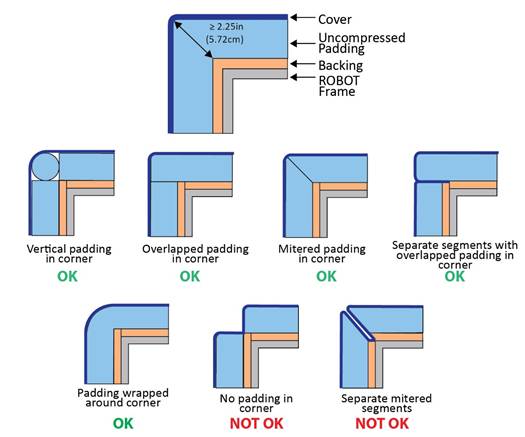
This measurement is intended to be made in a ROBOT’S
expected configuration(s) while navigating the FIELD and is relative to
whatever surface the ROBOT is currently driving on. BUMPERS leaving the BUMPER
ZONE due to ROBOTS inadvertently tipping is not a violation of this rule.
R406
*Fill BUMPER corners. Corner joints between
BUMPERS must be filled with uncompressed padding material extending at least 2.25in
(5.72cm) from the corner with no gaps or voids. Examples of implementation
are shown in Figure 8‑10.
Figure 8‑10 Uncompressed corner padding
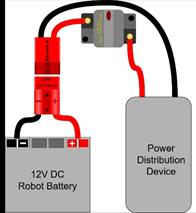
Separate bumper segments meeting at a miter in the corner
are not considered to “fill” the corner due to the cloth covering and do not
meet the requirements of this rule.
R407
*BUMPERS shouldn’t be wedges. BUMPERS
must not act as wedges when interacting with other BUMPERS.
Examples of BUMPERS which might act as a wedge, and may
invite additional scrutiny, include:
A. BUMPERS utilizing softer foam towards the top of a BUMPER
profile,
B. BUMPERS utilizing excessively rounded profiles such as a
single semi-circle, and
C. BUMPERS with tapered or stepped padding such that the
padding is thinner or thicker towards the top or bottom.
R408 *Weight limit with BUMPERS. The total weight of
the ROBOT (as described in R103) with BUMPERS must not exceed 135.0lb (61.23kg)
R409
*BUMPERS should be passive. BUMPERS
must be fixed relative to the ROBOT PERIMETER. BUMPERS may not contain any
elements which move during the MATCH or electrical elements.
Compression and flex of BUMPER covers and/or padding
materials, and incidental, inconsequential compression and flex in backing
and/or fastening systems are not considered violations of this rule.
R410 *BUMPERS must come off. BUMPERS must be
designed for installation and removal to facilitate inspection and weighing.
As a guideline, BUMPERS should be able to be installed or
removed by 2 people in fewer than 5 minutes.
R411
*BUMPERS indicate your ALLIANCE.
Each ROBOT must be able to display red or blue BUMPER covers to reflect their ALLIANCE
color, as assigned in the MATCH schedule distributed at the event (as described
in section 10.1 MATCH Schedules). Contrasting markings on outward,
upward, or downward facing surfaces of the BUMPER cover, other than the
following, are prohibited:
A.
those required per R412,
B.
hook-and-loop tape, snap fasteners, or functional equivalents backed by
the hard parts of the BUMPER,
C.
solid white FIRST logos between 4.75in (12.06cm) and 5.25in (13.33cm)
wide (i.e. comparable to those available in the REBUILT Virtual Kit), and
D.
narrow areas of underlying cloth exposed at seams, corners, or folds.
R412
*Team number on BUMPERS.
Team numbers must be displayed and positioned on the BUMPER cover in at least 3
locations approximately 90 degrees apart such that an observer walking around
the perimeter of the ROBOT can unambiguously tell the team’s number from most points
of view, from as far as approximately 720.0in (18.29m). Team numbers must meet
the following additional criteria:
A.
consist of only white Arabic numerals at least 3.75in (9.53cm) high, at
least 0.5in (1.27cm) in stroke width,
The 0.5in (1.27cm) stroke width requirement applies to the
majority of the stroke. Font elements less than 0.5in (1.27cm) such as serifs,
rounded edges, small hairlines or gaps, etc. are permitted as long as the
majority of the stroke meets the sizing requirement and the numbers are
unambiguous.
B.
must not wrap around sharp corners (less than 135.0°) of the ROBOT PERIMETER,
C.
must not split individual digits such that the team number is ambiguous,
and
As a guideline, spacing between digits or groups of digits
which exceeds ~4.0in (10.16cm) may be ambiguous.
D.
may not substitute logos or icons for numerals.
There is no prohibition against
splitting team numbers onto different sections of BUMPER. The intent is that
the team’s number is clearly visible and unambiguous so that Judges, REFEREES,
Announcers, and other teams can easily identify competing ROBOTS.
This marking is intended to display the
team number only, not to intentionally change the surface characteristics of
the BUMPER. Excessive material usage as part of any team number marking will
invite close scrutiny.
R501
*Allowable motors. The
only motors and actuators permitted include the following (in any quantity):
Table 8‑1 Motor allowances
|
Motor
Name
|
Part
Numbers Available
|
|
AndyMark
9015
|
am-0912
|
AndyMark
9015
|
|
AndyMark NeveRest
|
am-3104
|
|
|
AndyMark
PG
|
am-2161
(alt. PN am-2765)
|
am-2194
(alt. PN am-2766)
|
|
AndyMark RedLine Motor
|
am-3775
|
am-3775a
|
|
AndyMark
Snow Blower Motor
|
am-2235
|
am-2235a
|
|
Banebots
|
am-3830
M7-RS775-18
RS775WC-8514
|
M5 –
RS550-12
RS550VC-7527
RS550
|
|
CIM
|
FR801-001
M4-R0062-12
AM802-001A
217-2000
PM25R-44F-1005
|
PM25R-45F-1004
PM25R-45F-1003
PMR25R-45F-1003
PMR25R-44F-1005
am-0255
|
|
CTR
Electronics Minion
|
24-777378
|
WCP-1691
|
|
CTR
Electronics/VEX Robotics Falcon 500
|
217-6515
am-6515
|
19-708850
am-6515_Short
|
|
Current/former
KOP automotive motors
|
Denso
AE235100-0160
Denso
5-163800-RC1
Denso
262100-3030
|
Denso
262100-3040
Bosch 6
004 RA3 194-06
Johnson
Electric JE-PLG-149
Johnson
Electric JE-PLG-410
|
|
Playing with Fusion Venom
|
BDC-10001
|
|
|
REV Robotics HD Hex
|
REV-41-1291
|
|
|
REV Robotics NEO Brushless
|
REV-21-1650 (v1.0 or v1.1)
REV-21-1653
|
am-4258
am-4258a
|
|
REV Robotics
NEO 550
|
REV-21-1651
|
am-4259
|
|
REV Robotics NEO Vortex
|
REV-21-1652
|
am-5275
|
|
Thrifty Bot Pulsar 775
|
TTB-0350
|
|
|
VEX BAG
|
217-3351
|
|
|
VEX
Mini-CIM
|
217-3371
|
|
|
West
Coast Products Kraken x44
|
WCP-0941
|
|
|
West Coast Products Kraken x60
|
WCP-0940
|
am-5274
|
|
West
Coast Products RS775 Pro
|
217-4347
|
|
|
Fans,
no greater than 120mm (nominal) size and rated electrical input power no
greater than 10 watts (W) continuous duty at 12 volts (VDC)
|
|
Hard
drive motors part of a legal COTS computing device
|
|
Factory
installed vibration and autofocus motors resident in COTS computing devices
(e.g. rumble motor in a smartphone).
|
|
PWM
COTS rotational servos
with stall current ≤ 4A and mechanical output power ≤ 8W at 6V. PWM COTS
linear servos with max stall current ≤ 1A at 6V.
|
|
Motors integral to a COTS sensor (e.g. LIDAR, scanning sonar, etc.), provided the
device is not modified except to facilitate mounting
|
|
1 compressor compliant with R806 and used to compress air for the ROBOT’S pneumatic system
|
|
COTS brushed motors, linear actuators, electrical
solenoid actuators, or electromagnets rated for 12V and wired to an approved
power regulating device downstream of a breaker 20A or less. Electrical
solenoid actuators or electromagnets used at 24V must be rated for 24V.
|
For servos, note that the roboRIO is limited to a max
current output of 2.2A on the 6V rail (12.4W of electrical input power). Teams
should make sure that their total servo power usage remains below this limit at
all times.
Servo mechanical output power is approximated by the
following formula (using 6V data reported by manufacturer): Mechanical Output
Power (in W) = 0.25 x (Stall Torque in N-m) x (No Load Speed in rad/s). This calculator from the FIRST Tech Challenge
documentation can be used to help calculate output power from inputs
of various units.
Given the extensive amount of motors allowed on the ROBOT,
teams are encouraged to consider the total power available from the ROBOT
battery during the design and build of the ROBOT. Drawing large amounts of
current from many motors at the same time could lead to drops in ROBOT battery
voltage that may result in tripping the main breaker or trigger the brownout
protection of the roboRIO. For more information about the roboRIO brownout
protection and measuring current draw using the PDP/PDH, see roboRIO Brownout and Understanding Current Draw.
AndyMark PG Gearmotors are sold with labeling based on the
entire assembly. Assemblies labeled am-3651 through am-3656 contain legal
motors specified in Table 8‑1. These motors
may be used with or without the provided gearbox.
R502
*Only 4 propulsion motors. A
ROBOT may not have more than 4 propulsion motors. A propulsion motor is a motor
that enables the ROBOT to move around the FIELD surface (i.e., carpet). Motors
that generate small amounts of thrust as a secondary or incidental feature are
not considered propulsion motors.
Examples that are not considered propulsion motors include:
A. motors that primarily alter the alignment of a wheel in
contact with the FIELD surface (such as a swerve steering motor),
B. motors that run MECHANISM wheels (e.g. for SCORING ELEMENT manipulation)
that occasionally happen to contact the carpet, but without enough force to
generate significant thrust,
C. motors that change the speed of the drive wheels using a
shifting MECHANISM without significantly contributing to propulsion, and
D. motors that enable the ROBOT to move via contact with non-carpeted
surfaces of FIELD elements.
R503
*Don’t modify motors (mostly).
The integral mechanical and electrical system of any motor must not be
modified. Motors, servos, and electric solenoids used on the ROBOT shall not be
modified in any way, except as follows:
A.
The mounting brackets and/or output shaft/interface may be modified to
facilitate the physical connection of the motor to the ROBOT and actuated part.
B.
The electrical leads may be trimmed to length as necessary and
connectors or splices to additional wiring may be added.
C.
The locking pins on the window motors (P/N 262100-3030 and 262100-3040)
may be removed.
D.
The connector housings on KOP automotive motors listed in Table 8‑1 may be
modified to facilitate lead connections.
E.
Servos may be modified as specified by the manufacturer (e.g.
re-programming or modification for continuous rotation).
F.
Minimal labeling may be applied to indicate device purpose,
connectivity, functional performance, etc.
G.
Any number of #10-32 plug screws may be removed from the Falcon 500 and
the Kraken X60.
H.
Insulation may be applied to electrical terminals.
I.
Repairs, provided the original performance and specifications are
unchanged.
J.
Maintenance recommended by the manufacturer.
The intent of this rule is to allow teams to modify
mounting tabs and the like, not to gain a weight reduction by potentially
compromising the structural integrity of any motor.
R504 *Power (most) actuators off of approved devices.
With the exception of servos, fans, or motors integral to sensors of COTS
computing devices permitted in R501, each actuator must be controlled by a power
regulating device. The only power regulating devices for actuators permitted on
the ROBOT include:
A. motor
controllers:
a. Koors40
Motor Controller (P/N am-5600),
b. Spark
Flex Motor Controller (P/N REV-11-2159, am-5276)
c. Spark
Motor Controller (P/N REV-11-1200, am-4260),
d. Spark
MAX Motor Controller (P/N REV-11-2158, am-4261),
e. Talon
FX Motor Controller (P/N 217-6515, 19-708850, am-6515, am-6515_Short, WCP-0940,
WCP-0941) for controlling integral Falcon 500, Kraken X60, Kraken X44 only,
f.
Talon FXS Motor Controller (P/N 24-708883, WCP-1692)
g. Talon
Motor Controller (P/N CTRE_Talon, CTRE_Talon_SR, and am-2195),
h. Talon
SRX Motor Controller (P/N 217-8080, am-2854, 14-838288),
i.
Thrifty Nova (P/N TTB-0100),
j.
Venom Motor with Controller (P/N BDC-10001) for controlling integral
motor only,
k. Victor
SP Motor Controller (P/N 217-9090, am-2855, 14-868380), and
l.
Victor SPX Motor Controller (P/N 217-9191, 17-868388, am-3748).
B.
relay modules:
a. Spike
H-Bridge Relay (P/N 217-0220 and SPIKE-RELAY-H),
b. Automation
Direct Relay (P/N AD-SSR6M12-DC-200D, AD-SSRM6M25-DC-200D, AD-SSR6M40-DC-200D),
and
c. Power
Distribution Hub (PDH) switched channel (P/N REV-11-1850) for controlling
non-actuator CUSTOM CIRCUITS only.
C. pneumatics
controllers:
a. Pneumatics
Control Module (P/N am-2858, 217-4243) and
b. Pneumatic
Hub (P/N REV-11-1852).
D. servo
controllers:
a. Servo Hub (P/N REV-11-1855)
Note: The Automation Direct Relays are single directional.
Per R504 they may not be
wired together in an attempt to provide bi-directional control.
R505 *Don’t overload controllers. Each power
regulating device may control electrical loads per Table 8‑2. Unless otherwise noted, each power
regulating device shall control 1 and only 1 electrical load.
Table 8‑2 Power regulating device allotments
|
Electrical Load
|
Motor Controller
|
Relay Module
|
Pneumatics Controller
|
|
AndyMark
RedLine Motor
Banebots
CIM
CTR
Electronics Minion
REV
Robotics NEO Brushless
REV
Robotics NEO 550
REV
Robotics NEO Vortex
ThriftyBot
Pulsar 775
VEX
Mini-CIM
WCP
RS775 Pro
|
Yes
|
No
|
No
|
|
AndyMark
9015
VEXpro
BAG
|
Yes
(up to 2 per controller)
|
No
|
No
|
|
AndyMark
PG
KOP
Automotive Motors
NeveRest
Snow
Blower Motor
REV
Robotics HD Hex
|
Yes
(up to 2 per controller)
|
Yes
|
No
|
|
Other Brushed Motor
Linear
Actuator
|
Yes (20A breaker max)
|
Yes (20A breaker max)
|
No
|
|
CTR
Electronics/VEX Falcon 500
Playing
With Fusion Venom
WCP
Kraken X44
WCP
Kraken X60
|
Yes
(integrated controller only)
|
No
|
No
|
|
Compressor
|
No
|
Yes
|
Yes
|
|
Pneumatic
Solenoid Valves
|
No
|
Yes
(multiple)
|
Yes
(1 per channel)
|
|
Electric
Solenoids
|
Yes
(multiple)
|
Yes
(multiple)
|
Yes
(1 per channel)
|
|
CUSTOM
CIRCUITS
|
Yes
(multiple)
|
Yes
(multiple)
|
Yes
(multiple)
|
R506
*Control servos safely. Servos
must be connected to, and only to, 1 of the following:
A.
PWM ports on the roboRIO,
B.
PWM ports on a WCP Spartan Sensor Board (P/N WCP-0045),
C.
REV Robotics Servo Power Module (P/N REV-11-1144), or
D.
REV Robotics Servo Hub (P/N REV-11-1855).
In order to maintain safety, the rules in this section apply
at all times while at the event, not just while the ROBOT is on the FIELD for MATCHES.
R601 *Battery limit – everyone has the same power.
The only legal source of electrical energy for the ROBOT during the
competition, the ROBOT battery, must be 1 and only 1 non-spillable sealed lead
acid (SLA) battery with the following specifications:
A.
Nominal voltage: 12V
B.
Nominal capacity at 20-hour discharge rate: minimum 17Ah, maximum 18.2Ah
C.
Shape: Rectangular
D.
Nominal Dimensions: 7.1in x 3.0in x 6.6in, +/- 0.1in for each dimension (18.03cm
x 7.62cm x 16.76cm, +/-0.25cm for each dimension)
E.
Nominal weight: 11.0lb to 14.5lb (4.99kg to 6.57kg)
F.
Terminals: Nut and bolt style
G.
Battery vents must not be obstructed during charging.
"Nut and bolt style" refers to any style battery
terminal where the connector is secured to the battery using a threaded
fastener.
Examples of batteries which meet these criteria include:
A. Enersys (P/N NP18-12, NP18-12B, NP18-12BFR),
B. MK Battery (P/N ES17-12),
C. Battery Mart (P/N SLA-12V18),
D. Sigma (P/N SP12-18),
E. Universal Battery (P/N UB12180),
F. Power Patrol (P/N SLA1116),
G. Werker Battery (P/N WKA12-18NB),
H. Power Sonic (P/N PS-12180NB),
I.
Yuasa (P/N NP18-12B),
J. Panasonic (P/N LC-RD-1217),
K. Interstate Batteries (P/N BSL1116), and
L.
Duracell Ultra Battery (P/N
DURA12-18NB).
Teams should be aware that they may be asked to provide
documentation of the specifications of any battery not listed above.
Batteries should be charged in accordance with
manufacturer’s specification. (Please see the FIRST Safety Manual for additional
information.)
While teams should generally attempt to leave the battery
vent (the inset rectangle on the top face of the battery) as unobstructed as
possible during charging, as long as the short edges of the rectangle are not
sealed or directly covered the vent will be considered not obstructed.
R602 *Other batteries for cameras or computers only. COTS
USB battery packs with a capacity of 100Wh or less (27000mAh at 3.7V) with 5V/5A
max output or 12V/5A max output using USB-PD per port, batteries integral to
and part of a COTS computing device or self-contained camera (e.g. laptop
batteries, GoPro style camera, etc.), or batteries used to power CMOS/RTC
features may be used to power COTS computing devices and any peripheral COTS
input or output devices connected to the COTS computing device provided they
are:
A.
securely fastened to the ROBOT,
B.
connected only using unmodified COTS cables, and
C.
charged according to manufacturer recommendations.
A COTS computing device is a non-roboRIO device used to
process or collect sensor information (e.g. a “smart flashlight” is not a COTS
computing device).
R603
*Charge batteries with safe
connectors. Any battery charger used to charge a ROBOT battery must have
the corresponding Anderson SB connector installed.
R604
*Charge batteries at a safe rate.
Any battery charger used to charge a ROBOT battery may not be used such that it
exceeds 6-Amp average charge current.
R605
*Batteries are not ballast. No
batteries other than those allowed per R601 and R602 are allowed on the ROBOT, whether or not they
are being used to supply power.
For example, teams may not use additional batteries as
extra weight on their ROBOTS.
R606
*Secure the battery. The ROBOT
battery must be secured such that it will not dislodge during vigorous ROBOT
interaction including if the ROBOT is turned over or placed in any arbitrary
orientation.
R607
*Insulate battery connections.
Each electrical terminal on the ROBOT battery, main breaker, and their
connections (lugs, stripped wire ends, etc.) to the wire must be fully
insulated at all times.
R608
*Limit non-battery energy.
Non-electrical sources of energy used by the ROBOT (i.e., stored at the start
of a MATCH) shall come only from the following sources:
A.
compressed air stored in the pneumatic system that has been charged in
compliance with R806 and R807,
B.
a change in the altitude of the ROBOT center of gravity,
C.
storage achieved by deformation of ROBOT parts,
D.
closed-loop COTS pneumatic (gas) shocks, or
E.
air-filled (pneumatic) wheels.
R609 *Connect main power safely. The following
devices shall be connected with 6 AWG (7 SWG or 16 mm2) copper wire or larger
as shown in Figure 8‑11:
A.
1 ROBOT battery
B.
a single pair of Anderson Power Products (or APP) 2-pole SB type
connectors
C.
a single main 120-Amp (120A) surface mount circuit breaker (Cooper
Bussman P/N CB185-120, CB185F-120, CB285-120 CB285F-120, CB285120F or Optifuse
P/N 153120, 253120)
D.
a single main power distribution device (PD):
a. CTR
Electronics Power Distribution Panel (PDP) P/N am-2856,
217-4244, 14-806880,
b. CTR
Electronics Power Distribution Panel 2.0 (PDP 2.0) P/N 24-806880, WCP-1690
c. REV Robotics
Power Distribution Hub (PDH) P/N REV-11-1850
d. AndyMark
Power Distribution (AMPD) P/N am-5754
No additional devices or modifications shall
be permitted with the following exceptions:
E.
Monitoring circuitry permitted by R625
F.
SB-50 to SB-120 adapters, provided they have been presented for
Inspection
G.
Termination of wires with appropriate cable lugs
Figure 8‑11 Electrical connection diagram

“SB type” refers to SB type only (e.g. SB-50, SB-120,
etc.), not SBS or any other part type beginning with SB. All batteries supplied
by FIRST (such as Spare Parts and international batteries) will have a
red or pink SB50 connector installed which may not be removed.
The pink connectors included in the KOP mate with the red
SB50 connector.
While pure copper wire is recommended, copper-clad aluminum
wire is considered copper wire
R610
*1 breaker/fuse per circuit.
All circuits, with the exceptions of those listed in R615 and R617, must connect to, and have power sourced
solely by, a single protected connector pair of the PD. Circuits must not
connect to the main power input of the PD.
R611
*The ROBOT frame is not a wire.
All wiring and electrical devices shall be electrically isolated from the ROBOT
frame. The ROBOT frame must not be used to carry electrical current.
Compliance with this rule is checked by observing a
>120Ω resistance between either the (+) or (-) post within the APP connector
that is attached to the PD and any point on the ROBOT.
All legal motor controllers with metal cases are
electrically isolated. They may be mounted directly to ROBOT frame COMPONENTS.
Note that some cameras, decorative lights, and sensors
(e.g. some encoders, some IR sensors, etc.) have grounded enclosures or are
manufactured with conductive plastics. These devices must be electrically
isolated from the ROBOT frame to ensure compliance with this rule.
R612
*Must be able to turn ROBOT on and
off safely. The 120A circuit breaker must be quickly and safely
accessible from the exterior of the ROBOT. This is the only 120A circuit
breaker allowed on the ROBOT.
Examples considered not “quickly and safely accessible”
include breakers covered by an access panel or door, or mounted on, underneath
or immediately adjacent to moving COMPONENTS.
It is strongly recommended that the 120A circuit breaker
location be clearly and obviously labeled so it can be easily found by FIELD
STAFF if needed.
While the main breaker must be accessible, consider positioning
or shielding it such that it’s protected from accidental actuation (e.g. it’s
unlikely to be hit by a SCORING ELEMENT during game play).
R613
*Electrical system must be
inspectable. The PD, associated wiring, and all circuit breakers must be
visible for inspection.
“Visible for inspection” does not require that the items be
visible when the ROBOT is in STARTING CONFIGURATION, provided the team can make
the items viewable during the inspection process.
R614
*No high voltage allowed. Any active electrical item that is not an actuator
(specified in R501) or core control system item (specified in R710) is considered a CUSTOM CIRCUIT. CUSTOM
CIRCUITS shall not produce measurable voltages exceeding 24V with the exception
of COTS Power-over-Ethernet (PoE) injector devices used with COTS Ethernet
cables and COTS receiving devices (i.e. not a breakout or adapter).
R615 *Power roboRIO as specified. The roboRIO power
input must be connected directly to a non-switched pair of protected output
terminals of a PD with a 10A fuse or circuit breaker installed. No other
electrical load can be connected to the breaker or fuse supplying this circuit.
R616 *Power radio as specified – Part 1. The
wireless bridge (radio) power must be connected based on the radio type:
A. For
VH-109 radios, radio power must be sourced from one or both of:
a.
Injected into the “RIO” port of the radio using a passive injector or
modified Ethernet cable connected directly to a PD, and/or
b. Wired
directly to the 12V power input of the radio from a PD.
B. For
OM5P radios (China events only), radio power must be sourced from only one of:
a. the
12V/2A output of a CTR Electronics Voltage Regulator Module
(VRM) (P/N am-2857, 217-4245), as shown in Figure 8‑12, and must be the only load connected to
any of the 12V/2A terminals or
Figure 8‑12
Radio power source from a VRM
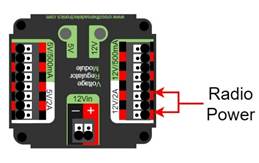
b.
using an Ethernet cable between a REV Radio Power Module
(RPM) (P/N REV-11-1856) and the “18-24v PoE” port.
Note that this prohibits using any other active PoE
injector device to power the radio but does not prohibit using any PASSIVE
CONDUCTORS to inject the VRM power into an Ethernet cable plugged into the OM5P
radio port labeled “18-24v PoE.”
Please reference How to Wire an FRC Robot for wireless bridge wiring information.
R617
*Power radio as specified – Part 2. The
device supplying power to the wireless bridge per R616 must be connected
directly to a non-switched pair of protected output terminals of a PD with a
10A fuse or circuit breaker installed with the exception of the PDP 1.0 shared
VRM/PCM pairs which may be protected with a 20A fuse or circuit breaker. No
other electrical load can be connected to the breaker or fuse supplying this
circuit with the exception of a single PCM if using the shared VRM/PCM ports of
a PDP 1.0.
R618
*Use PD terminals as designed.
Only 1 wire shall be connected to each terminal on the PD.
If multi-point distribution of circuit power is needed
(e.g. to provide power to multiple PCMs and/or VRMs from a single 20A circuit),
then all incoming wires may be appropriately spliced into the main lead (e.g.
using an insulated terminal block, crimped splice or soldered wire splice), and
the single main lead inserted into the terminal to power the circuit.
R619
*Only use specified circuit breakers
in a PD. The only circuit breakers permitted for use in the PD are:
A.
Snap Action VB3-A Series or AT2-A, terminal style F57, 40A rating or
lower,
B.
Snap Action MX5-A or MX5-L Series, 40A rating or lower,
C.
REV Robotics ATO auto-resetting breakers 40A rating or lower,
D.
CTR Electronics ATO auto-resetting breakers 40A rating or lower, and
E.
Any ATM circuit breaker with value less than or equal to the fuses
permitted per R620.
R620 *Only use specified fuses in PD. The only fuses
permitted for use in the PD are automotive blade fuses with the following
values:
A.
for the PDP, ATM style fuses with values matching the value printed on
the device’s corresponding fuse holder,
B.
for all PDs ATC/ATO style fuses with values 10A or lower, and
C.
for the PDH, ATM style fuses with values 15A or lower with the exception
of a single 20A fuse for powering a PCM or PH.
Note that these fuses must be pressed very firmly to seat
properly. Improper seating can cause a device to reboot upon impact.
R621 *Protect circuits with appropriate circuit breakers.
Each branch circuit must be protected by 1 and only 1 circuit breaker or fuse
on the PD per Table 8‑3. No other electrical load can be
connected to the breaker or fuse supplying this circuit with the exception of
devices downstream of a permitted motor power adapter board placed between the
PD and a motor controller (WCP-1380, WCP-1903, WCP-1904, RF-4003, RF-4004, RF-4005).
Table 8‑3 Branch circuit protection
requirements
|
Branch Circuit
|
Circuit Breaker/ Fuse Value
|
Quantity Allowed Per Breaker
|
|
Motor Controller
|
Up to 40A
|
1
|
|
CUSTOM CIRCUIT
|
Up to 40A
|
No limit
|
|
Automation Direct Relay 40A
(*6M40*)
|
Up to 40A
|
1
|
|
Fans permitted per R501 and not
already part of COTS computing devices.
|
Up to 20A
|
No limit
|
|
Spike Relay Module
|
Up to 20A
|
1
|
|
Automation Direct Relay 25A
(*6M25*)
|
Up to 20A
|
1
|
|
PCM/PH – with compressor
|
Up to 20A
|
1
|
|
Servo Power Module/Servo
Hub
|
Up to 20A
|
1
|
|
Additional VRM
(non-radio)/Additional PCM/PH (non-compressor)
|
Up to 20A
|
3 total
|
|
Automation Direct Relay 12A
(*6M12*)
|
Up to 10A
|
1
|
This rule does not prohibit the use of smaller value
breakers in the PD or any fuses or breakers within CUSTOM CIRCUITS for
additional protection.
Fans permitted per R501 may also be included
within CUSTOM CIRCUITS.
R622 *Use appropriately sized wire. All circuits
shall be wired with appropriately sized insulated copper wire (SIGNAL LEVEL
cables don’t have to be copper):
Table 8‑4 Breaker and wire sizing
Wires that are recommended by the device
manufacturer or originally attached to legal devices are considered part of the
device and by default legal. Such wires are exempt from this rule, provided
they are powered by the smallest value fuse or breaker which permits proper
device operation.
In order to show compliance with these rules, teams should
use wire with clearly labeled sizes if possible. If unlabeled wiring is used,
teams should be prepared to demonstrate that the wire used meets the
requirements of this rule (e.g. wire samples and evidence that they are the
required size).
While pure copper wire is recommended, copper-clad aluminum
wire is considered copper wire.
R623
*Use only appropriate connectors.
Branch circuits may include intermediate elements such as COTS connectors,
splices, COTS flexible/rolling/sliding contacts, and COTS slip rings, as long
as the entire electrical pathway is via appropriately gauged/rated elements.
Slip rings containing mercury are prohibited per R203.
R624
*Use specified wire colors (mostly).
All non-SIGNAL LEVEL wiring with a constant polarity (i.e., except for outputs
of relay modules, motor controllers, or sensors) shall be color-coded along
their entire length from the manufacturer as follows:
A.
red, yellow, white, brown, or black-with-stripe on the positive (e.g.
+24VDC, +12VDC, +5VDC, etc.) connections,
B.
black or blue for the common or negative side (-) of the connections
Exceptions to this rule include:
C.
wires that are originally attached to legal devices and any extensions
to these wires using the same color as the manufacturer,
D.
Ethernet cable used in PoE cables.
R625 *Don’t modify critical power paths. CUSTOM
CIRCUITS shall not directly alter the power pathways between the ROBOT battery,
PD, motor controllers, relays (per R504-B), motors
and actuators (per R501), pneumatic solenoid valves, or other
elements of the ROBOT control system (items explicitly mentioned in R710). Custom high impedance voltage monitoring or
low impedance current monitoring circuitry connected to the ROBOT’S electrical
system is acceptable, if the effect on the ROBOT outputs is inconsequential.
A noise filter may be wired across motor leads or PWM
leads. Such filters will not be considered CUSTOM CIRCUITS and violate neither
this rule nor R712.
Acceptable signal filters must be fully insulated and must
be 1 of the following:
-
1 microfarad (1 µF) or less,
non-polarized, capacitor may be applied across the power leads of any motor on
your ROBOT (as close to the actual motor leads as reasonably possible) or
-
a resistor may be used as a shunt load
for the PWM control signal feeding a servo.
R626
*VH-109 PoE passthrough. The
VH-109 PoE output may be used only under the following conditions:
A.
The device being powered is a COTS device or COTS adapter connected to a
single COTS device with current draw ≤ 2A at 12V.
B.
The connection is made using standard Cat5e/6/7/8 cable.
C.
The VH-109 is powered using the 12V input terminals with 18AWG wire or
larger (it may additionally be powered using the PoE input if desired).
R701 *Control the ROBOT with a roboRIO. ROBOTS must
be controlled via 1 programmable NI roboRIO or roboRIO 2.0 (P/N am3000 or
am3000a, both versions referred to throughout this manual as “roboRIO”), with
image version 2026_v1.2 or later.
There are no rules that prohibit co-processors, provided
commands originate from the roboRIO to enable and disable all power regulating
devices. This includes motor controllers legally wired to the CAN bus.
R702 *Communicate with the ROBOT with the specified radio. 1
Vivid Hosting wireless bridge (P/N: VH-109, WCP-1538), that has been configured
with the appropriate encryption key for your team number at each event, is the
only permitted device for communicating to and from the ROBOT during the MATCH.
Events held in China are the exceptions to this rule and must use an OpenMesh
(P/N: OM5P-AN or OM5P-AC) radio.
R703
*Use specific Ethernet port for
roboRIO. The roboRIO Ethernet port must be connected as specified:
A.
For VH-109 v1.5 radios: to the port labeled “RIO” either directly, via a
Cat5 Ethernet pigtail, or via a passive PoE injector cable or adapter.
B.
For VH-109 v1.0 radios (either directly or via Cat5 Ethernet pigtail):
a. to the
radio port labeled “RIO” via a passive PoE injector cable or adapter (whether
or not it is used to power the radio), or an Ethernet cable with the
appropriate wires removed on the roboRIO end. All wires or adapters used must
be fully insulated, or
b. to the
radio port labeled “AUX 1” or “AUX 2” with the corresponding DIP switch in the
off (default) position.
C.
For OM5P radios (China events only): to the wireless bridge port labeled
“18-24v PoE” (either directly, via a network switch, via an RPM, or via a Cat5
Ethernet pigtail).
Note: Placing a switch between the roboRIO and radio may
impede the ability for FIELD STAFF to troubleshoot roboRIO connection issues on
the FIELD. Teams may be asked to connect directly between the radio and the
roboRIO as part of troubleshooting efforts.
If not using the “RIO” port of the VH-109 1.0, it is
strongly recommended to cover the port to prevent accidental damage to devices
such as laptops which may occur if attached to this port.
R704
*Only use allowed ports and bandwidth
to communicate with the ROBOT. Communication between the ROBOT and the
OPERATOR CONSOLE may not exceed the following and is restricted to network
ports listed in Table 8‑5:
A.
7.0Mbits/second for Vivid Hosting wireless bridge radios
B.
4.0Mbits/second for OpenMesh radios
Table 8‑5 Open FMS ports
|
Port
|
Designation
|
Bi-directional?
|
|
UDP/TCP 1180-1190
|
Camera data from the roboRIO to
dashboard software when the camera is connected the roboRIO via USB
|
Yes
|
|
TCP 1735
|
SmartDashboard
|
Yes
|
|
UDP 1130
|
Dashboard-to-ROBOT control data
|
Yes
|
|
UDP 1140
|
ROBOT-to-Dashboard status data
|
Yes
|
|
HTTP 80
|
Camera connected via switch on
the ROBOT
|
Yes
|
|
HTTP 443
|
Camera connected via switch on
the ROBOT
|
Yes
|
|
UDP/TCP 554
|
Real-Time Streaming Protocol for
h.264 camera streaming
|
Yes
|
|
UDP/TCP 1250
|
CTRE Diagnostics Server
|
Yes
|
|
UDP/TCP 5800-5810
|
Team use
|
Yes
|
Teams may use these ports as they wish if
they do not employ them as outlined above (i.e. TCP 1180 can be used to pass
data back and forth between the ROBOT and the Driver Station Software if the
team chooses not to use the camera on USB).
Note that the 4.0Mbit limit will be strictly enforced by
the wireless bridge.
The FMS Whitepaper has more details on how to check
and optimize bandwidth usage.
While FIRST makes every effort to provide a wireless
environment that allows teams access to a full 4.0Mbits/second data rate (with
about 100.0Kbit used for ROBOT control and status), at some events wireless
conditions may not accommodate this.
R705
*Configure devices for your team
number. The roboRIO, Driver Station Software, and wireless bridge must
be configured to correspond to the correct team number, per the procedures
defined in the FIRST Robotics Competition Control System
documentation.
R706 *Don’t bypass the ARENA network. All signals
must originate from the OPERATOR CONSOLE and be transmitted to the ROBOT via
the ARENA Ethernet network.
R707
*Limited wireless allowed. The
only forms of wireless communication that may be used to communicate to, from,
or within the ROBOT, include:
A. those
required per R702 and R706,
B. tags
used for location detection systems if provided by the event, and
C. RFID
or NFC systems used exclusively within the ROBOT.
Devices that employ signals in the visual spectrum (e.g.
cameras) and non-RF sensors that don’t receive human-originated commands (e.g.
“beam break” sensors or IR sensors on the ROBOT used to detect FIELD elements)
are not wireless communication devices and thus this rule doesn’t apply.
R708
*Wireless bridge must be visible. The
wireless bridge must be mounted on the ROBOT such that the diagnostic lights
are visible to FIELD STAFF.
Teams are encouraged to mount the wireless bridge away from
noise generating devices such as motors, PCM(s)/PH(s), and VRM(s)/RPM(s).
R709
*ROBOTS must have a signal light. ROBOTS
must use at least 1, but no more than 2, diagnostic ROBOT Signal
Light (RSL) (P/N 855PB-B12ME522 and/or am-3583).
Any RSL must be:
A. mounted
on the ROBOT such that it is easily visible while standing 36.0in (91.44cm)
away from at least one side of the ROBOT,
B. connected
to the “RSL” supply terminals on the roboRIO, and
C. if
using the 855PB-B12ME522, wired for solid light operation, by placing a jumper
between the “La” and “Lb” terminals on the light per Figure 8‑13.
Figure 8‑13 855PB-B12ME522 jumper wiring
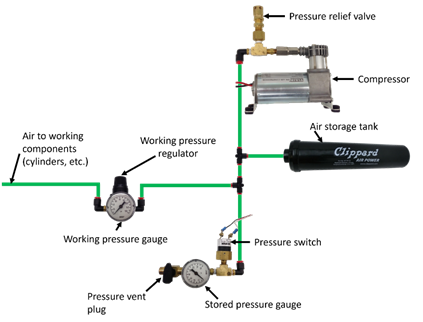
R710 *Only specified modifications to control system
devices permitted. The Driver Station Software, roboRIO, PD,
PCM(s)/PH(s), VRM(s)/RPM(s), RSL, 120A breaker, motor controllers, MXP devices
used to control actuators per R713-C, relay modules (per R504-B), wireless bridge, PD breakers and fuses, Servo
Power Module, Servo Hub, motor power adapter boards, and batteries shall not be
tampered with, modified, or adjusted in any way (tampering includes drilling,
cutting, machining, rewiring, disassembling, painting, etc.), with the
following exceptions:
Please note that the Driver Station Software is a separate
application from the Dashboard. The Driver Station Software may not be
modified, while teams are expected to customize their Dashboard code.
A.
User programmable code in the roboRIO may be customized.
B.
Motor controllers may be calibrated as described in owner's manuals.
C.
Fans may be attached to motor controllers and may be powered from the
power input terminals.
D.
If powering the compressor, the fuse on a Spike H-Bridge Relay may be
replaced with a VB3A-20A Snap-Action circuit breaker.
E.
Wires, cables, and signal lines may be connected via the standard
connection points provided on the devices.
F.
Fasteners (including adhesives) may be used to attach the device to the
OPERATOR CONSOLE or ROBOT or to secure cables to the device.
G.
Thermal interface material may be used to improve heat conduction.
H.
Labeling may be applied to indicate device purpose, connectivity,
functional performance, etc.
I.
Jumpers may be changed from their default location.
J.
Limit switch jumpers may be removed from a Jaguar motor controller and a
custom limit switch circuit may be substituted.
K.
Device firmware may be updated with manufacturer supplied firmware.
L.
Integral wires on motor controllers may be cut, stripped, and/or
connectorized.
M.
Devices may be repaired, provided the performance and specifications of
the device after the repair are identical to those before the repair.
N.
The cover may be removed from the Talon SRX or Talon FX data port.
O.
Electrical tape may be applied to the aluminum plate inside the wireless
bridge.
P.
The input terminal cover from the PDP may be omitted (no other element
may be installed using the threaded holes to install something in place of the
PDP terminal cover).
Q.
The roboRIO 2.0 SD card may be replaced with an SD card of any capacity.
R.
adding insulating material to exposed conductors.
S.
replacing control system power terminal blocks (e.g. RSL power
connector) with functional equivalents.
T.
tape may be applied for debris protection.
U.
VH-109 v1.0 may be upgraded to VH-109 v1.5 using manufacturer materials
and instructions.
Please note that while repairs are permitted, the allowance
is independent of any manufacturer’s warranty. Teams make repairs at their own
risk and should assume that any warranty or return options are forfeited. Be
aware that diagnosing and repairing COMPONENTS such as these can be difficult.
For more information about modification O, please see this OM5P-AC Radio Modification article.
R711
*Don’t connect motor outputs to
roboRIO. Neither 12VDC power nor relay module or motor controller
outputs shall be directly connected to the roboRIO, with the exception of the
designated 12VDC input.
R712 *Control PWM controllers from the roboRIO.
Every relay module (per R504-B), servo,
Servo Power Module, and PWM motor controller shall be connected to a
corresponding port (relays to Relay ports, servos, and PWM controllers to PWM
ports) on the roboRIO (either directly or through a WCP Spartan Sensor Board)
or via a legal MXP connection (per R713). They shall not be controlled by signals from
any other source.
R713 *Only approved MXP devices can control actuators.
If a motor is controlled via the MXP, its power regulating device must be
connected by 1 of the following methods:
A.
directly to any PWM pins,
B. via
a network of PASSIVE CONDUCTORS used to extend the PWM pins, or
C. via
1 approved ACTIVE DEVICE:
a. Kauai
Labs navX MXP
b. Kauai
Labs navX2 MXP
c. RCAL
MXP Daughterboard
d. REV Robotics
RIOduino
e. REV Robotics
Digit Board
f.
West Coast Products Spartan Sensor Board
g. Huskie
Robotics HUSKIE 2.0 Board
R714 *Control CAN motor controllers from the roboRIO.
Each CAN motor controller must be controlled with enable/disable inputs sourced
from the roboRIO and passed via either a PWM (wired per R713) or CAN bus (either directly or daisy-chained
via another CAN bus device) signal, but both shall not be wired simultaneously
on the same device.
As long as the CAN bus is wired legally so that the
heartbeat from the roboRIO is maintained, all closed loop control features of
the CAN motor controller may be used. (That is, commands originating from the
roboRIO to configure, enable, and specify an operating point for all CAN motor
controller closed loop modes fit the intent of R701).
“Wired directly” includes via any series of PASSIVE
CONDUCTORS (i.e. star or hub configurations using only PASSIVE CONDUCTORS are
permitted.)
R715
*Control PCM, PH, and Servo Hub from
roboRIO. Each Pneumatic Control Module (PCM), Pneumatic Hub (PH), and Servo Hub must be controlled with signal
inputs sourced from the roboRIO and passed via a CAN bus connection from the
built-in CAN on the roboRIO (either directly or daisy-chained via another CAN
bus device).
R716
*Don’t alter the CAN bus. No
device that interferes with, alters, or blocks communications among the roboRIO
and the PCMs/PHs, and/or CAN motor controllers on the bus will be permitted.
Only 1 wire should be inserted into each Weidmuller CAN
connector terminal. For documentation on how to wire the CAN bus connections
see How to Wire an FRC ROBOT.
R717
*USB to CAN adapter permitted.
Additional CAN bus connections may be added to the roboRIO using the CTR
Electronics CANivoreTM (P/N 21-678682, WCP-1522) USB-to-CAN adapter.
Any additional CAN bus added in this manner satisfies the
requirements of R714 (i.e. you may connect motor controllers to this additional
bus).
In order to maintain safety, the rules in this section apply
at all times while at the event, not just while the ROBOT is on the FIELD for MATCHES.
R801
*Only use explicitly permitted
pneumatic parts. To satisfy multiple constraints associated
with safety, consistency, inspection, and constructive innovation, no pneumatic
parts other than those explicitly permitted in this section shall be used on
the ROBOT.
R802
*No custom pneumatics and meet
minimum pressure ratings. All pneumatic items must be COTS pneumatic
devices and either:
A.
rated by their manufacturers for pressure of at least 125.0psi (861.8kPa,
8.618Bar), or
B.
installed downstream of the primary relieving regulator (see R809), and rated for pressure of at least 70.0psi (482.6kPa,
4.826Bar).
Any pressure specification such as “working,” “operating,”
“maximum,” etc. may be used to satisfy the requirements of this rule.
It is recommended that all pneumatic items be rated by
their manufacturers for a working pressure of at least 60.0psi (413.7kPa, 4.137Bar).
R803
*Don’t modify pneumatics. All
pneumatic COMPONENTS must be used in their original, unaltered condition.
Exceptions are as follows:
A. tubing
may be cut,
B. wiring
for pneumatic devices may be modified to interface with the control system,
C. assembling
and connecting pneumatic COMPONENTS using the pre-existing threads, mounting
brackets, quick-connect fittings, etc.,
D. removing
the mounting pin from a pneumatic cylinder, provided the cylinder itself is not
modified, and
E. labeling
applied to indicate device purpose, connectivity, functional performance, etc.
Do not, for example, paint, file, machine, or abrasively
remove any part of a pneumatic COMPONENT – this would cause the part to become
a prohibited item.
R804 *Only use specific pneumatic devices. The only
pneumatic system items permitted on ROBOTS include the following items:
A.
pneumatic pressure vent plug valves functionally equivalent to those
provided in the KOP,
Examples of acceptable valves include Parker PV609-2 or
MV709-2.
B.
pressure relief valves functionally equivalent to those provided in the
KOP,
Examples of acceptable valves include Norgren 16-004-011,
16-004-003 or McMaster-Carr 48435K714.
To be considered functionally equivalent the valve must be
preset or adjustable to 125.0psi (861.8kPa, 8.618Bar) and capable of relieving
at least 1.0scfm (471.9cm3/s).
C.
solenoid valves with a maximum ⅛in (nominal, 0.31cm) NPT, BSPP, or BSPT
port diameter or integrated quick connect ¼in (nominal, 0.64cm) outside
diameter tubing connection,
D.
additional pneumatic tubing, with a maximum ¼in (nominal, 0.64cm)
outside diameter,
E.
pressure transducers, pressure gauges, passive flow control valves
(specifically “needle valve”), manifolds, and connecting fittings (including
COTS pneumatic U-tubes),
F.
check and quick exhaust valves, provided that the requirements of R813 are still met,
G.
shutoff valves which relieve downstream pressure to atmosphere when
closed (may also be known as 3-way or 3-way exhausting valves),
H.
pressure regulators with the maximum outlet pressure adjusted to no more
than 60.0psi (413.7kPa, 4.137Bar),
I.
pneumatic cylinders, pneumatic linear actuators, and rotary actuators,
J.
pneumatic storage tanks (with the exception of white Clippard tanks P/N
AVT-PP-41),
K.
1 compressor that is compliant with R806,
L.
debris or coalescing (water) filters, and
M.
Venturi valves (note: the high-pressure side of a Venturi valve is
considered a pneumatic device and must follow all pneumatic rules. The vacuum
side of a Venturi valve is exempt from the pneumatic rules per “a” in the blue
box below).
The following devices are not considered pneumatic devices
and are not subject to pneumatic rules (though they must satisfy all other
rules):
A. a device that creates a vacuum,
B. closed-loop COTS pneumatic (gas) shocks,
C. air-filled (pneumatic) wheels, and
D. pneumatic devices not used as part of a pneumatic system
(i.e. used in a way that does not allow them to contain pressurized air)
R805
*If using pneumatics, these parts are
required. If pneumatic COMPONENTS are used, the following items are
required as part of the pneumatic circuit and must be used in accordance with
this section, as illustrated in Figure 8‑14.
A.
1 FIRST Robotics Competition legal compressor (per R806),
B.
a pressure relief valve (per R804-B) connected
and calibrated (per R811),
C.
a Nason pressure switch (P/N SM-2B-115R/443) and/or REV Robotics Analog
Pressure Sensor (P/N REV-11-1107) connected and wired per R812,
D.
at least 1 pressure vent plug plumbed (per R813),
E.
stored pressure gauge and working pressure gauge (per R810), and
F.
1 primary working pressure regulator (per R808).
Figure 8‑14
Pneumatic circuitry

R806 *Compressed air from ROBOT compressor only.
Throughout an event, compressed air on the ROBOT must be provided by its 1
onboard compressor only. Compressor specifications must not exceed nominal
1.1cfm (519.1cm3/s) flow rate @ 12VDC at any pressure.
A ROBOT’S compressor may be substituted by another
compressor, but a ROBOT may only have 1 designated compressor at a time, and
all compressed air on the ROBOT must be sourced from a single compressor.
Note: Viair C-series compressors, which have a max working
pressure of 120.0psi, are rated for intermittent pressures greater than 125.0psi
and therefore meet the requirements of this rule.
R807 *Air storage pressure limit. Stored air
pressure on the ROBOT must be no greater than 120.0psi (~827 kPa, 8.2 Bar). No
stored air pressure intended for the ROBOT may be located off-board the ROBOT.
R808 *Working air pressure limit. Working air
pressure (air pressure used to actuate devices) on the ROBOT must be no greater
than 60.0psi (413.7kPa, 4.137Bar) and must be provided through a single primary
adjustable, relieving, pressure regulator. Additional regulators may be located
downstream of the single primary regulator.
Examples of acceptable valves include Norgren regulator P/N
R07-100-RNEA and Monnier P/N 101-3002-1.
R809 *Limited devices at high pressure. Only the
compressor, relief valve, pressure switch, pressure vent plug, pressure gauge,
storage tanks, tubing, pressure transducers, filters, and connecting fittings
may be in the high-pressure pneumatic circuit upstream from the regulator.
It is recommended that all COMPONENTS in the high-pressure
pneumatic circuit upstream from the regulator be rated for at least 115.0psi
(792.9kPa, 7.929Bar) working pressure.
R810 *Pressure gauges must be visible. Pressure
gauges must be placed in easily visible locations upstream and downstream of
the regulator to display the stored and working pressures, respectively.
Pressure gauges must show pressure in psi, kPa, or Bar.
R811 *Relief valve requirements. The relief valve
must be attached directly to the compressor or attached by legal hard fittings
(e.g. brass, nylon, etc.) connected to the compressor output port.
Teams are required to check and/or adjust the
relief valve to release air at 125.0psi (861.8kPa, 8.618Bar). The valve may or
may not have been calibrated prior to being supplied to teams.
Instructions for adjusting the pressure relief valve can be
found in the Pneumatic Manual.
R812 *Pressure switch requirements. The pressure
switch must be connected to the high-pressure side of the pneumatic circuit
(i.e. prior to the pressure regulator) to sense the stored pressure of the
circuit.
It must be either:
A.
Nason P/N SM-2B-115R/443 (wired as described) and/or
The 2 wires from
the pressure switch must be connected directly to the pressure switch input of
the PCM/PH controlling the compressor or, if controlled using the roboRIO and a
relay, to the roboRIO. If connected to the roboRIO, the roboRIO must be programmed
to sense the state of the switch and operate the relay module that powers the
compressor to prevent over-pressuring the system.
B.
REV Robotics P/N REV-11-1107 (wired as described)
The analog output
of the sensor must be connected directly to analog input 0 of the PH (with
firmware version 22.0.2 or newer) controlling the compressor.
The REV Robotics Analog Pressure Sensor may only be used
with PH compressor control and may not be used with PCM compressor control.
R813 *Vent plug requirements. Any pressure vent plug
must be:
A. connected
to the pneumatic circuit such that, when manually operated, it will vent to the
atmosphere to relieve all stored pressure in a reasonable amount of time and
B. placed
on the ROBOT so that it is visible and easily accessible.
R814 *Don’t connect solenoid outputs together. The
output air from multiple solenoid valves must not be combined.
Manifolds, shuttle valves, and other devices which do not
combine output airflow, even though it may be plumbed into the same device, are
not violations of this rule.
8.9 OPERATOR
CONSOLE
R901
*Use the specified Driver Station
Software. The Driver Station Software provided by National Instruments (install instructions found here) is the only application permitted to specify and
communicate the operating mode (i.e. AUTO/TELEOP) and operating state
(Enable/Disable) to the ROBOT. The Driver Station Software must be version 26.0
or newer.
Teams are permitted to use a portable computing device of
their choice (laptop computer, tablet, etc.) to host the Driver Station
Software while participating in MATCHES.
R902
*The OPERATOR CONSOLE must have a
visible display. The OPERATOR CONSOLE, the
set of COMPONENTS and MECHANISMS used by the DRIVERS and/or HUMAN PLAYERS to
relay commands to the ROBOT, must include a graphic display to present the
Driver Station Software diagnostic information. It must be positioned within
the OPERATOR CONSOLE so that the screen display can be clearly seen during
inspection and in a MATCH.
R903
*Connect FMS Ethernet directly to the
OPERATOR CONSOLE. Devices hosting the Driver Station Software must only
interface with the FMS via the Ethernet cable provided at the DRIVER STATION
(e.g. not through a switch). Teams may connect the FMS Ethernet cable to the
device running the Driver Station Software directly via an Ethernet pigtail, or
with a single-port Ethernet converter (e.g. docking station, USB-Ethernet
converter, Thunderbolt-Ethernet converter, etc.). The Ethernet port on the
OPERATOR CONSOLE must be easily and quickly accessible.
Teams are strongly encouraged to use pigtails on the
Ethernet port used to connect to the FMS. Such pigtails will reduce wear and
tear on the device’s port and, with proper strain relief employed, will protect
the port from accidental damage.
R904
*OPERATOR CONSOLE physical
requirements. The OPERATOR CONSOLE must not
A.
be longer than 60.0in (1.524m),
B.
be deeper than 16.0in (40.64cm) (excluding any items that are held or
worn by the DRIVERS during the MATCH),
C.
extend more than 78.0in (1.981m) above the floor, or
D.
attach to the ARENA, except via the loop tape as described in section 5.9.1 DRIVER STATIONS or clamping to the DRIVER STATION
support shelf (as long as the shelf is not damaged).
There is a 54.0in (1.372m) long by 2.0in (nominal, 5.08cm)
wide strip of hook-and-loop tape (“loop” side) along the center of the DRIVER
STATION support shelf that should be used to secure the OPERATOR CONSOLE to the
shelf. See section 5.9.1 DRIVER STATIONS for
details.
Please note that while there is no hard weight limit,
OPERATOR CONSOLES that weigh more than 30lb (13.61kg) will invite extra
scrutiny as they are likely to present unsafe circumstances.
R905
*FIELD wireless only. Other
than the system provided by the FIELD, no other form of wireless communications
shall be used to communicate to, from, or within the OPERATOR CONSOLE.
Examples of prohibited wireless systems include, but are
not limited to, active wireless network cards and Bluetooth devices. For the
case of the FIRST Robotics Competition, a motion sensing input device
(e.g. Microsoft Kinect) is not considered wireless communication and is
allowed.
R906
*No unsafe OPERATOR CONSOLES. OPERATOR
CONSOLES shall not be made using hazardous materials, be unsafe, cause an
unsafe condition, or interfere with other DRIVE TEAMS or the operation of other
ROBOTS.
R907
*No AC inverters. OPERATOR
CONSOLES must not contain AC inverters.
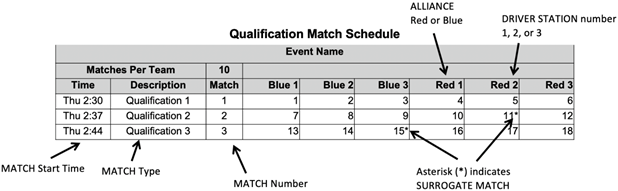
9
Inspection & Eligibility (I)
This section describes the rules governing MATCH
participation. A team has participated in a MATCH if any member of their DRIVE
TEAM is in the ALLIANCE AREA, with or without the ROBOT on the FIELD, at the
start of the MATCH.
At each event, the Lead ROBOT INSPECTOR (LRI)
has final authority on the legality of any COMPONENT, MECHANISM, or ROBOT. The
LRI may consult with additional sources including the Global LRIs and/or FIRST
personnel before making their final decision. INSPECTORS may re-inspect ROBOTS
at any time to ensure compliance with the rules. Teams are encouraged to
consult with INSPECTORS or the LRI if they have any questions regarding the
legality of a ROBOT or about how to make a ROBOT legal.
The inspection process may progress in blocks, i.e. it may
pause for a team’s Practice MATCH, lunch break, etc. The process may employ
various INSPECTORS throughout the process based on availability. At the team’s
discretion, they may request a different INSPECTOR or invite the Lead ROBOT
INSPECTOR to participate in their ROBOT’S inspection.
ROBOTS may be modified after completing initial inspection;
however, note that, per I104, any modifications not specifically exempt
must be re-inspected. Prior to the beginning of Playoff MATCHES, all ROBOTS wishing
to participate will be re-weighed to help identify any modifications that
should be re-inspected per I104.
ROBOTS are permitted to participate in scheduled Practice MATCHES
prior to passing inspection. However, the FTA, LRI, or Head REFEREE may
determine at any time that the ROBOT is unsafe and may prohibit further
participation in Practice MATCHES until the condition is corrected and/or the ROBOT
passes inspection. A safe ROBOT has functional BUMPERS that approximately meet
the required coverage (R401), height (R402), and cross section (R408) requirements.
Prior to the start of a MATCH, any ROBOT
which is unable or ineligible to participate in that MATCH, as determined by
the FTA, LRI, or Head REFEREE, is declared to be BYPASSED and is DISABLED.
A team whose ROBOT is BYPASSED remains eligible to receive Qualification
Ranking Points or Playoff MATCH points provided that its ROBOT has passed
inspection, per I102.
An Inspection Checklist is available to help teams
self-inspect their ROBOT before their event. Teams are strongly encouraged to
self-inspect prior to their event.
I101
*It’s your team’s ROBOT. The
ROBOT and its MAJOR MECHANISMS must be built by the FIRST Robotics Competition
team.
A MAJOR MECHANISM is a
group of COMPONENTS and/or MECHANISMS assembled together to address at least 1
game challenge: ROBOT movement, SCORING ELEMENT manipulation, FIELD element
manipulation, or performance of a scorable task without the assistance of
another ROBOT.
This rule requires that the ROBOT
and its MAJOR MECHANISMS were built by its team, but isn’t intended to prohibit
or discourage assistance from other teams (e.g. fabricating elements,
supporting construction, writing software, developing game strategy,
contributing COMPONENTS and/or MECHANISMS, etc.)
Examples of MAJOR MECHANISMS
include, but are not limited to, assemblies used to:
A. manipulate SCORING ELEMENTS,
B. manipulate a FIELD element, and
C. move the ROBOT around the FIELD.
Examples that would generally not
be considered MAJOR MECHANISMS, and thus probably aren’t subject to this rule
include, but are not limited to, the following:
D. a gearbox assembly,
E. a COMPONENT or MECHANISM that’s part of a MAJOR MECHANISM,
and
F. COTS items.
Neither this rule nor the
language in this blue box define specific thresholds for how much of a MAJOR
MECHANISM must be the result of the team’s effort. This rule expects and
requires the team’s honest assessment of whether they built the MAJOR MECHANISMS
of their ROBOT.
Attempts to exploit loopholes in
the definition of MAJOR MECHANISM in order to bypass this requirement are in
the spirit of neither this rule nor the FIRST Robotics Competition.
Examples of exploitation include:
G. assembling pieces of a MAJOR MECHANISM provided by another
team, except COTS kits and
H. receiving a mostly complete MAJOR MECHANISM from another
team and providing a small piece.
I102
*Get inspected before
playing a Qualification MATCH. A team is only permitted to
participate in a Qualification or Playoff MATCH and receive Ranking or MATCH
Points if their ROBOT has passed an initial, complete inspection.
Violation: If prior to the start of the MATCH, the team is
DISQUALIFIED and not eligible to participate in the MATCH.
If after the MATCH, the team receives a RED CARD and the MATCH may be
replayed per T201.
I103
*Bring it all to inspection.
At the time of inspection, the OPERATOR CONSOLE and the ROBOT must be presented
with all MECHANISMS (including all COMPONENTS of each MECHANISM),
configurations, and decorations that will be used on the ROBOT in MATCHES
without re-inspection (per I104) and may not exceed 150.0lb (68.04kg) (note
that while up to 150.0lb (68.04kg) of ROBOT MECHANISMS may be inspected
together, the ROBOT configuration used in a MATCH may not violate R103). The OPERATOR CONSOLE and exceptions listed in R103 are not included in this weight.
I104
*Unless the change is listed
below, any change to a ROBOT must get re-inspected. A ROBOT may play MATCHES
with a subset of the MECHANISMS that were present during inspection provided
the reconfigured ROBOT still complies with all ROBOT Construction Rules. Only
MECHANISMS that were present during the inspection may be added, removed, or
reconfigured between MATCHES without re-inspection per this rule. If a ROBOT is
modified after its most recent passed inspection, it must be re-inspected
before it is eligible to participate in a MATCH.
Exceptions are listed in A through F (unless
they result in a significant change to the ROBOT’S size, weight, legality, or
safety).
A.
addition, relocation, or removal of fasteners (e.g. cable ties, tape,
and rivets),
B.
addition, relocation, or removal of labeling or marking,
C.
revision of ROBOT code,
D.
replacement of a COTS COMPONENT with an identical COTS COMPONENT,
E.
replacement of a MECHANISM with an identical MECHANISM (size, weight,
material), and
F.
additions, removals, or reconfiguration of ROBOT with a subset of
MECHANISMS already inspected per I103.
I105
*Don’t exploit re-inspection.
Teams may not use the re-inspection process in I104 to circumvent the weight limit in I103.
This restriction is not intended to prevent a team from
returning to a previous configuration (e.g. due to an unsuccessful upgrade or
failure of a new COMPONENT). If a team is believed to be violating this rule,
the LRI will discuss the situation with the team to understand the changes and,
if appropriate, the LRI in conjunction with the team will select a single
configuration with which the team will compete for the duration of the event.
Example 1: A ROBOT passes initial inspection (which
includes MECHANISM A). Its team then decides they want to use MECHANISM B,
which was not inspected. The weight of the ROBOT, A, and B is less than the
weight limit in I103, but more than that
in R103. I104 requires the ROBOT be
re-inspected, and this rule allows the ROBOT, A, and B to be inspected
collectively. If passed, the ROBOT may then compete in subsequent MATCHES with
A or B.
Example 2: A ROBOT passes initial inspection (which
includes MECHANISM A). Its team then decides they want to use MECHANISM B,
which was not inspected. The weight of the ROBOT, A, and B is greater than the
weight limit in I103. This requires
re-inspection per I104 and A is excluded to
satisfy I103. B breaks, and the
team decides to switch back to A. The ROBOT must be re-inspected per I104, and the team is not
violating this rule.
Example 3: A team arrives at an event with a ROBOT,
MECHANISM A, and MECHANISM B, which collectively weigh 175.0lb (79.38kg). The ROBOT
passes initial inspection with A and plays a MATCH. The team switches to B,
gets re-inspected, and plays again. The team switches back to A, gets
re-inspected, and plays again. The team switches back to B and asks to be
re-inspected. At this point, the LRI suspects the team may be violating this
rule and has a discussion with the team to understand the changes being made. The
team reveals that this rule has been violated, and the LRI works with them to
select A or B for use for the remainder of the event.
I106
*ROBOTS are off for inspection
(mostly). For the safety of all those involved, ROBOTS must be presented
for inspection with the ROBOT powered off, pneumatics unpressurized, and
springs or other stored energy devices in their lowest potential energy states
(e.g. battery removed).
Power and air pressure should only be enabled
on the ROBOT during those portions of the inspection process where it is
absolutely required to validate certain system functionality and compliance
with specific rules (firmware check, etc.). INSPECTORS may allow the ROBOT to
be powered beyond the parameters above if both criteria below are met:
A.
the ROBOT design requires power or a charged stored energy device in
order to confirm that the ROBOT meets volume requirements and
B.
the team has included safety interlocks that mitigate unexpected release
of such stored energy.
The team may be asked to demonstrate these interlocks
during the inspection process.
I107
*No STUDENT, no inspection.
At least 1 STUDENT team member must accompany the ROBOT for any inspection
efforts.
Exceptions may be made for major conflicts, e.g. religious
holidays, major testing, transportation issues, etc.
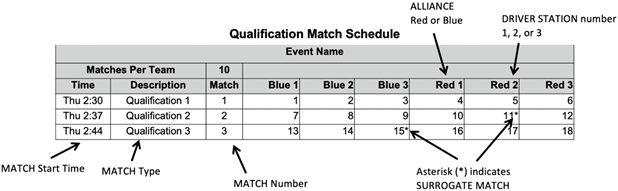
Each 2026 FIRST Robotics Competition event is played
in a tournament format. Each tournament consists of 3 types of MATCHES: Practice
MATCHES (not necessarily played at all District Events), Qualification MATCHES,
and Playoff MATCHES.
Practice MATCHES provide each team with an opportunity to
operate its ROBOT on the FIELD prior to the start of the Qualification MATCHES.
Qualification MATCHES allow each team to earn Ranking Points
which determine their seeding position and may qualify them for participation
in the Playoff MATCHES.
Playoff MATCHES determine the event Champions.
A MATCH schedule is used to coordinate MATCHES at an Event. Figure 10‑1 details information shown on each
schedule. SURROGATE MATCHES are described in section 10.5.2 MATCH Assignment.
Figure 10‑1 Sample MATCH schedule

Over the course of the tournament, it may be necessary for a
MATCH to be replayed. Typical causes for replays are MATCHES that end in a tie
during the Playoffs (due to criteria listed in Table 10‑3. or any Finals MATCH), MATCHES that are
stopped because FIELD STAFF anticipated FIELD damage or personal injury, or if
there is an ARENA FAULT.
An ARENA FAULT is an error in ARENA
operation that includes, but is not limited to:
A.
broken FIELD elements due to
a. normal,
expected game play or
b. ROBOT
abuse of FIELD elements that affects the outcome of the MATCH for their
opponents.
A broken FIELD element caused by ROBOT abuse that affects
the outcome of the MATCH for their ALLIANCE is not an ARENA FAULT.
B.
power failure to a portion of the FIELD (tripping the circuit breaker in
the DRIVER STATION is not considered a power failure),
C.
improper activation by the FMS,
It is not an ARENA FAULT if FMS Game Data is not sent, not
received, or if delayed. Incorrect Game Data being sent would be considered an
ARENA FAULT.
D.
errors by FIELD STAFF (except those listed in section 6.8 Other Logistics), and
E.
a ROBOT radio disconnect that impairs operation of other ROBOTS on the
FIELD for more than 8 seconds.
If, in the judgment of the Head REFEREE, an ARENA FAULT
occurs that affects the outcome of the MATCH and any team on the affected
ALLIANCE desires a replay, the MATCH will be replayed. FIRST
Headquarters reserves the right to, with consultation of the Head REFEREE and
the FTA, replay a MATCH in which an ARENA FAULT impacts the outcome of an
event. Once a MATCH replay is granted, a team may not withdraw the request for
the replay.
The outcome of the MATCH is affected if an error occurs
that, in the judgement of the Head REFEREE, changes which ALLIANCE would have
won the MATCH and/or the assignment of Ranking Points.
The outcome of an event is affected if an error occurs
that, in the judgement of FIRST Headquarters, changes the assignment of
Ranking Points or has a dramatic effect on points used for ranking criteria.
Note that an ARENA FAULT that does not affect MATCH
outcome, in the judgement of the Head REFEREE, does not lead to a MATCH replay.
Examples include, but are not limited to:
A. a piece of FIELD plastic falls into the FIELD, far away
from any human or ROBOT activity, and in such a way that it does not affect
MATCH outcome,
B. delay in the playing of an ARENA sound,
C. mismatch between the timer on the audience screen and the
ARENA timer,
D. any adjustment or delay in assignment of a score or penalty
(including those made after the MATCH), and
Examples of errors by FIELD STAFF include, but are not
limited to:
E. a gate being left open when the MATCH starts,
F. mistakenly allowing a ROBOT in violation of I102 that hasn’t passed an
initial, complete inspection to participate in the MATCH
T201 *Replays will be the same. All reasonable
effort is made to create the same conditions when replaying a MATCH caused by
an ARENA FAULT or FIELD damage. This means, for example, that a team that was
BYPASSED prior to the start of the MATCH which is to be replayed is BYPASSED
for the replay MATCH. ROBOT and DRIVE TEAM starting locations do not need to be
replicated when replaying a MATCH.
Violation: MATCH with not start until the situation is
corrected
Per section 6.6.1 YELLOW and RED CARDS,
cards assigned in previous MATCHES, including prior instances of the MATCH to
be replayed, are not cleared.
At each event, the ARENA will be open for at least 30
minutes prior to the start of Qualification MATCHES, during which time teams
may survey and/or measure the ARENA and bring ROBOTS on the FIELD to perform
sensor calibration. Events may schedule additional measurement and calibration
times. The specific time(s) that the FIELD is open will be communicated to
teams at the event. Teams may bring specific questions or comments to the FTA.
T301
*Measurement, not practice.
During the period when the ARENA is open for measurement:
A.
ROBOTS can be enabled, but may neither drive, extend outside their ROBOT
PERIMETER, nor interact with (e.g. score, push, pickup, etc.) SCORING ELEMENTS
(or anything resembling SCORING ELEMENTS), a HUB, BUMP, TRENCH, OUTPOST, or
other FIELD elements.
B.
Humans may touch a SCORING ELEMENT but may not practice with it (e.g.
throw FUEL, or anything resembling FUEL, or use the OUTPOST).
Violation: VERBAL WARNING, plus YELLOW CARD if subsequent
violations at any point during the event or egregious.
Practice MATCHES are played before Qualification MATCHES.
The Practice MATCH schedule is available as soon as possible, but no later than
the start of Practice MATCHES. For Regional events, it will also be published
and available online on the FRC-Events website, except during exceptional
circumstances. Practice MATCHES are randomly assigned, and teams may not switch
scheduled Practice MATCHES. Each team is assigned an equal number of Practice
MATCHES unless the number of teams multiplied by number of Practice MATCHES is
not divisible by 6. In this case, the FMS randomly selects some teams to play
an extra Practice MATCH.
Practice MATCHES are not guaranteed at District Events due
to event schedule constraints.
A Filler Line is used to fill open slots at events that
employ scheduled Practice MATCHES or all slots at events with an open Practice
MATCH schedule. Teams from the Filler Line are used on a first come, first
served basis to fill empty spots in Practice MATCHES left by other teams that
do not report to Queueing. The number of teams in the Filler Line is dependent
upon space at venues.
Only teams that meet all criteria below qualify for the
Filler Line:
A.
ROBOTS in the Filler Line must have passed inspection (this requirement
may be waived for events with open Practice MATCH schedules),
B.
DRIVE TEAMS must join the Filler Line with their ROBOT,
C.
teams may not work on their ROBOT while in the Filler Line,
D.
teams may not occupy more than 1 spot in the Filler Line, and
E.
if a team is queued for their Practice MATCH, they may not also join the
Filler Line.
The Qualification MATCH schedule is made available as soon
as possible, but no later than 30 minutes before Qualification MATCHES are
scheduled to begin. Teams receive 1 hard copy and it is also available on the FRC-Events
website, except during exceptional circumstances. Each Qualification
schedule consists of a series of rounds in which each team plays 1 MATCH per
round.
FMS assigns each team 2 ALLIANCE partners for each
Qualification MATCH using a predefined algorithm, and teams may not switch
Qualification MATCH assignments. The algorithm employs the following criteria,
listed in order of priority:
1. ensure
each team has at least the minimum required time between MATCHES (varies by
event size)
2. minimize
the number of times a team is allied with any team
3. minimize
the number of times a team plays opposite any team
4. minimize
the use of SURROGATES (teams randomly assigned by the FMS to
play an extra Qualification MATCH)
5. provide
even distribution of MATCHES played on blue and red ALLIANCE
6. provide
even distribution of MATCHES played in each DRIVER STATION number
At events with fewer than 24 participating teams, the
criteria are similar, except #5 is changed to minimize the number of times a
team swaps between the blue and red ALLIANCE rather than an even distribution.
All teams are assigned the same number of Qualification
MATCHES, equal to the number of rounds, unless the number of teams multiplied
by number of MATCHES is not divisible by 6. In this case, the FMS randomly
selects some teams to play an extra MATCH. For the purpose of seeding
calculations, those teams are designated as SURROGATES for the extra MATCH. If
a team plays a MATCH as a SURROGATE, it is indicated on the MATCH schedule, it
is always their third Qualification MATCH, and the outcome of the MATCH has no
effect on the team’s ranking. YELLOW and RED CARDS assigned to SURROGATES,
however, do carry forward to subsequent MATCHES.
Ranking Points are units credited to a team based on their ALLIANCE’S
performance in Qualification MATCHES. Ranking Points are awarded to each
eligible team at the completion of each Qualification MATCH per Table 6‑4.
Exceptions to Ranking Point assignment are as follows:
A.
A SURROGATE receives 0 Ranking Points.
B.
A DISQUALIFIED team, as determined by the Head REFEREE, receives 0
Ranking Points.
C.
A “no-show” team is either DISQUALIFIED from or issued a RED CARD for
that MATCH (see G208). A team is declared a no-show if no member of
the DRIVE TEAM is in the ALLIANCE AREA at the start of the MATCH.
The total number of Ranking Points earned by a team
throughout their Qualification MATCHES divided by the number of MATCHES they’ve
been scheduled to play (minus any SURROGATE MATCH), then rounded to 2 decimal
places, is their Ranking Score (RS).
All teams participating in Qualification MATCHES are ranked
by Ranking Score. If the number of teams in attendance is ‘n’, they are ranked
‘1’ through ‘n’, with ‘1’ being the team with the highest-Ranking Score and ‘n’
being the team with the lowest Ranking Score.
Teams are ranked in order, using the sorting criteria
defined in Table 10‑1.
Table 10‑1 Qualification MATCH ranking
criteria
|
Order Sort
|
Criteria
|
|
1st
|
Ranking Score
|
|
2nd
|
Average ALLIANCE MATCH points, not
including MINOR FOULS and MAJOR FOULS
|
|
3rd
|
Average FUEL scored in AUTO
|
|
4th
|
Average TOWER points
|
|
5th
|
Random sorting by the FMS
|
Playoff MATCHES follow the qualification MATCHES. In the
Playoffs, teams play on set ALLIANCES, chosen during ALLIANCE selection, and
advance through a double elimination bracket. Teams do not earn Ranking Points;
they advance based on winning, losing, or tying a MATCH.
A DISQUALIFIED team, as determined by the Head REFEREE,
causes their ALLIANCE to receive 0 MATCH points in a Playoff MATCH.
At the end of the Qualification MATCHES, the top 8 ranked
teams become the ALLIANCE Leads. The ranked ALLIANCES are designated, in order,
ALLIANCE 1, ALLIANCE 2, etc., down to ALLIANCE 8. Using the ALLIANCE selection
process described in this section, each ALLIANCE Lead chooses 2 other teams to
join their ALLIANCE.
A break of 8 minutes (8:00) occurs between the posting of
scores from the last qualification match (scheduled or replay, whichever comes
later) and the start of the ALLIANCE Selection process for events that host
Alliance Selection shortly after QUALIFICATION MATCHES. At the end of this
break, ALLIANCE 1 is “on the clock” as defined below in T605.
T601 *Send your STUDENT representatives. Each team
must choose and send a minimum of one and a maximum of three STUDENT team
representatives. Representative(s) must report to the ARENA before the start of
ALLIANCE Selection.
Violation: Team is ineligible for the Playoff Tournament if
they are not represented by the time they are announced.
If an absent team would have been an ALLIANCE Lead, all
lower ranked ALLIANCE Leads are promoted 1 spot.
The designated STUDENT
representative from each ALLIANCE Lead is called the ALLIANCE CAPTAIN (if
the ALLIANCE has sent multiple STUDENT representatives, they must designate
only one as the ALLIANCE CAPTAIN). This representative may change between
ALLIANCE selection and Playoff MATCHES.
T602 *STUDENTS must outnumber adults. A non-STUDENT
may additionally be a representative from a team if the team has exactly two
STUDENT representatives.
Violation: Non-STUDENT must leave the ARENA
These are the possible combinations of ALLIANCE Selection
representatives between T601/T602:
A. One STUDENT
B. Two STUDENTS
C. Three STUDENTS
D. Two STUDENTS and one non-STUDENT
The ALLIANCE selection process consists of rounds during
which each ALLIANCE CAPTAIN invites a team ranked below them in the standings
to join their ALLIANCE. The invited team’s representative must either accept or
decline the invitation immediately. If the team accepts, it becomes a member of
that ALLIANCE. This process results in 8 ALLIANCES of 3 teams.
Each round is complete when all ALLIANCES have added one
additional team, and each round must be complete before the next round can
begin. In round 1 selections are made in descending order (ALLIANCE 1 to
ALLIANCE 8), whereas in round 2 selections are made in ascending order
(ALLIANCE 8 to ALLIANCE 1).
T603
* Only STUDENTS may use the mic. Only a single
STUDENT from the invited team is allowed to accept/decline.
Violation: The team is assumed to have declined.
T604
* Only the ALLIANCE CAPTAIN may invite an ALLIANCE. The
ALLIANCE CAPTAIN is the only representative of the ALLIANCE who may approach
the emcee and make a valid pick via the microphone.
Violation: Pick does not count, and pick timer continues to
count down.
T605 * Picks are time
limited. Once the emcee requests an ALLIANCE’S selection, the ALLIANCE
is considered “on the clock” and the pick timer begins to countdown. In round
1, the timer begins at 45 seconds (0:45), in round 2 the timer begins at 1
minute and 30 seconds (1:30). A sound will play to indicate that there are 5
seconds left on the timer and a buzzer will go off to indicate the end of the
time. The ALLIANCE CAPTAIN must make a good faith effort, as determined by the
FTA or their designee, to state a valid team selection before the expiration of
the pick timer.
Violation: The ALLIANCE is skipped, and the emcee moves to
the next ALLIANCE, unless the selection is the last of a round in which case
the ALLIANCE receives the next highest-ranked unselected team to the ALLIANCE.
The time remaining on the pick timer is displayed on the
FIELD timers. Please note that audio cues are intended as a courtesy to
participants and not intended as official markers.
A valid team selection includes any team who has not yet
accepted or declined an invitation to join another ALLIANCE and is not an
ALLIANCE Lead that has had a pick timer violation. If an ALLIANCE CAPTAIN
attempts to select a team that is not valid, the pick timer continues to run
until it either expires, or a different (valid) team is invited to join the
ALLIANCE.
Examples of good faith efforts to state a valid team
selection include but are not limited to:
A. Walking safely towards the emcee when the clock hits zero
B. Starting to state a team as the clock hits zero
Examples that are not considered good faith efforts to
quickly state a valid team selection include but are not limited to:
C. Continuing to talk with your ALLIANCE partners without
moving towards the emcee
D. Talking into the microphone for more than approximately 30
seconds without clearly stating a team number to invite
If an ALLIANCE CAPTAIN extends a valid invitation and the
invited team declines, the pick clock resets to the time for the designated
round and restarts immediately.
After each accepted ALLIANCE invitation or T605 violation, the emcee invites any ALLIANCE
CAPTAINS that received a T605 violation in that round to make their
selections. Each ALLIANCE CAPTAIN may either indicate that they are ready to
make their selection (and immediately do so as determined by the FTA or their
designee) or indicate that they are not yet ready, and they will be revisited
after the next accepted invitation or T605 violation. If a team with a T605 violation extends a valid invitation and the
invited team declines, they are allowed to make another selection immediately
or else they are skipped and will be revisited as described above. If there are
multiple ALLIANCE CAPTAINS that have received T605 violations, they are revisited in the same
order in which they received their violations. If all remaining teams in a
round have received a T605 violation, each team is revisited to either
make a pick immediately or receive the next highest-ranked unselected team.
The ALLIANCE CAPTAIN with the last selection of a given
round may not be the ALLIANCE CAPTAIN scheduled to have the final
pick. For example, imagine in round 1 that ALLIANCES 1-6 have all made valid
selections and ALLIANCE Lead 7 receives a T605 violation. If
ALLIANCE Lead 8 makes a valid selection, then ALLIANCE Lead 7 now has the final
selection of round 1.
A break of 2 minutes (2:00) occurs between each round of
selections. At the conclusion of the break, the ALLIANCE scheduled to make the
next selection goes “on the clock” and their timer begins per T605.
T606
*Declining teams can’t be picked. An
ALLIANCE CAPTAIN may not invite a team that has declined another ALLIANCE’S
invitation to participate in the Playoff tournament. Declining teams are
ineligible to be a BACKUP TEAM.
Violation: The ALLIANCE CAPTAIN must make another selection
and pick timer continues to count down.
When a team has declined, the team will show with a
strikethrough on the team number in the audience display.
Teams highlighted in orange (will become captain if not
picked) will NOT get a strikethrough if they decline as they can still become
captains.
An ALLIANCE Lead that declines an invitation from another
ALLIANCE is able to invite teams to join their ALLIANCE but may not be invited
to join another ALLIANCE.
At the conclusion of ALLIANCE selection, the highest ranked
unselected teams are eligible to become a BACKUP TEAM, as defined in section 10.6.3 BACKUP TEAMS.
The double elimination tournament consists of an Upper and
Lower bracket as shown in Figure 10‑2. Each ALLIANCE begins with a slot in
the Upper bracket. If an ALLIANCE wins a MATCH in the Upper bracket, they
remain in the Upper bracket. If an ALLIANCE loses a MATCH in the Upper bracket,
they transition to the Lower bracket. ALLIANCES in the Lower bracket must win
any subsequent MATCHES (except for finals) to remain in the tournament, i.e.
once they lose a MATCH, they’re out of the tournament.
In Round 1, the higher ranked ALLIANCE is assigned to the
red ALLIANCE. For subsequent rounds, ALLIANCE color is assigned as shown in Figure 10‑2. regardless of ALLIANCE rank at the
start of the Playoff tournament.
Figure 10‑2 Playoff MATCH bracket (Red ALLIANCE
tops each pairing)

As shown in Figure 10‑2 and Table 10‑2, Playoff MATCHES consist of 6 rounds
with breaks between later rounds and between Finals MATCHES. Breaks begin after
the FIELD has been cleared from the previous MATCH. The Blue and Red Gap
columns indicate the approximate time between each ALLIANCE’S MATCHES. The
expected start time of the scheduled MATCH is the time indicated on the MATCH
schedule or 15 minutes from the end of either ALLIANCE’S previous MATCH,
whichever is later. Occasionally, replayed MATCHES within a round may be played
out of order; if MATCHES are played out of order, teams are informed by the
emcee, FIELD STAFF, and/or queueing staff.
If a Playoff MATCH needs to be replayed as described in section
10.2 MATCH Replays, teams are notified of when the replay
will occur. A minimum 10-minute delay is provided for teams to reset their
ROBOTS prior to the replay unless all teams are ready sooner. The affected
MATCH must be replayed before the next round begins.
Table 10‑2 Typical Playoff MATCH schedule
|
Round
|
MATCH
|
Upper/
Lower
|
|
|
Gap
(min)
|
Next MATCH
(MATCH # (ALLIANCE color))
|
|
Blue
|
Red
|
Blue
|
Red
|
Winner
|
Loser
|
|
1
|
1
|
Upper
|
8
|
1
|
|
M7 (R)
|
M5 (R)
|
|
2
|
Upper
|
5
|
4
|
M7 (B)
|
M5 (B)
|
|
3
|
Upper
|
7
|
2
|
M8 (R)
|
M6 (R)
|
|
4
|
Upper
|
6
|
3
|
M8 (B)
|
M6 (B)
|
|
2
|
5
|
Lower
|
L2
|
L1
|
0:24
|
0:33
|
M10 (B)
|
|
|
6
|
Lower
|
L4
|
L3
|
0:15
|
0:24
|
M9 (B)
|
|
7
|
Upper
|
W2
|
W1
|
0:42
|
0:51
|
M11 (R)
|
M9 (R)
|
|
8
|
Upper
|
W4
|
W3
|
0:33
|
0:42
|
M11 (B)
|
M10 (R)
|
|
3
|
9
|
Lower
|
W6
|
L7
|
0:24
|
0:15
|
M12 (B)
|
|
|
10
|
Lower
|
W5
|
L8
|
0:42
|
0:15
|
M12 (R)
|
|
6-minute break
|
|
4
|
11
|
Upper
|
W8
|
W7
|
0:27
|
0:36
|
M14 (R)
|
M13 (R)
|
|
12
|
Lower
|
W9
|
W10
|
0:27
|
0:18
|
M13 (B)
|
|
|
15-minute awards break: Imagery, Gracious Professionalism, Team Spirit, and Rising All
Star
|
|
5
|
13
|
Lower
|
W12
|
L11
|
0:18
|
0:27
|
M14 (B)
|
|
|
15-minute awards break: Autonomous, Creativity, Quality, and Industrial Design
|
|
Finals
|
14
|
|
W13
|
W11
|
0:18
|
0:48
|
M15
|
M15
|
|
15-minute awards break: Innovation in Control, Excellence in Engineering, Team
Sustainability, Judges
|
|
Finals
|
15
|
|
W13
|
W11
|
0:18
|
0:18
|
M16*
|
M16*
|
|
15-minute awards break: Rookie All Star, FIRST Leadership Award, Engineering
Inspiration**
|
|
Finals
|
16*
|
|
W13
|
W11
|
0:18
|
0:18
|
|
|
Awards: Remaining awards, Finalists, Winners, and FIRST
Impact Award
|
* if required
** Program Delivery Partners may choose to hold these
awards until after all MATCHES are complete.
10.6.2.1 Playoff
MATCH ties
If final MATCH scores for both ALLIANCES are equal, the win
is awarded to the ALLIANCE per criteria listed in Table 10‑3.
Table 10‑3 Playoff MATCH Tiebreaker Criteria
|
Order Sort
|
Criteria
|
|
1st
|
Cumulative MAJOR FOUL points due
to opponent rule violations
|
|
2nd
|
ALLIANCE AUTO FUEL points
|
|
3rd
|
ALLIANCE TOWER points
|
|
4th
|
MATCH is replayed
|
10.6.2.2 Playoff
Finals
Once a single ALLIANCE remains in each Upper and Lower
bracket, those ALLIANCES proceed to the Finals round. The first ALLIANCE to win
2 MATCHES in the Finals becomes the event’s Champions.
If a Finals MATCH ends in a tie score, the tie is not broken
using the criteria in Table 10‑3, the MATCH remains a tie. In the case
where an ALLIANCE hasn’t won 2 MATCHES after 3 MATCHES have been played
(because of tied MATCHES), the Playoffs proceed with up to 3 additional Finals
MATCHES, called Overtime MATCHES, until an ALLIANCE has won 2 Finals MATCHES.
In the case where the Overtime MATCH scores for both ALLIANCES are equal, the
win for that Overtime MATCH is awarded based on the criteria listed in Table 10‑3.
During the Playoff MATCHES an ALLIANCE CAPTAIN may elect to
replace one of its ROBOTS. The team whose ROBOT and DRIVE
TEAM replaces another ROBOT and DRIVE TEAM on an ALLIANCE during the Playoff
MATCHES is called the BACKUP TEAM.
In this situation, the ALLIANCE CAPTAIN has the option to
bring in the highest ranked team from the pool of available teams to join its
ALLIANCE for the following MATCH. The resulting ALLIANCE is then composed of 4
teams.
ALLIANCES submit LINEUPS (as described in section 10.6.4 LINEUPS for each Playoff
MATCH. After the BACKUP TEAM’s first Playoff MATCH, the ALLIANCE’S LINEUP may
consist of any 3 of the ALLIANCE’S 4 teams.
10.6.3.1 BACKUP
TEAM Coupons
Each ALLIANCE is allotted 1 BACKUP TEAM coupon during the
Playoff MATCHES. If two or more ROBOTS from the ALLIANCE become inoperable,
then the ALLIANCE must play the following MATCHES with only 2 (or even 1)
ROBOTS.
Example: 3 teams, A, B and C, form an ALLIANCE going into
the Playoff MATCHES. The highest ranked team not on 1 of the 8 ALLIANCES is
Team D. During 1 of the Playoff MATCHES, Team C’s ROBOT suffers damage to its
mechanical arm. The ALLIANCE CAPTAIN decides to bring in Team D to replace Team
C in the next MATCH. The new ALLIANCE of Teams A, B, C, and D are successful in
advancing to the Finals and win the event. Teams A, B, C, and D are all
recognized as members of the Winning ALLIANCE and receive awards.
The Head REFEREE will not accept the BACKUP TEAM coupon
unless it lists the number of the team whose ROBOT is being replaced and is
initialed by the ALLIANCE CAPTAIN. Once a BACKUP TEAM coupon is submitted and
accepted by the Head REFEREE, the BACKUP TEAM coupon may not be withdrawn by
the ALLIANCE.
T607
*No BACKUP TEAM for replayed MATCHES.
An ALLIANCE may not request a BACKUP TEAM for a replayed MATCH. The sole
exception is if, in the judgment of the Head REFEREE, the replay is due to an
ARENA FAULT that rendered an ALLIANCE’S ROBOT inoperable.
Violation: The request is denied.
T608
*No BACKUP TEAMS for 1st MATCH.
An ALLIANCE may not request a BACKUP TEAM until after their first Playoff
MATCH.
Violation: The request is denied.
T609
*BACKUP TEAMS play when called.
A BACKUP TEAM must be included in the LINEUP for the ALLIANCE’S next MATCH
following their recruitment.
Violation: The LINEUP is denied.
If the Head REFEREE is busy, and there is no designee, the
ALLIANCE CAPTAIN remains in the Question Box to report the LINEUP.
T610
*BACKUP TEAMS due 2 minutes before
the MATCH start time. The BACKUP TEAM Coupon must be submitted to the
Head REFEREE (or their designee) by the ALLIANCE CAPTIAN not later than 2
minutes before the expected MATCH start time in which the BACKUP TEAM is to
play.
Violation: The request is denied
If the Head REFEREE is busy, and there is no designee, the
ALLIANCE CAPTAIN remains in the Question Box to submit the BACKUP TEAM coupon.
10.6.3.2 BACKUP
POOL
After the top ranked ALLIANCE has made their final pick
during ALLIANCE Selection, the lead queuer (or their designee) polls the
remaining eligible teams. In rank order, the lead queuer (or their designee)
will invite remaining teams to accept or decline a position in the BACKUP POOL,
i.e. the group of teams willing and able to join an
ALLIANCE during the Playoff MATCHES, if needed, until up to 8 teams accept.
T611
*Be there to be a BACKUP TEAM.
A team must be present after ALLIANCE Selection to accept the lead queuer’s (or
their designee) invitation to join the BACKUP POOL.
Violation: Team is ineligible to be a BACKUP TEAM.
T612
*Send a BACKUP TEAM Representative.
The top 2 ranked BACKUP TEAMS must send at least 1 STUDENT representative (and
optionally 1 additional STUDENT or mentor) to a designated area near the FIELD
for the duration of the Playoff MATCHES.
These 2 representatives are available to
answer questions and accept invitations to be a BACKUP TEAM from ALLIANCE
CAPTAINS. If 1 of these 2 teams joins an ALLIANCE or excuses themselves from
the BACKUP POOL, the next highest ranked team in the BACKUP POOL must provide
their representative. Once a BACKUP TEAM has declined an invitation to join an
ALLIANCE, it is no longer a member of the BACKUP POOL and ineligible to join
another ALLIANCE.
Violation: VERBAL WARNING, plus the team is removed from
BACKUP POOL if the situation cannot be corrected within a reasonable amount of
time.
Some events may offer an area near the FIELD where the top
1 or 2 teams in the BACKUP POOL may choose to stage their ROBOT for quick and
easy access to the FIELD if recruited.
Each ALLIANCE competing in a Playoff MATCH has the option to
submit a LINEUP, which lists the 3 teams participating in the
MATCH and their selected DRIVER STATIONS.
The LINEUP is kept confidential until the FIELD is set for
the MATCH at which point each ALLIANCE’S LINEUP appears on the Team Signs.
10.6.4.1 LINEUPS
for 4-team ALLIANCES
If an ALLIANCE has 4 members (either because a 3-team
ALLIANCE has called a BACKUP TEAM or the event is the FIRST
Championship), a single representative from the team not on the LINEUP is
allowed as a sixteenth ALLIANCE member but must be a member of that team’s
DRIVE TEAM. This additional representative may only serve as a DRIVE COACH.
10.6.4.2 Default
LINEUP
T613
*LINEUPS due 2 minutes before the
MATCH. The ALLIANCE CAPTAIN must submit their LINEUP in writing to the
Head REFEREE (or their designee) 2 minutes before their expected MATCH start
time.
Violation: Late LINEUPS are denied, and the ALLIANCE’S most
recent LINEUP is applied.
If the Head REFEREE is busy, and there is no designee, the
ALLIANCE CAPTAIN remains in the Question Box to report the LINEUP.
If no previous LINEUP exists, the ALLIANCE Lead is assigned
DRIVER STATION 2, 1st team selected is assigned DRIVER STATION 1, and the 2nd
team selected is assigned DRIVER STATION 3. If any of these 3 ROBOTS are unable
to play, the ALLIANCE must play the MATCH with only 2 (or even 1) ROBOT(s).
Example: 3 teams, A, B, and C form an ALLIANCE going into
the Playoff MATCHES. During one of the Playoff MATCHES, Team C’s ROBOT becomes
inoperable. The ALLIANCE decides to bring in Team D to replace Team C. Team C
repairs their ROBOT and may play in any subsequent Playoff MATCHES replacing
Team A, B, or D
If a BACKUP TEAM Coupon is accepted and the LINEUP for the
next MATCH is not submitted or it omits the BACKUP TEAM, then the ALLIANCE’S
most recent LINEUP is used with the BACKUP TEAM in the position populated by
the team for whom they’re substituting.
T614
*For replays, no changing LINEUPS
(mostly). If a MATCH must be replayed due to an ARENA FAULT, the LINEUP
for the replayed MATCH is the same as the original MATCH. The sole exception is
if, in the opinion of the Head REFEREE, the ARENA FAULT rendered a ROBOT
inoperable, in which case the LINEUP can be changed.
Violation: The new LINEUP is denied.
During the Playoff MATCHES and because of the distance
between the FIELD and the pit area, extra team members may be needed to
maintain and otherwise assist with the ROBOT between MATCHES. Each team is
permitted to have up to 3 additional pit crew members to help with needed ROBOT
repairs/maintenance.
The scheduling algorithm described in section 10.5.2 MATCH Assignment works to minimize teams playing in
back-to-back MATCHES. However, at events with fewer than 24 teams, back-to-back
plays may occur.
Multi-day events with 24 teams or fewer employ a modified
Playoff MATCH format. Instead of 8 ALLIANCES, these events proceed through
ALLIANCE SELECTION and the Playoff Tournament with the maximum number of
complete 3-team ALLIANCES that can be formed while leaving at least 1 BACKUP
TEAM (e.g. a 24-team event creates 7 ALLIANCES, a 20-team event creates 6
ALLIANCES).

The Playoff Bracket remains as shown in Figure 10‑2 with any matchup against a non-existent
ALLIANCE resulting in a bye (i.e. automatic advancement to the next round). An
ALLIANCE assigned a bye-MATCH is invited, though not required, to practice
together in a null MATCH (i.e. it has no bearing on the Playoff tournament)
during the designated time in the Playoff schedule.
District points for Draft Order Acceptance (per section 11.1.2 ALLIANCE Selection Results) are awarded as if a full
set of ALLIANCES was selected (i.e. the 2nd selection of the 3-seed
ALLIANCE still receive 3 points regardless of how many ALLIANCES are formed).
Teams advance through the season depending on the events at
which they compete: Regional or District. This section details how District
teams advance from District qualifying events to their District Championship.
District teams are ranked throughout the season based on the
points they earn at the first 2 home District events they attend, as well as at
their District Championship. Points are awarded to teams as follows:
Table 11‑1 District Point Assignment
|
Category
|
Points
|
|
Qualification Round
Performance
|
Normal distribution of points from 22 to 4 across the highest
ranked team to the lowest based on an equation. See section 11.1.1 Qualification Round Performance for details.
For a typically sized District
event, this will result in a minimum of 4 points being awarded for
Qualification round performance. For events of all sizes, a maximum of 22
points will be awarded.
|
|
ALLIANCE CAPTAINS
|
Equal to 17 minus the ALLIANCE
CAPTAIN number (e.g. 14 points for ALLIANCE #3 Captain)
|
|
Draft Order Acceptance
|
Equal to 17 minus the Draft
Order Acceptance Number (e.g. 12 points for the team that accepts the fifth
draft position, regardless of whether it was delayed per T605.)
|
|
Playoff Advancement
|
Points awarded based on team
participation in individual playoff rounds, and whether or not the ALLIANCE
advances. See section 11.1.3 Playoff Performance for
details.
|
|
Team Judged Awards
|
10 points for FIRST
Impact Award
8 points each for Engineering
Inspiration and Rookie All Star Awards
5 points each for all other team
judged awards
|
|
Team Age
|
10 points for 2026 rookie teams
5 points for 2025 rookie teams
|
Points earned at District Championships are multiplied by 3
and then added to points earned at District events, to determine the final
season point total for the team.
If there is a tie in the season point total between teams,
the higher ranked team will be determined using the following additional
sorting criteria:
Table 11‑2 District Team Sort Criteria
|
Order Sort
|
Criteria
|
|
1st
|
Total Playoff Performance Points
|
|
2nd
|
Best Playoff Points at a single
event
|
|
3rd
|
Total ALLIANCE Selection Results
Points
|
|
4th
|
Highest Qualification Round Seed
or Draft Order Acceptance (i.e. Highest ALLIANCE Selection points at a single
event)
|
|
5th
|
Total Qualification Round
Performance Points
|
|
6th
|
Highest Individual MATCH Score,
regardless of whether that score occurred in a Qualification or Playoff MATCH
|
|
7th
|
Second highest Individual MATCH
Score, regardless of whether that score occurred in a Qualification or
Playoff MATCH
|
|
8th
|
Third highest Individual MATCH
Score, regardless of whether that score occurred in a Qualification or
Playoff MATCH
|
|
9th
|
Random Selection
|
The calculation of Qualification performance points is done
using the equation below. This equation is an inverse error function which
utilizes the following variables:
-
R – the qualification rank of the team at the event at the
conclusion of Qualification MATCHES (as reported by FMS)
-
N – the number of FIRST Robotics Competition teams
participating in the Qualification rounds at the event
-
Alpha (α) – a static value (1.07) used to standardize the
distribution of points at events

This formula generates an approximately normal distribution
of Qualification Round Performance points at an event, based on rank, with most
teams getting a moderate number of points, and fewer teams getting the highest
or lowest numbers of points available.
Table 11‑3 displays sample Qualification Round
Performance points for variously ranked teams at a 40-team event. The system
will automatically generate the appropriate points for each team based on their
rank and the number of teams at the event.
Table 11‑3 Sample Qualification Round Point Assignments
|
Rank
|
1
|
2
|
3
|
4
|
…
|
19
|
20
|
21
|
…
|
37
|
38
|
39
|
40
|
|
Points
|
22
|
21
|
20
|
19
|
…
|
13
|
13
|
12
|
…
|
6
|
6
|
5
|
4
|
This attribute measures both individual team qualification
round seeding performance and recognition by peers.
ALLIANCE CAPTAINS are recognized based on their
qualification round seeding rank. This rank is a result of the rules of the
game, which typically incorporate several team performance attributes, and are
designed to eliminate ties in rank. ALLIANCE partners are rewarded based on
peer recognition. To be invited to join an ALLIANCE, a team’s peers have
decided that the team has attributes that are desirable. Giving points for
ALLIANCE selection also supports come-from-behind teams. A team taking several
MATCHES to optimize their performance may be recognized as a late bloomer by a
top seeded team, even if that performance isn’t reflected in the rankings
because of poor performance in early MATCHES. These points also have the
potential to recognize teams employing a unique strategy with their ROBOT.
Teams with unique or divergent ROBOT capabilities that complement the strengths
of other ALLIANCE members may be selected to fill a strategic niche.
Note also that ALLIANCE CAPTAINS are given the same number
of points as the team drafted in the same sequence. For example, the team who
accepts the pick from the third ALLIANCE CAPTAIN receives the same number of
points as the third ALLIANCE CAPTAIN. Numerical analysis supports the idea that
ALLIANCE CAPTAINS are about as strong in ROBOT performance as equivalently
drafted teams. An additional minor benefit to this system is that it allows
teams who would traditionally not be a top ranked team the opportunity to be an
ALLIANCE CAPTAIN.
This attribute measures team performance as part of an
ALLIANCE.
Teams that advance to at least MATCH 12 earn Double
Elimination (DE) Points per the formula below, where β is defined in Table 11‑4.
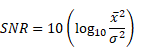
Table 11‑4 Double Elimination Points, β
values
|
ALLIANCE Finish
|
β
|
|
1st Place
(Winners)
|
20
|
|
2nd Place
(Finalists)
|
20
|
|
3rd Place (loser
of MATCH 13)
|
13
|
|
4th Place (loser
of MATCH 12)
|
7
|
In most cases, unless a BACKUP is recruited, a team plays
100% of the DE MATCHES won by their ALLIANCE, thus their DE Points simply equal
β. If a team does not play 100% of the DE MATCHES won by their ALLIANCE, their
DE Points equal their β value multiplied by the percentage of DE MATCHES won by
their ALLIANCE in which that team participated. If the result is not a whole
number, the value is rounded up to the nearest integer.
Teams on the winning ALLIANCE are awarded additional Finals
Points, which are 5 points for each Finals MATCH won and in which the team
participated, up to a maximum of 10 points.
For example, if Team X’s ALLIANCE wins the event, but Team
X only played in 2 MATCHES won by their ALLIANCE, MATCH 13 and Final 1, Team
X’s Playoff Performance points are 20 * (1/5) + 5 = 9 points.
The maximum number of Playoff Performance Points a team can
earn is 30 (20 DE points + 10 Finals Points).
This attribute measures team performance with respect to
team awards judged at the event.
The points earned for team awards in this system are not
intended to capture the full value of the award to the team winning the award,
or to represent the full value of the award to FIRST. In many ways, the
team’s experience in being selected for awards, especially the FIRST
Impact Award, the Engineering Inspiration Award, and the Rookie All Star Award
(which is optional for District Championship events), is beyond measure, and
could not be fully captured in its entirety by any points-based system. Points
are being assigned to awards in this system only to help teams recognize that FIRST
continues to be “More than Robots®,” with the emphasis on our
cultural awards, and to assist in elevating award-winning teams above
non-award-winning teams in the ranking system.
Teams only receive points for team awards judged at the
event. If an award is not judged, is not for a team (e.g. the FIRST
Leadership Award) or is not judged at the event (e.g. Safety Animation Award,
sponsored by UL), no points are earned.
This attribute recognizes the difficulty in being a rookie
or relatively new team.
Points are awarded to 2025 and 2026 rookie teams in
recognition of the unique challenges teams face in those early years, and to
increase the chance that they will make it to the District Championship to
compete with their ROBOTS. Like our dedicated Rookie awards, these additional
points are intended to recognize and motivate newer participants in FIRST
Robotics Competition. These points are awarded once at the beginning of the
season. Rookie year is calculated based on the year in which FIRST
recognizes the team as a rookie.
District teams neither earn points for their actions at any
Regionals, nor are eligible for any FIRST Championship qualifying
benefits at that Regional (awards, etc.).
A team competing in a District qualifies for their District
Championship by meeting 1 of the following criteria:
A.
District FIRST Impact Award Winner,
B.
District Ranking (based on total points earned at their first 2 home
District events as detailed in section 11.1 District Events),
Teams do not earn points at third or subsequent District
events, nor at any inter-district or Regional events at which they compete
during the season.
If a team declines an invitation to the District
Championship, the next highest uninvited team on the list is invited, and so
on, until the event capacity is filled.
C.
District Engineering Inspiration winner (qualifies to compete for the
award only), and
D.
District Rookie All Star winner (qualifies to compete for the award
only).
The capacity of each District Championship is shown in Table 11‑5. Each District determines the number of
teams that qualify for their District Championship. These limits are based on
factors including but not limited to the total number of teams in the District,
available venue capacity, etc.
Table 11‑5 2026 District Championship
Capacities
|
District Championship
|
Capacity
|
Divisions
|
|
FIRST California –
Northern California*
|
60
|
1
|
|
FIRST California – Southern
California*
|
60
|
1
|
|
FIRST Chesapeake
District Championship
|
54
|
1
|
|
FIRST in Michigan
State Championship
|
160
|
4
|
|
FIRST in Texas
District Championship
|
90
|
2
|
|
FIRST Indiana State
Championship
|
38
|
1
|
|
FIRST Israel
District Championship
|
42
|
1
|
|
FIRST Mid-Atlantic District Championship
|
66
|
1
|
|
FIRST North Carolina State Championship
|
50
|
1
|
|
FIRST Ontario Provincial Championship
|
100
|
2
|
|
FIRST South Carolina
State Championship
|
32
|
1
|
|
FIRST Wisconsin District Championship
|
36
|
1
|
|
New
England District Championship
|
100
|
2
|
|
Pacific
Northwest District Championship
|
50
|
1
|
|
Peachtree
District State Championship
|
45
|
1
|
* Due to the strong geographic
concentration of teams in two main regions of California, there are two
separate District Championships, but California will remain as one district.
Teams in California can compete and earn points in any District Qualifier event
in California. Teams are ranked based on the region they are located in
(Northern or Southern California) and advance to one of two District
Championships. The top 60 teams in each area (North and South) advance to their
District Championship.
If a District Championship has too many teams to allow all
teams 12 Qualification MATCHES, then the event hosts multiple divisions. These
events have 2 or 4 divisions (based on the number of teams participating, see Table 11‑5) with approximately 40–60 teams in each
division. Teams are assigned divisions by FIRST using a process
developed by FIRST in Michigan and balances need for accessible seating
between Divisions.
The process employs a “brute force iterative randomizer” and
is executed as follows:
1. The
district team list is sorted in order of cumulative district points earned as described
in section 11.1 District Events.
2. The
list is divided into quartiles based on rank (e.g. the first quartile has the
top 25% ranked teams). If the total number of teams is not evenly divisible by
4 times the number of divisions, additional teams are distributed to quartiles
4, then 2, then 3.
3. Division
assignments are randomly generated using equal contributions from each
quartile.
4. 3
criteria are calculated for each division:
a. average
strength: the arithmetic mean of the district point values of teams in a
division
b. distribution
of strength: the Signal to Noise Ratio (SNR) of the district point values of
teams in a division. SNR is calculated as follows:

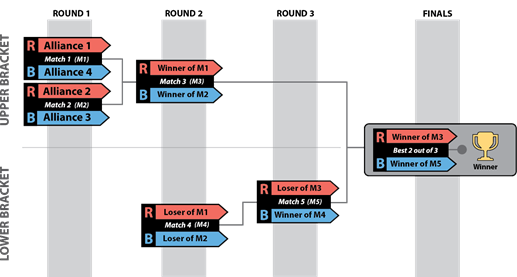 =
arithmetic mean of the district points in a division
=
arithmetic mean of the district points in a division
σ = standard
deviation of the district points in a division
c. distribution
of strength for “top” teams: The SNR of the district point values of teams in
the first quartile of a division
5. The
3 criteria for each division are compared to the other division(s). If the
difference between the division’s value and any other division’s value exceeds
the limits in Table 11‑6, the criteria is not met.
Table 11‑6 District Championship division evaluation
limits
|
|
2 divisions
|
4 divisions
|
|
Average strength
|
1
|
2
|
|
Distribution of strength
|
1
|
2.5
|
|
Distribution of strength for
“top” teams
|
1.5
|
2
|
6.
If all 3 criteria met, event organizers publish the assignments. If any
of the 3 criteria are not met, assignments are rejected, and the process
returns to Step 3.
In these cases:
-
Division winning ALLIANCES play each other in District
Championship Playoffs, employing the brackets shown in Figure 11‑1 and Figure 11‑2 (and detailed in Table 11‑7) that corresponds to their District,
until a winning ALLIANCE for the event is determined.
Figure 11‑1 4-division District Championship
Playoff Bracket
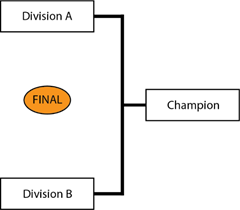
Figure 11‑2 2-division District Championship
Playoff Bracket

Table 11‑7 District Championship 4-ALLIANCE
Playoff MATCH schedule
|
Round
|
MATCH
|
Upper/
Lower
|
|
|
Gap
(min)
|
Next MATCH
(MATCH # (ALLIANCE color))
|
|
Blue
|
Red
|
Blue
|
Red
|
Winner
|
Loser
|
|
1
|
1
|
Upper
|
B
|
A
|
|
M3 (R)
|
M4 (R)
|
|
2
|
Upper
|
D
|
C
|
M3 (B)
|
M4 (B)
|
|
15-minute
break
|
|
2
|
3
|
Upper
|
W2
|
W1
|
17m
|
24m
|
M6 (R)
|
M5 (R)
|
|
4
|
Lower
|
L2
|
L1
|
24m
|
31m
|
M5 (B)
|
|
|
15-minute
break
|
|
3
|
5
|
Lower
|
W4
|
L3
|
17m
|
24m
|
M6 (B)
|
|
|
15-minute
break
|
|
Finals
|
6
|
|
W5
|
W3
|
17m
|
44m
|
M7
|
M7
|
|
15-minute
break
|
|
Finals
|
7
|
|
W5
|
W3
|
17m
|
17m
|
M8*
|
M8*
|
|
15-minute
break
|
|
Finals
|
8*
|
|
W5
|
W3
|
17m
|
17m
|
|
* if required
-
Each team on a Champion ALLIANCE of a 2-Division District
Championship Playoff tournament earns 10 points.
-
For a 4-Division District Championship Playoff tournament, each
team on a Champion ALLIANCE earns 20 points and each team on a Finalist
ALLIANCE receives 10 points.
-
If any of these ALLIANCES has recruited a BACKUP TEAM, these
points are divided amongst the teams as described in section 11.1.3 Playoff Performance.
-
If an ALLIANCE in a District Championship Playoff has not yet
recruited a BACKUP TEAM per section 10.6.3 BACKUP TEAMS, the ALLIANCE CAPTAIN may bring in only
the highest ranked team from their division’s BACKUP POOL to join its ALLIANCE.
Each District determines the number of FIRST
Leadership Award, FIRST Impact Awards, Rookie All Star Awards, and
Engineering Inspiration Awards to present at their District Championship,
within a range established by FIRST. The team counts are based on the
team representation of the respective District at the Championship. For the
awards, ranges are developed by using ratios agreed upon by FIRST and
District Leadership. These ranges allow each District to represent their own
community as they see fit.
-
For the FIRST Impact Award, the ratios range from one FIRST
Impact Award team for every 18 Championship District teams to one FIRST
Impact Award team for every nine Championship District teams.
-
For the FIRST Leadership Award Finalist, the ratios range
from one FIRST Leadership Award Finalist for every nine Championship
District teams to one FIRST Leadership Award Finalist for every six
Championship District teams.
-
All Districts, regardless of FIRST Championship Slot
allocation, may award one or two Engineering Inspiration and Rookie All-Star
Awards.
The following teams competing in the District model earn a
Merit-Based Qualifying slot:
-
District Championship
o
FIRST Impact Award Winners
o
Engineering Inspiration Award Winners
o
Rookie All-Star Winners (the judges can decide if they present
this award or not)
o
Winning Alliance members
-
as many teams in District-points total order to fill the
Allocated FIRST Championship slots granted per the table below.
Districts receive the percentage of 'available slots' at FIRST
Championship, rounded up to the nearest whole slot, equal to the percentage of
teams they have in their District compared to the total of all FIRST
Robotics Competition teams. 'Available slots' are calculated by taking the
total number of slots at FIRST Championship and subtracting the number
of pre-qualified teams. This overall calculation uses a ‘snapshot’ of teams
that have registered and paid as of three weeks after initial season payment was
due.
Table 11‑8 District FIRST Championship and awards allocations
|
District
|
Allocated FIRST
Championship Slots
|
FIRST Impact Award Winners
|
FIRST Leadership Award Finalists
|
Engineering Inspiration
Award Winners
|
Rookie All-Star Award
Winners
|
Woodie Flowers Award
Finalists
|
|
FIRST California
|
46*
|
2 per DCMP
|
4 per DCMP
|
1 per DCMP
|
1 per DCMP
|
1 per DCMP
|
|
FIRST Chesapeake
|
19
|
2
|
3
|
1
|
1
|
2
|
|
FIRST in Michigan
|
83
|
5
|
14
|
1
|
2
|
3
|
|
FIRST in Texas
|
28
|
2
|
5
|
2
|
2
|
2
|
|
FIRST Indiana Robotics
|
12
|
1
|
2
|
2
|
0
|
1
|
|
FIRST Israel
|
12
|
1
|
2
|
1
|
1
|
1
|
|
FIRST Mid-Atlantic
|
23
|
2
|
4
|
2
|
1
|
2
|
|
FIRST North Carolina
|
15
|
1
|
3
|
2
|
2
|
1
|
|
FIRST South Carolina
|
7
|
1
|
2
|
1
|
1
|
1
|
|
FIRST Wisconsin
|
12
|
1
|
2
|
1
|
1
|
1
|
|
NE FIRST
|
32
|
4
|
6
|
2
|
1
|
2
|
|
Ontario
|
19
|
2
|
3
|
1
|
1
|
2
|
|
Pacific Northwest
|
21
|
2
|
4
|
2
|
1
|
2
|
|
Peachtree
|
13
|
2
|
2
|
2
|
1
|
1
|
* Due to the strong geographic concentration of teams in two
main regions of California, there are two separate District Championships, but
California will remain as one district. Teams in California can compete and
earn points in any District Qualifier event in California. Teams are ranked
based on the region they are located in (Northern or Southern California) and
advance to one of two District Championships. The top 46 teams from the entire
District advance to FIRST Championship.

Teams advance through the season depending on the events at
which they compete: Regional or District. This section details how Regional
teams advance from Regional events to FIRST Championship.
Regional teams are ranked throughout the season based on the
points they earn at the first 2 Regional events they attend. Points are awarded
to teams as follows:
Table 12‑1 Regional Point Assignment
|
Category
|
Points
|
|
Qualification Round
Performance
|
Normal distribution of points from 22 to 3 across the highest
ranked team to the lowest based on an equation. See section 11.1.1 Qualification Round Performance for details.
|
|
ALLIANCE CAPTAINS
|
Equal to 17 minus the ALLIANCE
CAPTAIN number (e.g. 14 points for ALLIANCE #3 Captain.) See section 11.1.2 ALLIANCE Selection Results
for details.
|
|
Draft Order Acceptance
|
Equal to 17 minus the Draft
Order Acceptance Number (e.g. 12 points for the team that accepts the fifth
draft position, regardless of whether it was delayed per T605.)
|
|
Playoff Advancement
|
Points awarded based on team
participation in individual playoff rounds, and whether or not the ALLIANCE
advances. See section 11.1.3 Playoff Performance for
details.
|
|
Team Judged Awards
|
45 points for FIRST
Impact Award
28 points for Engineering
Inspiration Award
8 points for Rookie All Star
Award
5 points each for all other team
judged awards
See section 12.1.1 Team Judged Awards for
full details.
|
|
Team Age
|
10 points for 2026 rookie teams
5 points for 2025 rookie teams
See section 12.1.2 Team Age for full details.
|
If there is a tie in the event point total between teams,
the higher ranked team will be determined using the following additional
sorting criteria:
Table 12‑2 Regional team sort criteria
|
Order Sort
|
Criteria
|
|
1st
|
Best Playoff Points at a single
event
|
|
2nd
|
Highest Qualification Round Seed
or Draft Order Acceptance (i.e. Highest ALLIANCE Selection points at a single
event)
|
|
3rd
|
Best Qualification Round
Performance Points
|
|
4th
|
Highest Individual MATCH Score,
regardless of whether that score occurred in a Qualification or Playoff MATCH
|
|
5th
|
Second highest Individual MATCH
Score, regardless of whether that score occurred in a Qualification or
Playoff MATCH
|
|
6th
|
Third highest Individual MATCH
Score, regardless of whether that score occurred in a Qualification or
Playoff MATCH
|
|
7th
|
Random Selection
|
This attribute measures team performance with respect to
team awards judged at the event.
Much of what is stated in section 11.1.4 Team Judged Awards is also relevant to Regional
events. Points are assigned to awards to recognize that FIRST continues
to be “More than Robots®” and to elevate award-winning teams above
non-award-winning teams in the ranking system. These points are not intended to
capture the true value of these awards as that value is truly immeasurable.
Point values for some culture awards (FIRST Impact
Award, Engineering Inspiration) are higher for Regional events than District
events because Districts reward those teams with slots at an intermediate level
of competition: their District Championship. Regional teams do not have an
intermediate competition level and FIRST wants those teams to have an
opportunity to share their stories and celebrate their success outside of their
regional event.
This attribute recognizes the difficulty in being a rookie
or relatively new team.
Much of what is stated in section 11.1.5 Team Age is also relevant to Regional events. Points
are awarded to 2025 and 2026 rookie teams. Unlike in the District events where
these points are awarded once per season, for Regional events these points are
awarded at each event they attend. Awarding these points at every event will
assist rookies with earning one of the three per-event qualification slots
starting in 2026. Rookie year is calculated based on the year in which FIRST
recognizes the team as a rookie.
Regional teams can qualify for FIRST Championship in
one of two ways:
1. Direct
Event Qualification
2. Regional
Pool
12.2.1
Direct Event Qualification
At every regional event, teams earn points based on the
point system. Regional teams can earn points from and qualify directly for
the FIRST Championship at any Regional event they attend. The
top x number of teams who earned the most points at each event and who have not
already qualified for the FIRST Championship qualify for
the FIRST Championship.
-
Each International event will advance 4 teams.
-
Each US event will advance 3 teams.
Any team who wins the FIRST Impact Award at
a Regional event and does not qualify for FIRST Championship
via a direct slot or from the Regional Pool will be offered a remote interview
to be eligible to win at FIRST Championship. Teams who win the award and
qualify for the FIRST Championship must still attend the event in order
to receive an interview.
All Regional event teams not already qualified for the FIRST
Championship are ranked together in the “Regional Pool” based on the points
earned from their first two regional events. The top ranked teams from this
pool earn FIRST Championship qualification spots on a
weekly basis beginning after week 2. This list helps ensure the top
performing teams across events qualify for the FIRST Championship and
allows for the consideration of performance across multiple events for teams. Awarding
points at the first two events, with a projection if a team has only played one
event, rewards consistent performance over the season without being punitive to
single-event teams.
The global Regional Rankings webpage shows all regional
teams in rank order by their assigned points. Teams are invited to the FIRST
Championship from the Regional Pool on a weekly basis beginning after Week 2.
Our goal is to release enough slots each week so that the
same proportion of Championship slots have been filled as events have been
completed. For example, if 35 of 56 (~68%) Regional Events are completed after
Week 4, we plan to have approximately the same percentage of Regional slots
filled by that point.
If a team has only played one event at the end of the
interval, they are awarded second event points using this formula:

This model is based on a regression of Event 1 vs Event 2
points in 2023 and 2024. This calculation projects how many points would be
earned by the average team who earned X points at their first event. If the
result is not a whole number, the value is rounded to the nearest integer.
13
FIRST Championship Tournament (C)
At the 2026 FIRST Championship presented by BAE
Systems, teams are split into 8 divisions. The process used to assign teams to
their division is as follows:
1. Teams
requesting accessible seating are split amongst the divisions.
2. Rookies
are randomized and then assigned sequentially to divisions, skipping a division
for each rookie assigned in Step 1 (i.e. a team in Division 1, a team in
Division 2, a team in Division 3, a team in Division 4, a team in Division 5, a
team in Division 6, a team in Division 7, a team in Division 8, then back to
Division 1 again, until Rookies are all assigned to a division).
3. Step
2 is repeated with veteran teams, with additional assignments as necessary to
balance the total teams in each division.
Each division plays a standard tournament as described in section
10.5 Qualification MATCHES and section 10.6 Playoff MATCHES to produce the division Champions.
Those 8 division Champions proceed to the Championship Playoffs, on the
Einstein FIELDS, to determine the 2026 FIRST Robotics Competition
Championship Winners, per section 13.4 FIRST Championship Playoffs.
Details on how teams earn eligibility to attend the FIRST
Championship can be found in section 11.5 FIRST Championship Eligibility and section 12.2 FIRST Championship Eligibility. Teams that are
pre-qualified can be found on the FIRST Championship eligibility webpage.
There is no provision for BACKUP TEAMS at the FIRST
Championship.
Instead, before each division Playoff Tournament, ALLIANCES
are selected per the process as described in section 10.6.1 ALLIANCE Selection Process, however the process
continues with a third round of selection as follows.
Round 3: The same method is used for each ALLIANCE
CAPTAIN’S third choice except the selection order is reversed again, with
ALLIANCE 1 picking first and ALLIANCE 8 picking last. This process results in 8
ALLIANCES of 4 teams each.
ALLIANCES may start with any 3 of the 4 ROBOTS on their
ALLIANCE during division Playoff MATCHES and during the Championship Playoffs.
ALLIANCES submit LINEUPS for their MATCHES as described in section 10.6.4 LINEUPS.
FIRST distributes buttons to the ALLIANCE CAPTAINS
during the ALLIANCE CAPTAIN meeting, which takes place on the division FIELDS.
These buttons provide the necessary access to the ARENA for pit crew members.
C301
*Wear your buttons.
Only team members wearing proper buttons are allowed on the ARENA floor during
division and Playoff MATCHES.
Violation: MATCH won’t start until the situation is
corrected. Those not displaying identification must leave the ARENA.
Teams should assume they may be chosen for an ALLIANCE and
think about the logistics of button distribution and set a plan prior to the
ALLIANCE selection process. It is each ALLIANCE CAPTAIN’S responsibility to
distribute buttons to their pit crew members.
The 8 division Champions play a Double Elimination style
tournament as described in section 10.6 Playoff MATCHES to determine the 2026 FIRST
Robotics Competition Champions. Exact MATCH timing is provided to FIRST
Championship Playoff teams. ALLIANCES are paired as shown in Figure 13‑1.
Figure 13‑1 FIRST Championship playoff
bracket
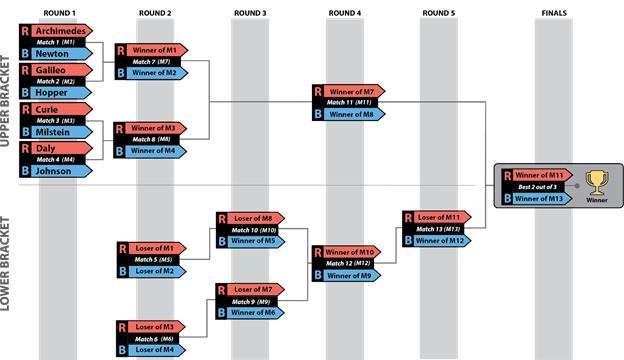
During the Einstein Finals, if the MATCH score of each
ALLIANCE is equal, the MATCH is replayed. In this circumstance, the LINEUP may
be changed.

The rules below apply throughout an event, i.e. from when
Load-In begins to when Load-Out is complete.
Additional rule specific violations, if applicable, are
listed with their corresponding rule.
Universal Violation Note: A violation of any Event Rule will
result in a VERBAL WARNING. Egregious or subsequent violations will be
addressed by the Head REFEREE, the Lead Robot INSPECTOR (LRI) and/or Event
Management. Teams should note that egregious and frequent violations may be
shared with the Judge Advisor which could lead to disqualification from awards.
FIRST is committed to STEM for Everyone™ and as such, FIRST strives to
make reasonable accommodations for persons with disabilities that request
accommodation. If a participant needs an accommodation for an event, we ask
that they talk to a volunteer at the event or contact their local leadership before the event so they can
ensure the request is addressed. Accommodations are considered reasonable if
they do not create an undue hardship, cause safety concerns, or fundamentally
alter the nature of the event.
Rules around safety and security within this section are
minimum requirements, and Program Delivery Partners are able to implement
increased restrictions due to local or venue requirements (e.g. requiring
badging for all attendees, reserving seating for accessibility, etc.). Partners
should communicate additional local requirements early enough to allow teams to
plan.
Safety is always paramount, and many rules are intended to
establish norms at each event that will mitigate injury risk to all
participants.
Event staff have the final decision authority for all
safety-related issues within a venue.
E101
*Personal safety comes first.
All team members must observe the following safety practices throughout the
event:
A.
wear safety glasses (only ANSI-approved, UL Listed, CE EN166 rated,
AS/NZS certified, or CSA rated non-shaded) while in and around the playing
FIELD and in the pit area. Lightly tinted lenses are permitted provided eyes
are clearly visible to others, but reflective lenses are prohibited.
Accommodations will be made for participants that require tinted safety
glasses. The only exception is for teams in their first 10 minutes of their
load in and for the first 10 minutes pits are open each day of the event as
long as they’re not working on the ROBOT or setting up their pit.
B.
wear closed toed/heeled shoes.
C.
tie back long hair while working on or around a ROBOT or ROBOT related
materials.
D.
wear appropriate clothing.
E.
walk in the venue
F.
health and safety requirements in place for that event (e.g. mask
wearing).
For more information about safety at FIRST Robotics
Competition events, please reference the Safety Manual.
E102
*Be nice. All
participants must be gracious and professional at all times while attending FIRST
Robotics Competition events. Uncivil behavior toward any participants is not
tolerated.
Examples of inappropriate behavior include, but are not
limited to
A. use of offensive language or other uncivil conduct,
B. intentionally blocking the view of other participants or
spectators for an extended period (team members momentarily holding up team
signs while directly supporting their team is not considered a violation of
this rule.), and
C. jamming or interfering with the remote sensing capabilities
of a ROBOT or the FIELD while in open-access spectator seating areas.
Examples of remote sensing capabilities include, but are
not limited to, vision systems, acoustic range finders, sonars, and infrared
proximity sensors.
Use of imagery that, to a reasonably astute observer,
mimics the AprilTags employed on the FIELD is a violation of this rule.
Examples of particularly contemptible behavior that may
result in ejection from the event include, but are not limited to, the
following:
A. assault, e.g. throwing something that hits another person
(even if unintended),
B. threat, e.g. saying something like “if you don’t reverse
that call, I’ll make you regret it,”
C. harassment, e.g. badgering someone with no new information
after a decision’s been made or a question’s been answered,
D. bullying, e.g. using body or verbal language to cause
another person to feel inadequate,
E. insulting, e.g. telling someone they don’t deserve to be on
a team,
F. swearing at another person (versus swearing under one’s
breath or at oneself), and
G. yelling at another person(s) in anger or frustration.
E103
*Children with adults, please.
Children under 12 must be accompanied in the pits by an adult at all
times.
E104
*Respect the venue. Teams
may not damage the venue, including but not limited to bleachers, floors,
walls, railings, etc., in any way.
E105
*Teams must check in. An
adult team member must check in at the Pit Administration station no later than
90 minutes before Qualification MATCHES are scheduled to start.
Violation: Teams will be contacted in their pit. Failure to
Check-In may result in a team not participating in the event.
Event check-in takes place at the Pit Administration
station the evening before and/or the first morning of each event.
Once a team’s consent and release forms are submitted at
Pit Administration, each team will receive their DRIVE TEAM & Safety
Captain buttons.
E106
*Some event resources for
event teams only. Only teams registered for an event may use that
event’s Competition FIELD, Practice Areas, Spare Parts, Machine Shop, and
Inspection. Host teams supplying TEST/PRACTICE AREA elements and/or Machine
Shop resources may use them, however teams registered for that event must be
granted priority.
E107
*Work in designated areas
only. At the event venue, teams may only produce FABRICATED ITEMS as
follows:
A.
in their pit area,
B.
in another team’s pit area with permission from that team,
C.
while queued for a MATCH or TEST/PRACTICE AREA (given space constraints,
extra scrutiny regarding safety is required),
D.
any area designated by Event Staff (e.g. Playoff Pit Area, etc.), or
E.
as permitted at provided machine shops that are available to all teams.
ROBOTS are permitted to be powered on while in queue. ROBOTS
which are powered on, but not enabled, such as to deploy code, require minimal
additional precautions. Teams enabling their ROBOT, such as to charge
pneumatics or test system functions, should ensure that they are maintaining
safe space for any mechanism on the ROBOT to move unexpectedly to its full
extent.
E108
*Some things don’t belong at
events. Do not bring or use the following:
A.
skateboards
B.
‘hoverboards’
C.
drones
D.
bottled gas tanks (e.g. helium)
E.
noisy devices or noisemakers, such as floor stompers, whistles and/or
air horns
F.
walkie-talkies
G.
scooters, except for those used for accommodations
H.
any item with bright lights which flash faster than approximately 5
times per second
E109
*Don’t arrange for additional
utilities. Do not arrange for power, internet access, or phone lines
from venue service providers or attempt to use venue internet connections
reserved for event purposes (e.g. the FIELD Management System or web casting).
E110
*Don’t sell stuff.
Teams may not conduct sales at an event. This includes, but is not limited to,
raffle tickets, food, hats, shirts, candy, water, soft drinks, fruit, or any
promotional products.
E111
*Don’t give out food.
Teams may not distribute food to others at an event.
E112
*Make FIRST loud, but
with restrictions. Do not invite or bring live bands to play in the
audience. Do not play loud music.
E113
*Hang banners with care.
Be respectful when hanging your banners.
A.
Do not cover or move other team or sponsor signs already in place.
B.
Share the available space fairly with other teams.
C.
Do not obstruct the view of spectators.
D.
Get permission from the Event Coordinator before hanging banners outside
of your pit.
E.
Hang signs and banners in a safe manner.
F.
Banners hung outside team pits must not be larger than 25ft2
(2.3m2).
We encourage teams to bring team flags and/or signs for
display in their pits and/or the playing FIELD area.
To find your Event Coordinator, inquire at the Pit
Administration desk.
Respect venue-specific rules regarding sign location and
hanging methods. At the end of the event, safely remove all signs and anything
used to hang the signs (tape, string, etc.).
E114
*Limit flag and flagpole size.
Flags and flagpoles may not be of unreasonable size and weight.
As a guideline, reasonable flags are less than 36.0in by 60.0in
(91.44cm by 1.524m) in size and weigh less than 2.0lb (0.91kg). Reasonable flagpoles
may not be more than 96.0in (2.438m) long and weigh less than 3.0lb (1.4kg).
E115
*No firearms. Firearms
are prohibited at all FIRST events for all FIRST programs,
including without limitation, all official FIRST Events posted here.
This policy does not apply to law enforcement or venue security personnel.
E116
*Only COTS batteries allowed.
Teams may only bring COTS batteries to events. Output wires or connectors may
be modified as long as no safety systems are compromised.
Violation: Teams will be asked to remove or not bring in the
batteries.
E117
*Do not record anyone at the
event without their consent. Do not record interactions with anyone at
an event, without the person’s consent. FIRST event staff and
volunteers are empowered to excuse themselves from an interaction in which they
are being recorded after declining consent.
Please
note that many FIRST events are livestreamed and FIRST
participants have given permission to appear in footage from FIRST. This
does not mean that people can record specific interactions without additional
consent.
Laws
regarding recording of conversations vary state-to-state and country-to
country, and, in some cases, recording without consent may be criminal.
Introducing the idea of recording a conversation with an implied reason of
proving someone’s error can escalate a discussion and is likely to increase its
adversarial nature.
E118
*Enter only 1 ROBOT.
Each registered FIRST Robotics Competition team may enter only 1 ROBOT
(or “robot,” a ROBOT-like assembly equipped with most of its drive base, i.e.
its MAJOR MECHANISM that enables it to move around a FIELD) into a 2026 FIRST
Robotics Competition Event.
“Entering” a ROBOT (or robot) into a FIRST Robotics Competition
means bringing it to or using it at the event such that it’s an aid to your
team (e.g. for spare parts, judging material, or for practice).
While “most of its drive base” is a subjective assessment,
for the purposes of this rule, an assembly whose drive base is missing all
wheels/treads, gearboxes, and belts/chains is not considered a “ROBOT.” If any
of those COMPONENTS are incorporated, the assembly is now considered a “ROBOT.”
This rule does not prohibit teams from bringing in ROBOTS
from other FIRST programs for the purposes of awards presentations or
pit displays.
Some events host a machine shop, open during specific hours
(see the event’s agenda), to help teams with repair and fabrication of their
ROBOT. Machine shops are typically sponsored by NASA or local organizations.
While the machine shops vary, FIRST strives to have welding and a
variety of high-powered tools available at all events.
In most cases, the machine shop is on site and readily
accessible to all teams. If a team attends an event where the Machine Shop is
off-site, volunteers are in place to transport the ROBOT or parts to and from
the machine shop. In this case, a team fills out a Machine Shop Request Form
that travels with the ROBOT or parts, so the machine shop staff and volunteers
can follow their directions. The event should set up a method of communication
between the venue and off-site machine shop in case there are any questions.
E201
*The ROBOT goes alone to
off-site machine shops. Team members may not travel to off-site machine
shops with the ROBOT being transported by volunteers.
Teams may travel to the off-site machine shop on their own,
either by walking or using their own vehicle, but all STUDENT team members must
be accompanied by an adult at all times. Teams should strongly consider
including a third team member per the FIRST Youth Protection Program guidelines.
E301
*No wireless communication.
Teams may not set up their own 802.11a/b/g/n/ac/ax/be wireless communication
(e.g. access points or ad-hoc networks) in the venue.
A wireless hot spot created by a cellular device, camera,
smart TV, etc. is considered an access point.
Some smart TVs have access points enabled by factory
default. Please make sure that functionality is disabled for any TVs brought to
the event.
E302
*Don’t interfere with wireless
networks. Participants may not interfere, attempt to interfere, or
attempt to connect with any other team or FIRST wireless communication
except as expressly allowed for purposes of communicating with their team’s
ROBOT on the FIELD or TEST/PRACTICE AREA.
Teams are encouraged to report suspected wireless security
vulnerabilities to the FIRST Technical Advisor (FTA) if at the event or
to FIRST via customerservice@firstinspires.org.
Violation: Subsequent violations may lead to dismissal from
event and/or legal action based on applicable laws.
E303
*Tethered operation outside
FIELDS/PRACTICE AREAS. ROBOTS may only be operated by tether when
outside the FIELD or PRACTICE AREA.
Events set specific time frames, published on the event’s
schedule, in which teams are invited to load their ROBOT and equipment into
their pit areas before pits officially open. At a typical District qualifier,
events have pits open and load in marked as the same time on the public agenda
and thus some of these rules will not apply. At most District Championships and
most Regionals, there are typically load in periods without pits being opened
and thus these rules do apply.
Load-In can be stressful for teams and volunteers, which can
be mitigated by preparation and planning. Unanticipated factors, like traffic
or weather, can change a team’s scheduled arrival time, making the process
difficult. The most important things a team should remember are to be safe,
gracious, and professional.
E401
*Load in during Load-In. Teams
must load in the ROBOT and all ROBOT elements into the event by the end of the
last designated Load-In period on the Public Schedule. ROBOT and all ROBOT
elements that are loaded in, may not be brought back out until Load-Out. Exceptions
are as follows:
A.
raw stock
B.
OPERATOR CONSOLES, BUMPERS, battery assemblies
C.
COTS items with minor modifications (attachment of connectors, assembly
of COTS items per manufacturer instructions, labeling or decoration, etc.)
D.
3D printed parts
E.
gearboxes attached to associated motor(s)
F.
exceptional circumstances that result in a team not being able to make
the Load-In time and has made arrangements with Event Management.
Public Schedules can be found in the additional info
section via the Team & Event Search.
There are no rules that explicitly restrict items that may
be brought into the venue during the designated Load-In period. During Load-In,
teams are not limited to a single trip, and are encouraged to be as efficient
and safe as possible.
Violation: Item will not be permitted into venue.
E402
*Load-In person limit is 6. Only
6 team members (one of which must be an adult) may be in the pit area during
any Load-In period prior to pits opening.
Violation: Extra team members must leave the venue.
E403
*Load-In Restrictions. The
only team permitted activities during load in periods prior to pits opening are:
A.
bringing materials into their pit area,.
B.
ROBOT and BUMPER weighing (if available at your event), including any
necessary BUMPER installation or removal,
C.
Early Pit Setup (if available at your event), and
D.
District Championships and FIRST Championship may allow
inspection during load-in which will be announced in the public schedule.
Violation: Teams will be asked to leave the pit area.
E404
*Pit must be left in a safe
state. Teams must have their pits in a safe state by the time pits close
(even if some tasks are left undone).
E405
*Once done, head out. Unless
assisting other teams, teams must leave the venue once finished delivering
materials (or, in the case of Early Pit Setup, when setup is complete) prior to
pits opening.
If an event has designated Early Pit Setup times both the
evening before and the morning before pits officially open, a team may use both
periods for Load-In and setup, but per this rule must leave once pit setup is
complete.
Violation: Teams will be asked to leave the pit area.
A team pit is the designated space, usually 120.0in by 120.0in
by 120.0in (3.048m x 3.048m x 3.048m), where a team may work on their ROBOT.
Each team is assigned a pit space marked with their team number. This helps
team members, judges, and visitors find teams easily. Each team pit has a power
outlet and a table may be provided.
Teams, volunteers, FIRST staff, and guests spend a
lot of time in the pits. Get to know other teams and help each other when you
can. Time is short and help is very often right "next door" in the
adjacent team pits.
Small, bench-top machinery, with appropriate guards, is
permitted in team pits. ‘Small’ machinery is machinery that can be easily
lifted by one person and examples include, but are not limited to, small band
saws, drill presses, desktop CNC mills, and sanders.
E501
*Pits are unavailable if
closed. Teams may not be in their team pit outside the designated pit
hours.
E502
*Stay in your pit.
Teams should set up their allowed equipment fully within their assigned pit
space. Teams may not:
A.
run power or internet lines from their team pit to any other area except
as instructed or allowed by the event,
B.
swap team pits with other teams, or
C.
move themselves to empty team pits without approval.
E503
*Keep aisles clear.
Aisles must be kept clear.
E504
*No sparks or flames.
Tools that throw sparks or produce open flames are prohibited.
Examples of tools that violate this rule include, but are
not limited to, welders, bench and angle grinders, gas torches, etc.
E505
*Nothing too big. Floor
standing power tools are prohibited.
Examples include but are not limited to full-size drill
presses, band saws, and table saws.
Violation: Teams will be asked to remove or not bring in
floor standing power tools. Any items that are deemed unsafe or outside
specifications by FIRST personnel, event management, and/or local committee
members must be removed.
E506
*No brazing or welding.
Brazing/welding is prohibited.
Violation: Teams will be asked to remove or not bring in
brazing/welding tools. Any items that are deemed unsafe or outside
specifications by FIRST personnel, event management, and/or local committee
members must be removed.
E507
*Solder with specific tools
only. Soldering may be done using an electric iron/gun only.
Violation: Any items that are deemed unsafe or outside
specifications by FIRST personnel, event management, and/or local committee
members must be removed.
E508
*Structures must be safe.
Teams may not build any structure that supports people or stores items
overhead.
Violation: Any pit structures that is deemed unsafe or
outside specifications by FIRST personnel, event management, and/or local
committee members must be removed.
E509
*Secure team identification
assets. Team signs, flags, and displays must be securely mounted to the
pit structure.
Violation: Any pit structures that is deemed unsafe or
outside specifications by FIRST personnel, event management, and/or local
committee members must be removed.
E510
*No automated tools overnight.
Teams may not run a 3D printer or other automated manufacturing process
overnight in the pit.
E511
*Pit Power Limit. Power
to team pits is often shared between multiple teams. Team pits that are causing
breakers to trip may be asked to reduce power consumption.
FIRST Robotics Competition events have TEST AREAS.
TEST AREAS are areas at events where teams can test their ROBOT with representative
FIELD elements. Teams may also be able to test their starting AUTO modes but
TEST AREAS are not designed for full FIELD play such as AUTO modes that
traverse larger areas of the FIELD or interact with multiple FIELD elements.
TEST AREAS are tether-only. FUEL is not provided and if a team wishes to
practice with FUEL, they must bring their own.
FIRST provides a recommended layout, but events may
need to tweak exact placement depending on the space available in the venue. Teams
may not relocate elements from their original locations. The layout is
specifically intended to discourage testing of complex AUTO routines.
FIRST provides a small set of production run
AprilTags for the TEST AREAS. The tags provided for the 2026 TEST AREA will
include tags 2, 5, 8, 9, 10, 11, 13, 14, 15, and 16. Teams that wish to use
other AprilTag IDs for the TEST AREA may print copies of other tags to bring to
events but should not remove the provided tags. Printable copies of the field
AprilTags can be found on the Playing FIELD webpage. Teams may temporarily
cover up the provided tags (e.g. with a blank sheet of paper) to prevent their
vision systems from reading nearby tags unintentionally.
HUMAN PLAYERS are welcome to practice throwing FUEL into the
TEST AREA HUB as long as the area around the HUB is clear of other ROBOTS and
humans to avoid missed shots hitting people or interfering with ROBOT testing.
Priority is given to ROBOT practice over HUMAN PLAYER practice. Teams choosing
to practice throwing FUEL must bring their own FUEL.
Although some events may also provide PRACTICE AREAS, many
do not have the space or resources to provide long full FIELD interactions.
PRACTICE AREAS are defined as areas with a full FIELD. Some District
Championships and FIRST Championship may choose to run a full Field
Management System on the PRACTICE AREA which allows them to connect robots
wirelessly. For events that have full FIELDS but are using tether, teams should
expect that 2 teams are allowed on half the field at a time. Practice
Attendants may allow additional teams provided teams are a safe distance from
one another.
E601
*Inspection for TEST &
PRACTICE AREAS. A team may only use the designated TEST AREAS and
PRACTICE AREAS with a ROBOT that has passed an initial, complete inspection.
E602
*Practice only when/where
permitted. Teams may only practice with their ROBOT in their pit space,
in the designated event TEST AREAS, PRACTICE AREAS, or while in a Practice
MATCH.
Teams may not set up their own practice equipment outside
their pit. When practicing in their pit, safety must remain the top priority.
If Event Management determines a pit practice setup is unsafe or interferes
with activity in adjacent pits or aisles, the team must discontinue the
activity.
E603
*TEST/PRACTICE AREA attendance
is limited. Only team members actively working on the ROBOT are allowed
to be at the TEST/PRACTICE AREA.
The intent of this rule is to limit the number of people
directly next to ROBOTS that are enabled. The recommendation is no more than 5
members per team, but some events may limit further due to available space.
Teams may have additional team members watching from a
distance, provided the venue has space, but those members should be a safe
distance from all ROBOTS operating at the TEST/PRACTICE AREA.
E604
*Give ROBOTS space.
When using a tether on TEST AREAS and PRACTICE AREAS, teams must keep a safe
distance from all ROBOTS and moving elements and must not interact directly
with the ROBOT when it is enabled.
Generally, a safe distance is ~72.0in (~1.83m) from the
ROBOT.
E605
*Be ready to DISABLE.
Teams must be ready to DISABLE their ROBOT if the ROBOT does not move in the
desired direction or in case of safety.
E606
*Be safe. G102 and G103 also apply at the TEST AREAS and PRACTICE
AREAS.
Violation: VERBAL WARNING. TEST/PRACTICE AREA suspension if
subsequent violations during the event.
Most teams use carts to transport their ROBOT throughout an
event. Carts are not required but are strongly recommended (to minimize risk of
muscle strains, dropped ROBOTS, and other hazards). In addition to the rules
listed below, teams are strongly encouraged to put the team’s number on the
cart, refer to the FIRST Safety Manual for ROBOT lifting
techniques, and practice putting the ROBOT on and off the cart to develop a
safe, quick, fluid routine.
E701
*Carts must be safe and easy
to use. Carts must be easy to control, maneuver, and pose no risk to
bystanders.
E702
*Carts shouldn’t be too big.
Carts must fit through a standard 30.0in (76.2cm) door.
E703
*Carts can’t park anywhere.
Carts must remain in the team pit (or cart staging area if during a MATCH) when
not in use.
E704
*No noisy carts. Carts
may not be equipped with music or other sound-generating devices, except for
devices of reasonable volume used for safety purposes (e.g. to make others in
the vicinity aware that a ROBOT is on the move).
E705
*No motor driven carts.
ROBOT carts may not use powered propulsion.
E706
*Small ROBOT carts are allowed
on the FIELD. ROBOT carts smaller than 30.0in (76.2cm) by 36.0in (91.4cm)
may be brought onto the FIELD to aid in staging and retrieving the ROBOT
provided they are not left unattended and do not pose any other safety hazards.
At every event, there are Opening and Closing Ceremonies to
show honor and respect for represented countries, sponsors, teams, mentors,
volunteers, and award winners. Ceremonies provide everyone with the opportunity
to collectively applaud the successes of all participants. They also give teams
a chance to "meet" the volunteers and other people and sponsors
involved with the event. Closing Ceremony elements at the end of the event are
integrated into and presented between Playoff Matches.
At the Awards Ceremony, FIRST presents trophies and
medallions to outstanding teams. All team members are encouraged to attend the
ceremonies, be punctual, and show appreciation to volunteers that staffed the
event.
E801
*If in the pits during
Ceremonies, shhhhhh. During Ceremonies outside of Playoff MATCHES, team
members may not:
A.
use power tools,
B.
use loud hand tools (hammers, saws, etc.), or
C.
shout, yell, or use loud voices, unless as a demonstration of approval
during a ceremonial activity.
E802
*Pit person limit during
Ceremonies is 5. No more than 5 team members may be in the pits during
Ceremonies outside of Playoff MATCHES.
E803
*Be respectful during anthems.
Team members, including any remaining in the pits, should exhibit peaceful
behavior during the presentation of all national anthems. Traditionally, team
members stand to face the flag, remove hats, and either sing along or maintain
a respectful silence during the anthems of all nations present at the event. If
team members wish to abstain, they have a right to do so, as long as they
remain silent and non-disruptive.
E901
*No saving seats. Teams
are not permitted to save or designate seats for team members that are not
present.
Teams may not hang banners or ribbons or otherwise
designate seating. (Event staff will remove and discard any banners, roping,
etc., used to designate seating.) Please take turns sitting in the
bleachers/stands if seating is limited. If there is a crowding problem, we ask
that you kindly leave after your team's MATCH and return later, if possible.
Event management may reserve seats for attendees who
require accommodations.
E902
*Don’t throw items from the
stands. Items may not be thrown from audience seating.

|
Term
|
Definition
|
|
ACTIVE DEVICE
|
any device capable of dynamically controlling and/or
converting a source of electrical energy by the application of external
electrical stimulus
|
|
ALLIANCE
|
a cooperative of up to 4 FIRST Robotics
Competition teams
|
|
ALLIANCE AREA
|
an approximately 360in wide by 134in deep (~9.14m by 3.4m)
infinitely tall volume formed by, and including the ALLIANCE WALL, OUTPOST,
TOWER WALL, the edge of the carpet, and ALLIANCE colored tape
|
|
ALLIANCE CAPTAIN
|
The designated STUDENT representative from each ALLIANCE
Lead
|
|
ALLIANCE SHIFT
|
One of four SHIFTS (SHIFT 1, SHIFT 2, SHIFT 3, and SHIFT 4) during the TELEOP Period
|
|
ALLIANCE WALL
|
A FIELD structure that separates ROBOTS from DRIVE TEAM members in the ALLIANCE
AREA
|
|
ALLIANCE ZONE
|
A 158.6in deep by 317.7in long (~4.03m by 8.07m),
infinitely tall volume formed by an ALLIANCE WALL, TOWER WALL, and guardrails
|
|
ARENA
|
includes all elements of the game infrastructure that are
required to play REBUILTTM presented by Haas: the FIELD, SCORING
ELEMENTS, queue area, team media area (when available), designated TECHNICIAN
area, and all equipment needed for FIELD control, ROBOT control, and
scorekeeping
|
|
ARENA FAULT
|
an error in ARENA operation
|
|
AUTO
|
the first 20 seconds of the MATCH, and the FMS blocks any
DRIVER control, so ROBOTS operate with only their pre-programmed instructions
|
|
BACKUP POOL
|
the group of teams willing and able to join an ALLIANCE
during the Playoff MATCHES
|
|
BACKUP TEAM
|
The team whose ROBOT and DRIVE TEAM replaces another
ROBOT and DRIVE TEAM on an ALLIANCE during the Playoff MATCHES
|
|
BONUS RP
|
ENERGIZED RP, SUPERCHARGED RP,
and TRAVERSAL RP.
|
|
BUMP
|
73.0in (1.854m) wide, 44.4in (1.128m) deep, and 6.513in
(16.54cm) tall structures on either side of the HUB that ROBOTS drive over
|
|
BUMPER
|
a required assembly which attaches to the ROBOT frame. BUMPERS
protect ROBOTS from damaging/being damaged by other ROBOTS and FIELD
elements.
|
|
BUMPER ZONE
|
a space between 2.5in (6.35cm) and 5.75in (14.61cm) from
the floor.
|
|
BYPASSED
|
any ROBOT which is unable or ineligible to participate in
that MATCH, as determined by the FTA, LRI, or Head REFEREE
|
|
CENTER LINE
|
a white line that spans the width of the FIELD that
bisects the NEUTRAL ZONE in half
|
|
CHUTE
|
15.0° sloped tunnel that
leads to the upper opening in the OUTPOST
|
|
CHUTE DOOR
|
an HDPE arm on a pivot that can be rotated approximately
90 degrees by the HUMAN PLAYER to open or close the CHUTE
|
|
COMPONENT
|
any part in its most basic configuration, which cannot be
disassembled without damaging or destroying the part or altering its
fundamental function
|
|
CONTINUOUS
|
describes durations that are more than approximately 10
seconds
|
|
CONTROL
|
an action by a ROBOT in which a SCORING ELEMENT is fully supported by or stuck in, on, or
under the ROBOT
|
|
CORRAL
|
8.13in (20.6cm) tall polycarbonate panels that create a 35.8in
(90.8cm) wide, 37.6in (95.5cm) deep area on the floor in which FUEL can be
stored
|
|
COTS
|
a standard (i.e. not custom order) part commonly
available from a VENDOR for all teams for purchase
|
|
CUSTOM CIRCUIT
|
Any active electrical item that is not an actuator
(specified in R501) or core control system item (specified in R710)
|
|
DEPOT
|
a 42.0in (1.07m) wide, 27.0in (68.6cm) deep structure
located along the ALLIANCE WALL
|
|
DISABLED
|
the state in which a ROBOT is commanded to deactivate all
outputs, rendering the ROBOT inoperable for the remainder of the MATCH
|
|
DISQUALIFIED
|
the state of a team in which they receive 0 MATCH points
and 0 Ranking Points in a Qualification MATCH or causes their ALLIANCE to
receive 0 MATCH points in a Playoff MATCH
|
|
DRIVE COACH
|
a guide or advisor
|
|
DRIVE TEAM
|
a set of up to 5 people from the same FIRST Robotics
Competition team responsible for team performance for a specific MATCH
|
|
DRIVER
|
an operator and controller of the ROBOT
|
|
DRIVER STATION
|
1 of 3 assemblies within an ALLIANCE WALL behind which a
DRIVE TEAM operates their ROBOT
|
|
END GAME
|
SHIFT during the TELEOP Period
where where both HUBS return to active.
|
|
ENERGIZED RP
|
BONUS RP earned when the amount of FUEL scored in an active HUB is at or above
threshold
|
|
FABRICATED ITEM
|
any COMPONENT or MECHANISM that has been altered, built,
cast, constructed, concocted, created, cut, heat treated, machined,
manufactured, modified, painted, produced, surface coated, or conjured
partially or completely into the final form in which it will be used on the
ROBOT
|
|
FIELD
|
an approximately 317.7in (~8.07m) by 651.2in (~16.54m)
carpeted area bounded by inward facing surfaces of the ALLIANCE WALLS,
OUTPOSTS, TOWER WALLS, and guardrails
|
|
FIELD STAFF
|
the collective group of people
working on or near the FIELD responsible for making sure the MATCHES are cycled
through efficiently, fairly, safely, and with a spirit of cooperation, Gracious
Professionalism, and generosity of spirit
|
|
FMS
|
the FIELD Management System
|
|
FTA
|
FIRST Technical Advisor
|
|
FUEL
|
a 5.91in (15.0cm) diameter, high density foam ball
|
|
HIGH RUNG
|
A RUNG 63.0in (1.6m) from the floor
|
|
HUB
|
one of two 47in by 47in (~1.19m by 1.19m) rectangular
prism structures with an extended opening at the top surface
|
|
HUMAN PLAYER
|
a SCORING ELEMENT manager
|
|
HUMAN STARTING LINE
|
a white line spanning the ALLIANCE AREA up to the OUTPOST
AREA a white line spanning the ALLIANCE AREA up to the OUTPOST
AREA
|
|
INSPECTOR
|
a person determined by FIRST
to accurately and efficiently assess the legality of a given
part of a ROBOT
|
|
KOP
|
the Kit of Parts
|
|
LINEUP
|
the 3 teams participating in the MATCH and their selected
DRIVER STATIONS
|
|
LEVEL
|
Criteria required to qualify for TOWER points
|
|
LOW RUNG
|
A RUNG located 27.0in (68.58cm) from the floor
|
|
LRI
|
the Lead ROBOT INSPECTOR
|
|
MAJOR FOUL
|
a credit of 15 points towards the opponent’s MATCH point
total
|
|
MAJOR MECHANISM
|
a group of COMPONENTS and/or MECHANISMS assembled
together to address at least 1 game challenge: ROBOT movement, SCORING
ELEMENT manipulation, FIELD element manipulation, or performance of a
scorable task without the assistance of another ROBOT.
|
|
MATCH
|
the 2-minute and 40-second in which a ROBOT is enabled to play REBUILT
|
|
MECHANISM
|
an assembly of COMPONENTS that provide specific
functionality on the ROBOT. A MECHANISM can be disassembled (and then
reassembled) into individual COMPONENTS without damage to the parts.
|
|
MID RUNG
|
A RUNG located 45.0in (114.3cm) from the floor
|
|
MINOR FOUL
|
a credit of 5 points towards the opponent’s MATCH point
total
|
|
MOMENTARY
|
describes durations that are fewer than approximately 3
seconds
|
|
MXP
|
myRIO Expansion port, the
expansion port on the roboRIO
|
|
NEUTRAL ZONE
|
A 283in deep by 317.7in long (7.19m by 8.07m), infinitely
tall volume formed by the BUMPS, TRENCHES, HUBS, and guardrails
|
|
OPERATOR CONSOLE
|
the set of COMPONENTS and MECHANISMS used by the DRIVERS
and/or HUMAN PLAYERS to relay commands to the ROBOT
|
|
OUTPOST
|
an assembly through which HUMAN PLAYERS feed FUEL into
the FIELD and ROBOTS can deliver FUEL to their HUMAN PLAYERS
|
|
OUTPOST AREA
|
a 71.0in wide by 134in deep (1.8m by 3.4m) infinitely
tall volume bounded by the OUTPOST, edge of carpet, and ALLIANCE and white
colored tape
|
|
PASSIVE CONDUCTOR
|
any device or circuit whose capability is limited to the
conduction and/or static regulation of the electrical energy applied to it
(e.g. wire, splices, connectors, printed wiring board, etc.)
|
|
PCM
|
Pneumatic Control Module
|
|
PDH
|
Power Distribution Hub
|
|
PDP
|
Power Distribution Panel
|
|
PH
|
Pneumatic Hub
|
|
PIN
|
an action by a ROBOT that is preventing the movement of an opponent ROBOT by contact,
either direct or transitive (such as against a FIELD element)
|
|
RED CARD
|
issued by the Head REFEREE for egregious ROBOT or team
member behavior or rule violations which results in a team being DISQUALIFIED
for the MATCH.
|
|
REFEREE
|
an official who is certified by FIRST
to enforce the rules of REBUILT
|
|
REPEATED
|
describes actions that happen more than once within a MATCH
|
|
ROBOT
|
an electromechanical assembly built by the FIRST
Robotics Competition team to play the current season’s game and includes all
the basic systems required to be an active participant in the game –power,
communications, control, BUMPERS, and movement about the FIELD
|
|
ROBOT PERIMETER
|
the part of a ROBOT contained within the BUMPER ZONE and established while in
the ROBOT’S STARTING CONFIGURATION, that is comprised of fixed, non-articulated
structural elements of the ROBOT
|
|
ROBOT STARTING LINE
|
an ALLIANCE colored line that spans the width of the
FIELD at the edge of an ALLIANCE ZONE in front of two BUMPS and an ALLIANCE
HUB
|
|
RP
|
Ranking Points
|
|
RPM
|
Radio Power Module
|
|
RS
|
Ranking Score
|
|
RSL
|
ROBOT Signal Light
|
|
RUNG
|
One of the 1-1/4in Sch 40 (1.66in (4.216cm) OD) pipeis centered between the UPRIGHT and extend 5.875in (14.92cm)
from the outer face of the UPRIGHT on either sides located on the TOWER
|
|
SCORING ELEMENT
|
a FUEL
|
|
SHIFT
|
see ALLIANCE SHIFT, TRANSITION
SHIFT
|
|
SIGNAL LEVEL
|
a term used to characterize
circuits which draw ≤1A continuous and have a source incapable of delivering
>1A, including but not limited to roboRIO non-PWM outputs, CAN signals,
PCM/PH Solenoid outputs, VRM 500mA outputs, RPM outputs, and Arduino outputs
|
|
STARTING CONFIGURATION
|
the physical configuration in which a ROBOT starts a
MATCH
|
|
STUDENT
|
a person who has not completed high-school, secondary
school, or the comparable level as of September 1 prior to Kickoff
|
|
SUPERCHARGED RP
|
BONUS RP earned when the amount of FUEL scored in an active HUB is at or above
threshold
|
|
SURROGATE
|
a team randomly assigned by the FMS to play an extra Qualification
MATCH
|
|
TECHNICIAN
|
a resource for ROBOT troubleshooting, setup, and removal
from the FIELD
|
|
TELEOP
|
the Teleoperated Period
|
|
TOWER
|
a 49.25in (1.251m) wide, 45.0in (1.143m) deep, and
78.25in (1.988m) tall structure made up of the TOWER WALL, TOWER BASE,
UPRIGHTS, RUNGS and supporting structures
|
|
TOWER BASE
|
a 39.0in (99.06cm) wide by 45.18in (1.148m) deep plate
that sits on the floor and extends from the TOWER WALL
|
|
TOWER WALL
|
Part of the TOWER integrated into each ALLIANCE WALL
|
|
TRANSITION SHIFT
|
Segment of TELEOP prior to the ALLIANCE SHIFTS
|
|
TRAVERSAL RP
|
BONUS RP earned when the amount of TOWER points scored during the MATCH is at or
above threshold
|
|
TRENCH
|
are a 65.65in (1.668m) wide, 47.0in (1.194m) deep, and
40.25in (1.022m) tall structure that ROBOTS drive underneath
|
|
UPRIGHTS
|
72.1in (1.831m) tall, 1.5in (3.81cm) thick, 3.5in
(8.89cm) deep sheet metal box frames that extend vertically up from the TOWER
BASE
|
|
VENDOR
|
a legitimate business source for COTS items that
satisfies criteria defined in Section 8
ROBOT Construction Rules
|
|
VERBAL WARNING
|
a warning issued to a team by event staff or the Head
REFEREE.
|
|
VRM
|
Voltage Regulator Module
|
|
YELLOW CARD
|
issued by the Head REFEREE for egregious ROBOT or team
member behavior or rule violations
|